


 For all latest news, follow the Daily Sun's Google News channel.


Iran reveals ‘first-ever offensive’ military doctrine amid signs of renewed war
Al Jazeera
Published: 22 Oct 2026, 09:01 PM
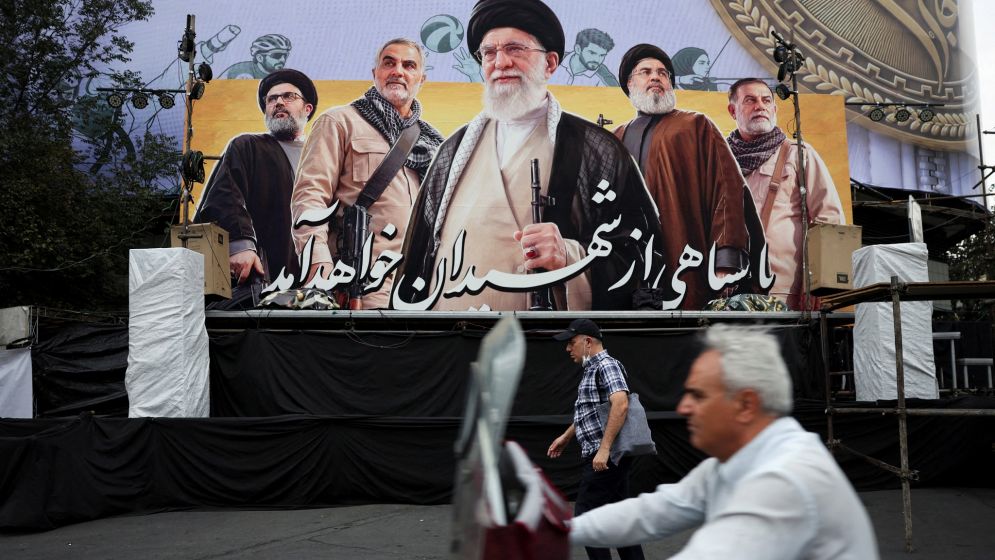
A man walks past a billboard depicting Iran's late Supreme Leader Ayatollah Ali Khamenei, the late former Hezbollah leader Hassan Nasrallah and the late military commander Qassem Soleimani, on a street in Tehran, Iran, 6 October 2026. Photo: Reuters
Iran’s Islamic Revolutionary Guard Corps (IRGC) says renewed
attacks by the United States could prompt Tehran to invade neighbouring
countries and hit bases used in US military operations as part of its new
“offensive” strategy.
The warning on Wednesday came amid escalating attacks on
shipping in the Strait of Hormuz, a global energy chokepoint, and uncertainty
over diplomatic efforts to end the nearly eight-month war.
“Our defence doctrine was previously defensive; we used to
say that if a country attacks us, we will respond. Now we say that if a country
attacks us, we will both respond and launch an offensive,” IRGC spokesman
Hossein Mohebi said.
Washington ordered some diplomatic personnel to leave Saudi
Arabia amid attacks from Yemen’s Houthis while US President Donald Trump has
signalled that a decision on the conflict could come soon.
According to media reports, the US and Israel are planning
potential attacks on Iran in the coming weeks.
Analysts have also warned that renewed US-Israeli attacks on
Iran are increasingly possible with both sides preparing for another
confrontation despite the continued possibility of diplomacy.
“Another round of war seems to be approaching,” said Negar
Mortazavi, senior fellow at the Centre for International Policy.
“Both sides appear to be preparing for renewed confrontation
while escalating tensions in the Strait of Hormuz increase the risk of a wider
conflict,” she said.
Israeli Prime Minister Benjamin Netanyahu reiterated on
Sunday his pledge to topple Iran’s government, saying it was key to preventing
it from rebuilding its nuclear programme and the “axis of resistance”, further
raising prospects of an escalation.
Trump has offered conflicting signals about Washington’s
next steps.
On Wednesday, he said the US was no longer negotiating with
Tehran and suggested developments were imminent. “We are going to have
something one way or the other that’ll happen fairly soon,” he told reporters.
He also said Washington could end the war immediately but
wanted a lasting outcome. “It’ll end very soon. We could leave now, but we want
to make sure it lasts for a long time,” Trump said at a campaign rally in South
Carolina.
Trump previously pledged not to attack Iran before the
November 3 elections.
US Secretary of State Marco Rubio said this week that
reaching a peace agreement is extremely difficult.
What is Iran’s new doctrine?
The IRGC on Wednesday announced a shift towards an
“offensive and asymmetrical” defence doctrine, threatening to invade countries
that launch attacks against it.
Mohebi said Tehran would no longer limit its military
operations to retaliatory strikes.
Mohebi stressed that Iran’s missile stockpile has increased
1.5 times since the 12-day war between Iran and Israel in June 2025. He did not
provide specific figures.
“The quality of the missiles has improved significantly, and
their range, destructive power and accuracy in hitting targets have increased,”
the spokesman said.
Moreover, Mohebi said Iranian forces were in the “stage of
preparing to unveil the ‘father of all bombs’. This is something new for the
enemy.”
Meanwhile, attacks in the Strait of Hormuz continued
unabated.
The IRGC’s navy said on Thursday that four vessels it
accused of being involved in illegal oil transfers were struck and caught fire
in the northern Gulf. Three other vessels hit mines west of the strait, it
added.
Before the war, one-fifth of the world’s oil and natural gas
supplies passed through the Strait of Hormuz. While shipments through the
strait are still below those levels, oil shipments from the region returned to
pre-war levels last month as exporters found alternative ways to ship out their
oil and gas, including using pipelines.
However, a flurry of recent attacks in the key waterway and
the fighting between Yemen’s Houthis and its Saudi-backed, internationally
recognised government, which has resulted in Houthi attacks on Saudi Arabia,
have once again sent oil prices surging. Brent crude climbed above $110 a
barrel on Thursday amid fears of further disruptions to regional energy supplies.
Why the shift?
Iran’s shift towards an offensive military doctrine reflects
Tehran’s determination to make future US-Israeli attacks significantly more
costly, according to analysts.
Negar Mortazavi, senior fellow at the Centre for
International Policy, told Al Jazeera that Tehran was drawing lessons from the
wars of 2025 and 2026 after its previous strategy of retaliation failed to
prevent repeated attacks.
“Tehran now wants to establish a new equation: Any future
attack on Iran will come at a much higher cost for the aggressors,” she told Al
Jazeera.
Unable to match conventional US military capabilities, Iran
is increasingly relying on asymmetric warfare, including missiles, drones and
its leverage over the Strait of Hormuz, Mortazavi explained.
She said Tehran was pursuing a broader strategy aimed at
imposing military, economic and political costs on Washington, including
potentially influencing the 3 November US midterm elections.
“Iran wants to teach Washington a lesson: Attacking Iran
comes with a high price, one that can even cost elections,” Mortazavi said,
referring to US surveys that are predicting electoral losses for Trump’s
Republican Party.
She added that Iranian officials were closely monitoring the elections, believing the economic fallout from the war could damage the Republican Party’s prospects of retaining control of Congress.