


 For all latest news, follow the Daily Sun's Google News channel.


As France erupts, Europe's far right gains from fuel-price protests ahead of elections
Reuters, Paris
Published: 20 Oct 2026, 04:26 PM
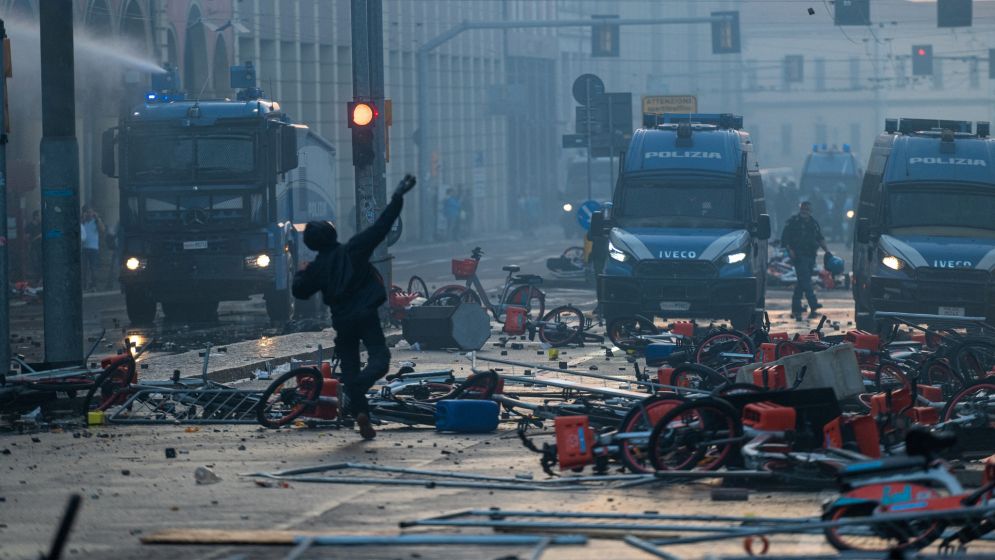
A masked demonstrator raises an arm in front of police vehicles during clashes following a protest against the rising cost of living in Bologna, Italy, 17 October 2026. Photo: REUTERS
The tractors rolling into the town of Gela on the southern
tip of Europe are flying the Sicilian flag, emblazoned with Medusa, three bent
legs and ears of wheat, a reminder of the island's role as a breadbasket since
Roman times.
But the farmers are not bringing in a harvest. They are
protesting.
As soaring fuel prices squeeze household budgets and
businesses across Europe, cost-of-living pressures are driving unrest and giving
fresh momentum to far-right parties ahead of elections next year in countries
including France, Italy and Poland.
Parties once considered fringe had already been gaining
ground, with voters from motorists in rural France to young men in Germany's
former Communist east looking for alternatives.
The US-Iran war, which erupted in February and sent energy prices sharply higher, has compounded the challenge for governments already struggling to contain inflation, support growth and rein in spending.
The discontent has spilled onto the streets.
In France, demonstrations that began over deteriorating
school facilities in Paris' northern suburbs have morphed into some of the
country's worst unrest in decades, with shops looted, buildings torched and a
19th-century town hall in Limoges set on fire.
"Why am I here? Well, quite simply, I find the current
cost of living truly terrifying," said Quentin Leviloux, a 21-year-old
protester in Nantes.
"Just think of people who earn barely the minimum wage,
when you look at the cost of food, fuel, and everything else. It’s terrifying
how incredibly expensive things have become."
The European Commission estimates the Iran conflict has cost
Europe roughly €100 billion ($112 billion) through disrupted trade and energy markets.
Gas prices have jumped about 140% and diesel prices have doubled.
In a weekend address, French President Emmanuel Macron
acknowledged the "legitimate demands" of protesters angered by rising
living and fuel costs, while condemning those responsible for violence and
looting. "We must never confuse them with those who destroyed, vandalised
and looted," he said.
Protests erupt across Europe
Violence has also erupted elsewhere. In the wealthy northern
Italian city of Milan, police clashed on Sunday with protesters hurling stones
and looting stores during demonstrations over poor public services and rising
living costs.
In Gela, on Sicily's southern coast, farmers say fuel costs
have made operating machinery prohibitively expensive. "We cultivate the
land, we harvest debts," said one banner.
"We are completely at a standstill," said
Arcangelo Gambino, a farmers' representative in Caltanissetta province.
"The (fuel) cost has more than doubled."
Roadblocks by truckers, farmers and steelworkers have
disrupted transport across parts of southern Italy, contributing to local fuel
shortages and concerns over supermarket supplies.
Tens of thousands marched through Lisbon on Saturday over
low wages, housing costs and the rising cost of living, increasing pressure on
Portugal's centre-right government.
In Spain, the eviction of an 87-year-old woman from her home
sparked nationwide demonstrations over housing shortages and soaring rents,
helping trigger a snap election next month.
Belgium has also seen demonstrations, while large rallies in
Albania have been driven by anger over perceived government corruption, a lack
of jobs and poor education standards.
The protests reflect broader economic anxieties that are
increasingly shaping politics across the continent.
Concerns about purchasing power have become "a major
driver of populist politics" across Europe, said Gilles Ivaldi, a
political scientist at Sciences Po.
Politicians on both the hard right and hard left have
increasingly argued that restoring energy ties with Russia would help lower
costs, challenging Europe's mainstream consensus on support for Ukraine.
Le Pen makes fuel prices a campaign issue
The latest energy shock comes after years of economic strain
following the pandemic and the fallout from Russia's 2022 invasion of Ukraine.
In France, rising energy costs have provided an explosive
backdrop to next April's presidential election. Macron's government is
struggling with a ballooning budget deficit and pressure from bond markets.
Frontrunner Marine Le Pen of the far-right National Rally
and hard-left veteran Jean-Luc Melenchon have both made fuel prices central
planks in their campaigns.
“Rising fuel prices are clearly an issue that boosts Marine
Le Pen,” said Ivaldi. “I think this is an issue she has owned for quite some
time."
Since the Iran war began, Le Pen's ratings have improved
while Macron's have slipped, according to polling by Elabe.
Le Pen's proposal to sharply cut value-added tax on fuel has
attracted broad public support. Analysts say the issue resonates strongly with
her core voters in rural and semi-rural areas where car travel is often
essential.
Calls to restore Russia ties
In neighbouring Germany, the Alternative for Germany (AfD)
is leading national opinion polls after strong gains in local elections. The
cost of living topped Germans' concerns for a fifth straight year in a survey
published this month.
German inflation spiked to nearly a three-year high in
September, with energy price inflation rising to 14.9%, handing ammunition to
the AfD to attack Chancellor Friedrich Merz.
The AfD is pushing to restore energy ties with Russia,
arguing that Berlin’s support for Ukraine is needlessly self-sabotaging at a
time when Europe’s largest economy and many of its energy-hungry companies are
struggling.
Past experience indicates a link between high energy prices
and voter turnout for the AfD, said Jan Steckel, professor for the political
economy of climate change at the Technical University of Munich.
“Populist parties often frame energy costs as avoidable and
attribute them to government policy choices ... rather than to the underlying
geopolitical shocks that drive them," he said.
“These geopolitical shocks are ... much more difficult to
explain. And I think this is why incumbent parties often struggle."
The argument is gaining traction elsewhere.
In Italy, Prime Minister Giorgia Meloni faces growing
competition from National Future, a new far-right party led by former army
general Roberto Vannacci that advocates restoring gas links with Russia.
In Poland, one of Ukraine's staunchest supporters, concern
over energy bills is helping boost support for the far-right Confederation of
the Polish Crown. Its leader, Grzegorz Braun, has called for a return to buying
Russian oil and gas, making the case alongside AfD politicians in Lubmin, where
the damaged Nord Stream pipelines land in Germany.
“I love the smell of Russian gas in the morning,” he said.