


 For all latest news, follow the Daily Sun's Google News channel.


Trump rallies on Republican turf as midterm fears mount
AFP, Wichita
Published: 20 Oct 2026, 08:55 AM
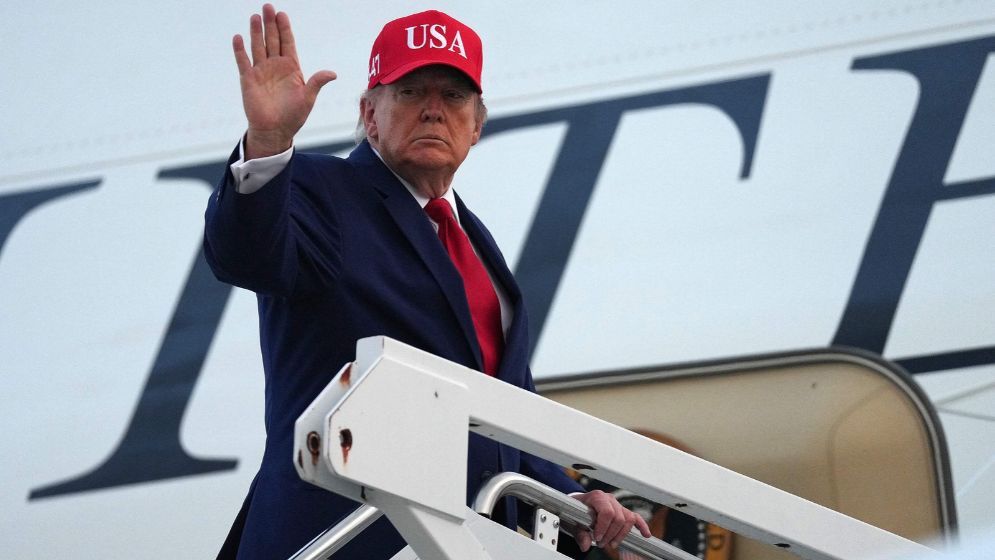
US President Donald Trump boards Air Force One as he departs Dobbins Air Reserve Base on 16 October, 2026 in Marietta, Georgia. Photo: AFP
US President Donald Trump addressed supporters in Kansas Monday to kickoff a seven-state campaign blitz through territory he carried in 2024, as dismal polls and unexpectedly tight races in Republican strongholds stoke fears of sweeping Democratic gains in November's midterms.
With 15 days until the 3 November vote, Trump's rally on the outskirts of Wichita called for voters to show up and support Senator Roger Marshall, who is locked in a dead heat with Methodist megachurch pastor Adam Hamilton.
"Whatever you do, get out and vote," Trump urged the crowd in a speech that repeated his pledges to end his unpopular war in Iran, make his tax cuts permanent and bring prosperity to Americans.
"All you have to do is turn out. If you turn out, we win," he added.
Trump won Kansas by 16 percentage points just two years ago, and the state has not elected a Democratic senator since 1932.
Yet analysts now rate it a "toss-up," and a key fundraising group for Republican senators has diverted money from North Carolina to defend a seat it once took for granted.
Control of Congress may hinge on such races, with Republicans holding slender majorities in both chambers, and Democrats needing a net gain of just four seats to capture the Senate.
Soaring costs
Over the coming six days, Trump will follow Kansas with rallies in the Carolinas, Iowa, Florida, Georgia and Michigan. All seven states backed him in 2024, though his margins in Michigan, Georgia and North Carolina were narrow.
The schedule suggests the aim is less to win over undecided voters than to fire up loyal supporters, many of whom stay home when he is not on the ballot.
Two stops, North Carolina and Iowa, are damage control in Republican-held seats, and many national party officials have all but written off North Carolina.
Elsewhere the party is on the offensive, targeting a Democratic-held seat in Michigan, though it has struggled to make headway in Georgia.
Vice President JD Vance is campaigning separately in North Carolina, in Ohio and in Nebraska, where the sitting Republican senator is fending off a strong challenge from an independent.
A Washington Post-ABC News-Ipsos survey published Sunday put Trump's approval rating at 33 percent, the lowest of either of his terms in that poll, with 66 percent disapproving. An NBC News poll released the same day had him at 34 percent.
Asked which party they would back for Congress, likely voters favored Democrats by eight points in the Post-ABC poll, and registered voters by 10 points in NBC's.
The figures point to a possible Democratic wave, although national polls do not translate neatly into seats, particularly after partisan redistricting, and they can miss by several points in either direction.
Headwinds
The economy has become a heavy liability for a president who promised to bring prices down.
Fuel costs have soared since the United States went to war with Iran and tariffs have added to the strain on consumers, especially farmers in agricultural states such as Iowa and Kansas.
Theater director Kim Klein, 64, who lives near Wichita, was among hundreds of people outside the rally who couldn't get into the packed event.
"He's done so much for us," Klein said of Trump after calling on fellow Republicans to vote. "He needs time. It's only been two years. This stuff takes time."
Even immigration, still Trump's best-rated issue, is drawing a backlash, with 56 percent in the Post-ABC poll saying his deportation campaign has gone too far.
Democrats are turning that discontent into campaign cash. Third-quarter filings showed their Senate candidates far outraising Republicans in Ohio, Iowa and other key races.
Just over nine million votes have already been cast nationwide, according to the University of Florida's Election Lab.
In Texas, where early voting began Monday, Democrat James Talarico raised about $64 million, a record quarter for a Senate candidate, and more than triple Republican Ken Paxton's $18 million.
In House races, at least 47 Republican incumbents were outraised by Democratic or independent challengers, according to Punchbowl News.
Republicans are relying on outside groups to close the gap, bankrolled in part by Elon Musk, the world's richest person, who has given some $366 million this election cycle, including $158 million to Paxton.