


 For all latest news, follow the Daily Sun's Google News channel.


US economists win Nobel for stabilisation models
AFP, Stockholm
Published: 12 Oct 2026, 04:22 PM
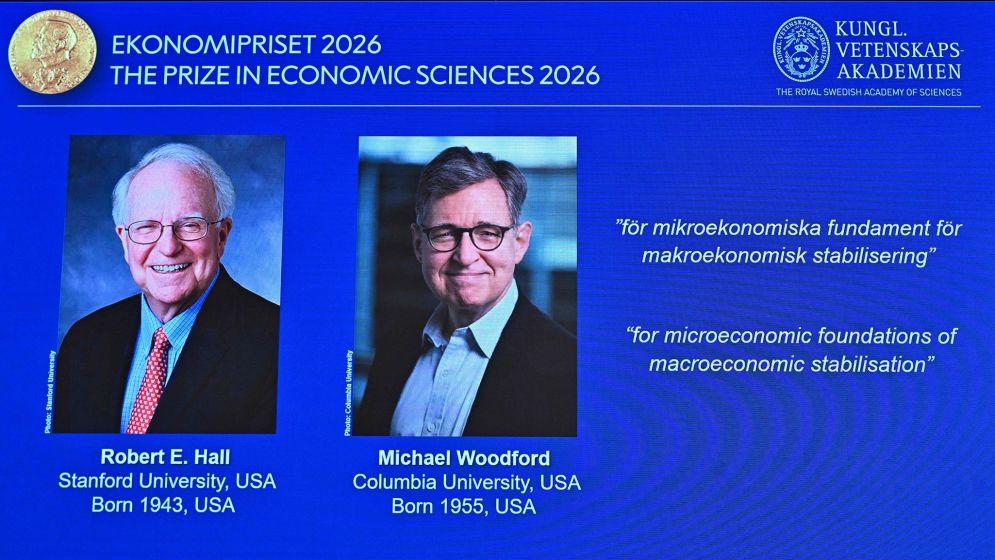
The winners of the 2026 Sveriges Riksbank Prize in Economic Sciences in Memory of Alfred Nobel, Robert E Hall (L) and Michael Woodford, are displayed on a screen at the Royal Swedish Academy of Sciences in Stockholm on 12 October 2026. Photo: AFP
American economists Robert Hall and Michael Woodford were
awarded the Nobel economics prize Monday for their work on how monetary and
fiscal policy can help stabilise fluctuations in the economy.
"The laureates' work has provided us with a stable
theoretical foundation for the models that are now used by central banks and
governments around the world," the jury at the Royal Swedish Academy of
Sciences said in a statement.
"With them, we are better equipped to deal with shocks
in the economy, such as energy crises or sudden changes in how much households
consume," John Hassler, chair of the prize committee, said in the
statement.
During the oil crises in the 1970s, the existing Keynesian
models long used to determine when and how measures should be implemented to
tackle recessions or other economic fluctuations no longer worked.
That prompted Hall and Woodford to develop new tools for
understanding which policy responses could be the most effective.
"Rather than basing the models on statistical links
between macroeconomic variables, such as inflation, production and consumption,
they chose to build them on a microeconomic foundation," the academy jury
said.
"This encompasses an understanding for how the total
mass of individual households and businesses affect the economy through their
actions."
The economics prize is the only Nobel not among the original
five created in the will of Swedish scientist Alfred Nobel, who died in 1896.
It was created instead through a donation from the Swedish
central bank in 1968, leading detractors to dub it "a false Nobel".
But like the Nobels in chemistry and physics, the Royal
Swedish Academy of Sciences chooses the winner and follows the same selection
process.
Last year, the award went to American-Israeli Joel Mokyr,
France's Philippe Aghion and Canada's Peter Howitt for research into how
technology drives and affects growth.
Like the other Nobels, the economics prize consists of a
diploma, a gold medal and a $1.2 million cheque.
The laureates will receive their prizes at formal ceremonies
on December 10, the anniversary of the death in 1896 of scientist Alfred Nobel,
who created the prizes in his will.