


 For all latest news, follow the Daily Sun's Google News channel.


Detentions of protesters continue in Delhi despite Supreme Court restrictions
Agencies
Published: 11 Oct 2026, 04:57 PM
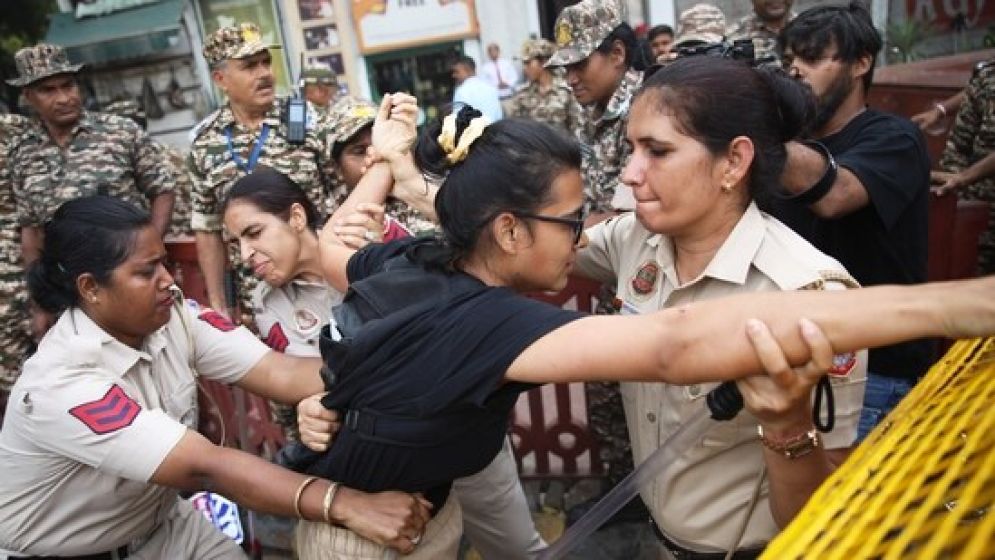
Indian police continued to detain protesters in New Delhi on
Sunday, despite a Supreme Court order barring detention of peaceful
demonstrators, as student groups and politicians launched protests for the
second day against alleged “vote theft.”
The election irregularities favoured the ruling BJP, the
protest groups including Congress and Cockroach Janta Party (CJP) have alleged,
and demanded the resignation of Chief Election Commissioner (CEC) Gyanesh Kumar
for his suspected role in the “rigging.”
Around a 100 protesters, including CPI(M) leader John
Brittas and student activist Neha Bora, were detained from around Connaught
Place in New Delhi on Sunday.
Three Express Hindi journalists have also been detained at
Connaught Place, and their phones have been snatched by the Delhi Police.
The group of protesters marched from Rajiv Chowk gate 1 and
made their way to the LIC building when officers started detaining people. Some
have been detained while others ran away.
CJP leaders Abhijeet Dipke, Ashutosh Ranka and Saurav Das
were released on Sunday, following their preventive arrest a day earlier, on
the condition that they would not “breach peace” for one year. Dipke said he
was returning home after his grandmother’s death.
On Sunday, CJP leaders renewed their attack on the BJP-led
government at a press conference. Criticising the security arrangements, they
said Prime Minister Narendra Modi and Home Minister Amit Shah “should be
ashamed” for allowing the situation to turn into a “war-like” scenario, after
around 7,000 were detained and internet services were cut in parts of Delhi on
Saturday.
Addressing the press conference, CJP spokesperson Saurav Das
said, “An atmosphere of fear has been created in country, it’s clearly being
done to save one person. We want to ask Modi and Shah, why are you trying to
save Gyanesh Kumar?”
Das questioned the National Human Rights Commission (NHRC)
and the Supreme Court over alleged custodial violence against protesters
detained during the demonstrations in Delhi.
He also alleged that right-wing groups were being mobilised
by the BJP, while police were registering cases against protesters instead.
He also questioned the Delhi security restrictions during
Saturday’s protest, asking why “millions of people” were inconvenienced to
protect Chief Election Commissioner (CEC) Gyanesh Kumar.
Das accused the government of targeting journalists amid the
protests in Delhi, alleging that independent journalists were being detained
for asking police personnel to display their name tags.
CJP leader Ashutosh Ranka on Sunday targeted Prime Minister
Narendra Modi and Union Home Minister Amit Shah, accusing them of shielding
Chief Election Commissioner Gyanesh Kumar amid the party’s protest against the
Election Commission.
“Narendra Modi is the biggest coward of India, an
embarrassment to India,” Ranka said at a press conference, alleging that the
Prime Minister had made it clear he would protect Kumar “at all costs”. He
added that the fight against the Election Commission and Kumar had now been
extended to Modi and Shah.
Das criticised the security arrangements in Delhi, claiming
that 30,000–40,000 personnel had been deployed, including BSF personnel brought
in from border areas and forces from Naxal-affected regions. He also alleged
that 57 Metro stations were restricted, railway services were shut and shops
were closed.
Das said the government had mistakenly believed the measures
would turn public opinion against the protesting youth. “But this is a mistake
because the whole country is watching this barbarity,” he said.
Opposition leaders and activists, including Arvind Kejriwal,
Mamata Banerjee, Pinarayi Vijayan, Neha Bora, Yogendra Yadav and Prashant
Bhushan, were detained in Delhi on Saturday as protests against the Election
Commission ran into a near-lockdown. Around 7,000 people had been detained
across the capital, and no protester was allowed to reach Jantar Mantar.
The Supreme Court on Sunday directed the government to
ensure Delhi Metro services operate on their normal schedule and that internet
services remain uninterrupted amid protests. The court also ordered avoiding
detention of “unarmed and peaceful” demonstrators. The arrests continued
anyway.