


 For all latest news, follow the Daily Sun's Google News channel.


Hong Kong maps new future with first five-year development plan
Innovation, Northern Metropolis, Greater Bay Area integration and housing at heart of 2026-2030 strategy
Mohammad Saiyedul Islam, China
Published: 16 Sep 2026, 08:04 PM
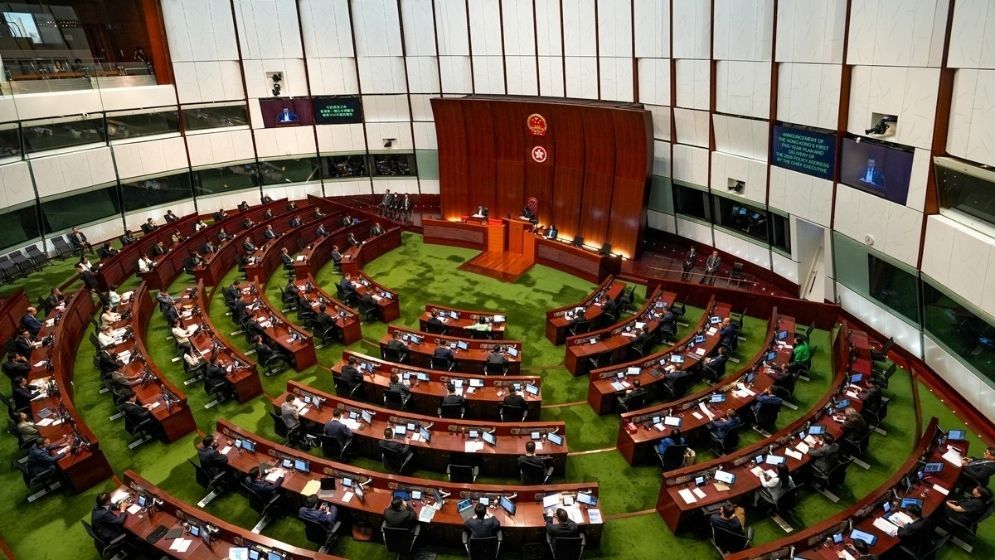
The Hong Kong Special Administrative Region (HKSAR) unveiled its first five-year plan for economic and social development (2026-2030) on 16 September 2026. Photo: VCG
Hong Kong has unveiled its first five-year plan for economic and social development, setting out a roadmap for 2026-2030 focused on economic competitiveness, innovation and technology, the Northern Metropolis, Greater Bay Area integration, housing and social welfare.
Chief
Executive John Lee announced the plan at the Legislative Council on Wednesday
alongside his 2026 Policy Address. The blueprint covers seven major areas and
sets out 105 indicators to monitor implementation, providing medium- and
long-term direction for the city’s development.
Lee
described the 2026-2030 period as crucial for Hong Kong’s transition from
stability to prosperity, improving people’s well-being and building a better
home for residents.
The
plan seeks to strengthen Hong Kong’s position as an international financial,
maritime and trading centre, while developing the city as an international
innovation and technology hub and a global centre for high-calibre talent.
Innovation
and technology are expected to play a growing role in the city’s economic
transformation. The government aims to raise total local expenditure on
innovation activities to 3 per cent of GDP after 2030, with artificial
intelligence, microelectronics, life and health technology, robotics and other
strategic technology sectors among its priorities.
The Northern Metropolis, along Hong Kong’s northern boundary with Shenzhen, is another major focus. The five-year plan targets 900 hectares of “spade-ready” sites and the completion of 70,000 housing units there during the period. The development is intended to provide land for industry, technology, housing and employment.
Greater
integration with the Guangdong-Hong Kong-Macao Greater Bay Area is also a key
priority. The plan calls for stronger connectivity and closer cooperation in
transport, professional services, healthcare, culture and tourism. It also aims
to facilitate cross-border flows of capital, talent and other resources while
expanding Hong Kong’s international collaboration network.
The
new blueprint comes as Hong Kong reports stronger economic performance
following several years of disruption. According to the 2026 Policy Address,
the economy contracted by 3.7 per cent four years ago but grew by 3.6 per cent
in 2025. In the first half of 2026, GDP expanded by 5.1 per cent year on year,
the strongest half-year performance in almost five years, while total exports
of goods rose by more than 26 per cent. GDP exceeded HK$3.3 trillion in 2025.
The
government also highlighted progress in employment and housing. Median monthly
employment earnings among citizens rose by a cumulative 20 per cent over the
past four years, according to the Policy Address.
On
housing, the government plans to increase public housing supply, with total
public housing production, including Light Public Housing, expected to reach
about 196,000 units over the next five years. It also aims to reduce the
composite waiting time for subsidised rental housing to below four years by
2030-31.
Social
welfare and public services feature prominently in the strategy. The plan
includes measures to strengthen the social protection system and improve
people’s well-being, while the Policy Address covers healthcare, education,
youth development, elderly care and workers’ protection.
The
government has linked the five-year blueprint with China’s 15th Five-Year Plan,
which began in 2026. Lee said the Hong Kong plan would align the city’s
development more closely with national development strategies and enable it to
better integrate into and contribute to national development.
The
plan also places the “one country, two systems” principle at the centre of Hong
Kong’s long-term development framework, alongside national security,
executive-led governance and efforts to improve governance effectiveness.
The
first five-year plan marks a move towards more structured long-term planning
for Hong Kong. Alongside its traditional strengths in finance, trade and
services, the city is seeking to broaden its economic base through technology,
innovation, talent development, regional integration and new urban development.
The
2026-2030 period will now provide the framework for translating the plan’s
targets into projects and measurable outcomes as Hong Kong seeks to shape its
next phase of economic and social development.