


 For all latest news, follow the Daily Sun's Google News channel.


Secret Israeli systems used in Gaza killings revealed in film
Testimony from Israeli military insiders involved in surveillance and remote killings features in documentary produced by the Guardian
The Guardian
Published: 11 Sep 2026, 05:37 PM
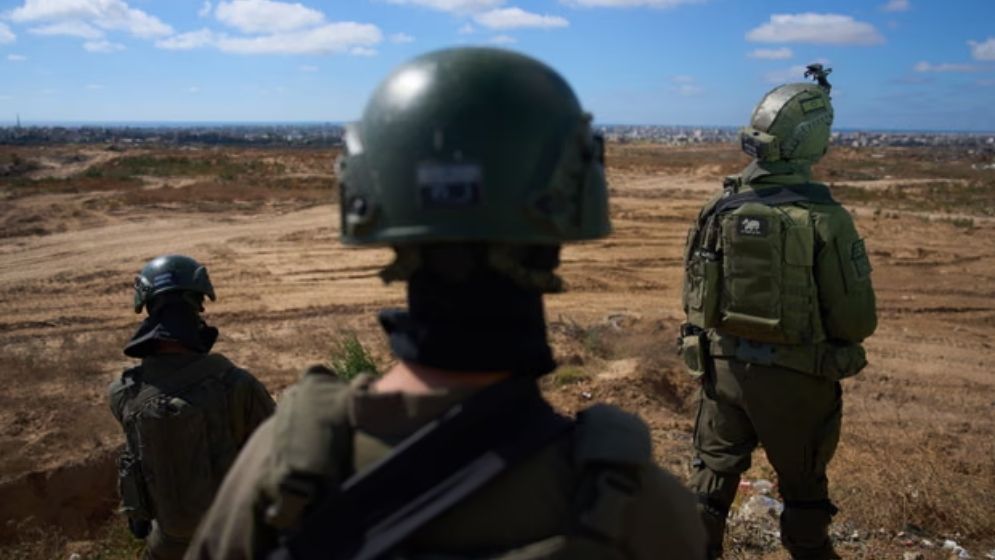
Israeli soldiers at a military position overlooking the so-called yellow line in Gaza in May. Photo: AP
Testimony from 24 Israeli military insiders on the secret systems used in the war on Gaza has been revealed in a new documentary film about the mass killing of Palestinian civilians.
NAZA, a film from the Oscar-winning Israeli
directors Yuval Abraham and Rachel Szor, was shown at the Venice international
film festival on Thursday as the only documentary competing for its prestigious
Golden Lion award.
The film’s title comes from an Israeli military acronym used euphemistically to refer to civilians expected to be killed in a military attack. Produced by the Guardian, it features extensive testimony from Israeli intelligence officers and soldiers involved in the surveillance and remote killing of Palestinian civilians.
Interviews were filmed at night on rooftops in Tel Aviv, on the condition of anonymity because of the risks involved in speaking publicly about Israel’s war activities. The appearance and voices of participants in the film were digitally altered to disguise their identities.
-6aa3eb6730830.jpg)
A scene from NAZA, a documentary produced by the Guardian
and directed by Yuval Abraham and Rachel Szor. Photo: The Guardian
The interviewees detail the secret methods
used by the Israeli military in Gaza, including AI-based systems built to
identify large numbers of potential low-ranking Hamas targets, who were then
bombed in their homes at night, in the knowledge attacks would also kill their
families.
The Israeli military hacked into phones to
identify the location of such targets, and covertly listened into conversations
with their wives and children moments before they were all killed.
The film also features first-person accounts
about the destruction of neighbourhoods where the Israeli military estimated
that up to 25% of residents were still sheltering in their homes, the
systematic burning of civilian homes, and the killing of civilians at a food
distribution site.
Abraham said at a press conference in Venice
on Thursday: “We just told these officers: ‘Please describe to us what you did.
How do these systems work? Sketch it out for us.’ Sometimes, in just asking the
questions, you get the answers.
“Some of them did not express remorse and
some did. Some spoke out of indifference, some out of pride.”
Several interviewees worked in a secret intelligence unit that reports directly to the office of Israeli prime minister, Benjamin Netanyahu; one said their mission was to “thwart peace”.
“We made this film out of a sense of
obligation to use our position as Israeli film-makers and journalists to
examine the systems behind the mass killing of Palestinian civilians for which
our country is responsible,” Abraham and Szor said in their directors’
statement.
The directors stressed the film’s focus was
not on “sporadic war crimes committed by rogue soldiers”. “It is on the orders
themselves, the policies, the accepted practices, the language and logic that
make those practices possible, and the people who operate within them,” they said.
“The system and its cogs.”
The documentary was co-produced by James
Wilson and executive produced by Jonathan Glazer, the same team behind the
Oscar-winning film The Zone of Interest.
The film received a nearly 25-minute standing
ovation after its screening, according to Variety, which called it a record for
length of applause not just at Venice but at any major film festival and
reported that Glazer embraced Abraham and Szor as it went on, while some
members of the audience held up Palestinian flags.
NAZA builds on revelations first published by
the Israeli-Palestinian publication +972 Magazine, the Hebrew-language outlet
Local Call and the Guardian between 2023 and 2025. It was filmed and produced
under tight security because of the risk to confidential journalistic sources,
and its contents have remained a closely guarded secret before Thursday’s
premiere.
Paul Lewis, the Guardian’s head of
investigations and an executive producer on the film, described NAZA as the
culmination of “years of painstaking work to uncover and verify the systems
used by Israeli military intelligence in Gaza”.
Abraham said making the documentary had
provided space to explore the collective impact of that work. “In this film
we’re talking to 24 people. We are looking at systems of mass killing. There is
something about cinema that allows you to explore structures and systems and
how you put things together.”
Before the premiere, Alberto Barbera, the
Venice film festival’s artistic director, told journalists NAZA would be “truly
groundbreaking”, calling it “a politically disruptive and cinematically
extremely interesting work”.
“It’s not just any collection of interviews,”
Italy’s Cinecittà News quoted Barbera as saying. “It took them three years to
convince these Israeli intelligence and military officials to share the work
they did when the invasion of Gaza began, and I assure you, their testimonies
are shocking.”
Israeli attacks in Gaza since 2023 have killed more than 73,000 Palestinians, the majority of them civilians, and injured more than 174,000 others, together representing more than 10% of Gaza’s prewar population.
-6aa3eb738030d.jpg)
The film’s directors, Rachel Szor and Yuval
Abhram (centre), with producers and crew members at the Venice film festival on
Thursday. Photo: Reuters
Israeli restrictions on food shipments created
a man-made famine last summer, and the Israeli military razed or damaged more
than three-quarters of homes, so surviving Palestinians are now crowded into
tent camps with little access to clean water or sanitation.
Israel launched its war after the 7 October
2023 Hamas-led attacks on Israel, when more than 1,200 people were killed and
251 taken to Gaza by militants. The majority of the dead and hostages were
civilians.
Abraham and Szor were two of the four
co-directors of No Other Land, which won the Oscar for best documentary in
2025.
Drawing a connection between the two films,
the directors said: “In the film No Other Land, we spent five years, together
with [Palestinian co-directors] Basel Adra and Hamdan Ballal, documenting the
army destroying Palestinian homes in order to paint a larger picture of a
system of occupation and ethnic supremacy aimed at the removal of Palestinians
from the West Bank.
“In NAZA, we are similarly connecting the
dots of a system, gathering the testimonies of two dozen intelligence officers
and soldiers and depicting the military systems used to perpetrate what a UN
commission and the world’s leading human rights groups have described as a
genocide.”