




 For all latest news, follow the Daily Sun's Google News channel.


Blockade succeeds where sanctions failed as Iran oil exports stall
Reuters, London
Published: 01 Sep 2026, 10:12 PM
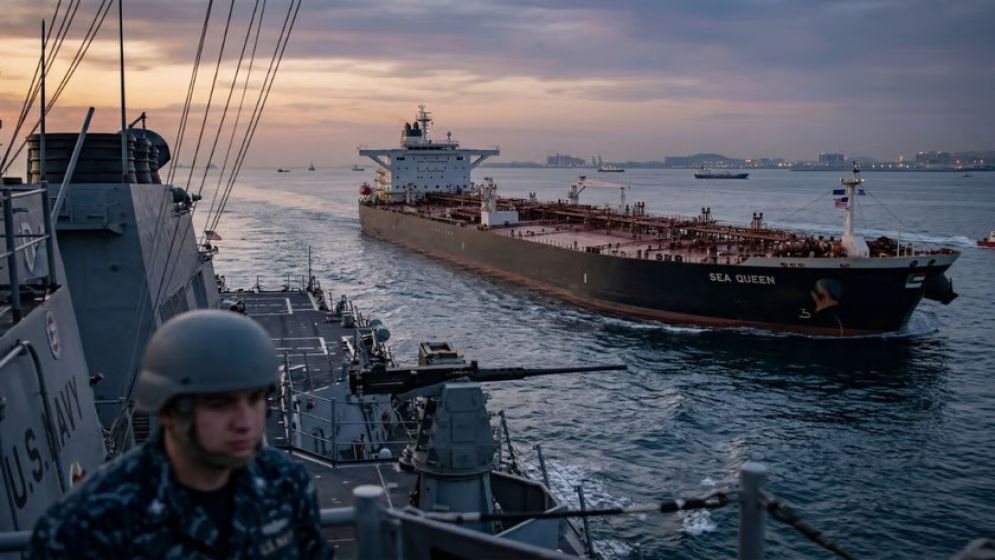
US Navy vessels deployed in the Middle East | File Photo: Collected
For the first time on record, Iran has gone about seven
weeks without shipping meaningful crude exports through the Strait of Hormuz,
as a US naval blockade succeeds where years of sanctions failed by cutting off
one of Tehran's main sources of foreign-currency earnings.
Unlike previous sanctions campaigns, when Iranian crude
continued reaching buyers despite restrictions, the current blockade has
stopped fresh crude cargoes reaching China, Tehran's only major remaining oil
customer, increasing pressure on government finances and foreign-currency
reserves.
Since the US reinstated its blockade on Iran on 14 July as
part of their six-month conflict, no Iranian crude cargoes have successfully
transited the Strait of Hormuz to China, according to Kpler, Vortexa and
TankerTrackers.com.
As a result, Iran can only sell crude to China from floating storage in Asia, which it cannot replenish as crude accumulates aboard tankers inside the strait.
"Even at the height of maximum-pressure sanctions in
2019-20, some Iranian crude cleared Hormuz every single month; at no point did
outbound flows fall to near-zero for a sustained stretch as they have since
mid-July," Vortexa analyst Claire Jungman said.
Iran loaded about 220,000 to 255,000 barrels per day of
crude oil and condensate in August, according to Vortexa and Kpler estimates,
down from roughly 740,000 bpd in July and about 2 million bpd in March.
The collapse in exports is draining one of Iran's main
sources of foreign-currency income and could force Tehran to finance spending
by printing money, risking even higher inflation, Kpler analyst Homayoun
Falakshahi said.
The International Monetary Fund estimates Iran's inflation
rate at nearly 70% this year, the world's third-highest after Venezuela and
Sudan.
Last week, Washington sought to increase the pressure by
threatening countries that continue trading with Tehran, while stopping short
of immediately imposing penalties.
The blockade and beyond
Iran currently has 29 tankers inside the strait carrying 36.11 million barrels of crude, TankerTrackers.com co-founder Samir Madani said.
The US blockade does not extend along Iran's entire
coastline. It sits farther south, between the Gulf of Oman and the Arabian Sea,
where US Navy vessels vet ships departing from and approaching Iranian ports.
Beyond the blockade zone, dozens of Iran-linked shadow-fleet
tankers remain active, with 51 vessels operating in the Gulf of Oman and
another 81 making deliveries in Asia or waiting off Malaysia, according to
David Tannenbaum of Blackstone Compliance Services.
Reuters could not independently verify those figures.
Iranian crude still for sale, but for how long?
Iranian crude remains openly available, with cargoes for
September and October delivery to China being offered, traders said.
They said available volumes are lower than for July and
August because floating storage outside the Gulf is shrinking as no fresh
supply arrives.
Iranian crude in floating storage west of the blockade line
rose to 41.7 million barrels by August 26 from 35.5 million at the end of July,
while total Iranian crude afloat fell to 107 million barrels from 135 million,
according to Vortexa data.
"China can grab whatever's floating around in their
neck of the woods, but that's about it for now, really," TankerTrackers
co-founder Samir Madani said.
Once sold, empty tankers cannot return to Iranian ports
because of the blockade, leaving vessels idle offshore.
Vortexa's Jungman said 27 sanctioned tankers linked to
Iran's oil trade are currently waiting off Sri Lanka in ballast, unable to
return to Iran.