


 For all latest news, follow the Daily Sun's Google News channel.


China hits US with ‘tit-for-tat’ sanctions ahead of Xi visit
Reuters, Beijing
Published: 05 Aug 2026, 10:22 PM
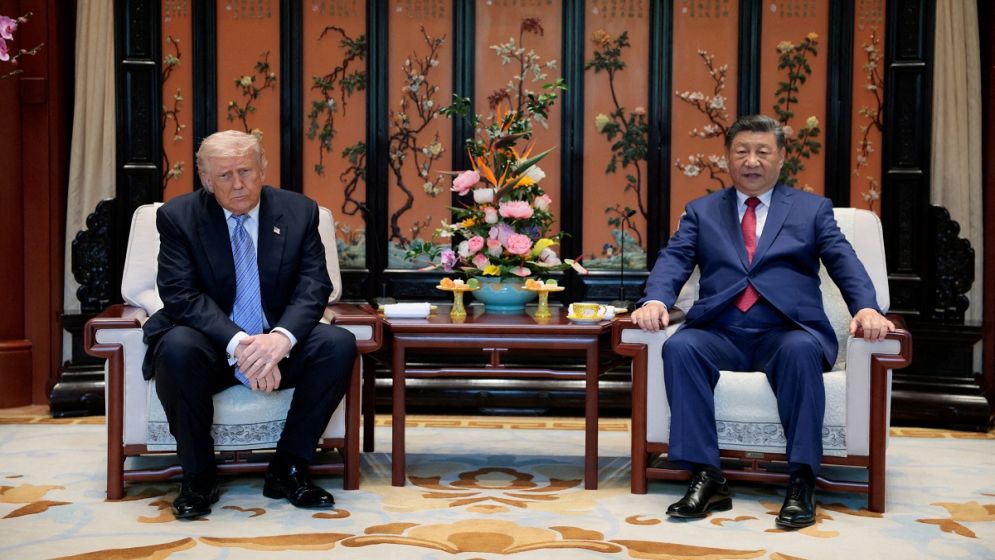
Chinese President Xi Jinping and US President Donald Trump attend a meeting on the sidelines of their visit to the Zhongnanhai Garden in Beijing, China, 15 May 2026. Photo: REUTERS
China's Commerce Ministry on Wednesday barred domestic
organisations and individuals from doing business with seven US entities,
tightened export controls on US-bound drones and related technology, and
restricted US agencies' role in mandatory Chinese factory certification
inspections.
The tit-for-tat sanctions come weeks ahead of an expected
summit between Chinese leader Xi Jinping and President Donald Trump in the US
next month, as the world’s two largest economies struggle to maintain what
they’ve called “constructive strategic stability” amid an intensifying tech
rivalry.
Beijing said the latest sanctions and trade moves responded
to recent US restrictions affecting Chinese telecom operators, testing
laboratories, drones, consumer routers, submarine cables, advanced robotics
equipment and power inverters.
It also cited Washington's addition last week of more than
40 Chinese entities to its Uyghur Forced Labor Prevention Act entity list.
The announcement also came after Reuters reported that the
Trump administration was drafting a national-security measure to bar US imports
of new models of Chinese data-centre components, including optical
transceivers.
"This is a retaliatory move, and it's hardly a
surprising one," said Alfredo Montufar-Helu, Beijing-based managing
director at Ankura China. "Beijing has spent the past several months
building out its countermeasures toolkit."
The steps mark the latest escalation in US-China trade and
technology tensions, with Washington tightening restrictions on Chinese access
to US technology and markets, and Beijing responding with export curbs and
sanctions on selected US entities.
Business restrictions
China put Mesa, Arizona-based Compliance Testing LLC on a
countermeasures list, barring Chinese organisations and individuals from
dealing or cooperating with it.
Beijing said the testing and certification firm had assisted
and supported recent US Federal Communications Commission measures targeting
China, which it said harmed Chinese companies' legitimate rights and interests,
without elaborating.
In April, the FCC adopted a fast-track review process for
devices tested in US or reciprocal-country laboratories, while proposing to
stop recognising testing laboratories and certification bodies in countries
without reciprocal arrangements with Washington.
If finalised, the proposal could make it harder for
China-based labs and certification bodies to help manufacturers obtain FCC
equipment authorization for devices sold in the United States.
China separately imposed the same business-dealing ban on
Applied DNA Sciences, Stratum Reservoir, Altana Technologies, the Responsible
Business Alliance, Verité Group and Human Rights in China, accusing them of
supporting US Xinjiang-related sanctions.
Several work on supply-chain tracing, labour-risk
assessments or human-rights advocacy. The orders did not specify asset freezes
or travel bans.
Drones, certification and printer probe
China said controlled drones, key components and related
technology destined for the United States would undergo stricter case-by-case
review, without streamlined licensing. The measure is not a blanket ban but
could delay shipments covered by China's dual-use export-control rules.
Beijing also suspended US-based agencies from conducting
follow-up factory inspections under China's mandatory certification system,
potentially raising costs and delays for manufacturers.
Separately, Beijing launched a national-security
investigation into imported printing, copying and office equipment.
The investigation does not name the United States or
specific companies, but the Commerce Ministry explicitly included it among its
responses to recent US actions.
Montufar-Helu said Beijing's language signaled frustration
with recent US moves, which China views as inconsistent with bilateral
understandings.
"Both Beijing and Washington keep reaching for
calibrated, targeted measures rather than sweeping ones," he said,
suggesting neither side wants tensions to spiral.