


 For all latest news, follow the Daily Sun's Google News channel.


When Dissent Is Treated as a Threat: Pakistan’s Past and Present Offer Lessons for South Asia
Special Correspondent
Published: 31 Jul 2026, 08:17 PM
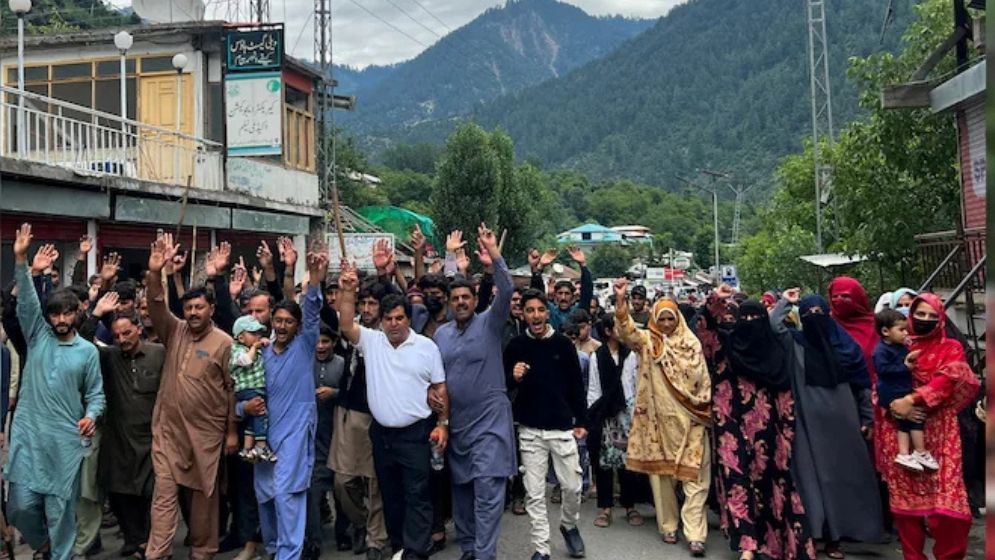
Protesters on the march in Pakistan-administered Kashmir during a strike called by the banned Joint Awami Action Committee, an alliance of civil society groups in Neelum Valley. Photo: Reuters
When a government begins to see public criticism as a security challenge rather than a democratic expression, the consequences can extend far beyond a single protest or political dispute.
The
recent unrest in Pakistan-administered Kashmir has once again placed Pakistan’s
human rights record under international scrutiny. The clashes, deaths,
communication restrictions and legal measures taken against a prominent civil
society coalition have renewed debate over the limits of state power and the
rights of citizens to organise, protest and demand accountability.
For
Bangladesh, the developments carry significance not because another country’s
difficulties provide grounds for political comparison, but because they
highlight a broader question facing democracies across South Asia: how should
governments respond when citizens raise grievances and demand greater political
participation?
The
answer has particular importance for Bangladesh, a country born from a struggle
over representation, political rights and the recognition of democratic
aspirations.
The
immediate crisis in Pakistan-administered Kashmir involved protests led by the
Joint Awami Action Committee (JAAC), a coalition of civil society groups that
raised demands related to governance, representation and public accountability.
Pakistani authorities took action against the organisation, citing concerns
over public order and security. Protest leaders, however, rejected allegations
that their movement posed a security threat and argued that their demands were political
and peaceful.
The
unrest resulted in large number deaths and injuries, although casualty figures
and responsibility for the violence have been disputed by different sides. The
lack of independent verification in the immediate aftermath has underlined the
importance of transparent investigations. The United Nations Human Rights
Office has called for prompt and independent inquiries into deaths linked to
the unrest and expressed concern over restrictions on peaceful assembly and
association.
The
controversy surrounding the Kashmir protests reflects wider debates about civil
liberties in Pakistan.
For
years, international human rights organisations have raised concerns over
restrictions on freedom of expression, pressure on journalists, the use of
security legislation against activists and allegations of enforced
disappearances. Organisations such as Amnesty International and Human Rights
Watch have documented cases in which activists, journalists and political
opponents have alleged intimidation, detention or restrictions on their
activities.
The
Pakistani government has often defended security measures by pointing to
serious challenges, including militant violence and separatist movements.
Authorities argue that extraordinary steps are sometimes necessary to protect
national security and public order. Critics, however, maintain that security
concerns cannot replace due process, transparency and accountability.
This
debate has been particularly visible in Balochistan, where families have for
years demanded information about relatives they say disappeared after being
taken into custody. Human rights organisations have documented allegations of
enforced disappearances and called for independent investigations. Pakistani
authorities have rejected many allegations and maintained that security
operations are directed against militant and separatist groups rather than
peaceful political activity.
Media
freedom has also remained a major area of concern. Journalists in Pakistan have
reported intimidation, legal pressure and restrictions on reporting sensitive
political and security issues. While Pakistan’s Constitution provides
protections for freedom of expression, critics argue that broad security laws
and regulatory measures have narrowed the space available for independent
journalism.
These
concerns are not raised only by political opponents of the Pakistani state.
They come from international organisations that assess human rights conditions
in countries around the world, including Bangladesh.
The
relevance for Bangladesh lies not in claiming moral superiority over a
neighbour. Human rights standards cannot be measured by asking whether one
country performs better than another. They must be judged against universal
principles of dignity, freedom and accountability.
Bangladesh
itself has faced international criticism on issues including freedom of
expression, electoral processes, security force accountability and allegations
of enforced disappearances. Those concerns deserve serious attention because
democratic institutions become stronger when they are open to scrutiny and
capable of addressing criticism.
The
history of Bangladesh provides a powerful reminder of why these issues matter.
The
country emerged in 1971 after a political crisis that followed years of
disputes over representation, economic inequality and cultural rights between
East and West Pakistan. Following the disputed political crisis after the 1970
general election, the Pakistan Army launched Operation Searchlight on 25 March
1971, beginning a brutal military campaign against Bengali nationalist
movements, civilians and political activists.
The
events of 1971 remain among the most traumatic chapters in South Asian history.
Large-scale killings, widespread human rights abuses and mass displacement took
place during the nine-month Liberation War. Around 10 million refugees fled to
India, while estimates of those killed vary among historians and researchers.
Bangladesh officially commemorates the deaths of three million people, while
other estimates differ.
What
remains beyond dispute is the scale of suffering experienced by the Bengali
population and the lasting impact of the conflict.
For
Bangladesh, the memory of 1971 is not only about independence. It is also about
the dangers of denying political representation and responding to democratic
demands through force. The tragedy demonstrated that military power cannot
permanently silence a population’s aspirations for dignity, participation and
self-determination.
However,
the significance of history lies not in claiming that every crisis is the same,
but in understanding the consequences when governments fail to address
legitimate grievances through dialogue and democratic institutions.
Across
South Asia, governments frequently defend restrictions by pointing to security
challenges. Many states in the region face genuine threats from armed groups,
separatist movements and political instability. Yet international human rights
principles emphasise that restrictions on fundamental freedoms must remain
lawful, necessary and proportionate.
The
long-term stability of any country depends not only on the strength of its
security institutions but also on public trust. A healthy democracy is not one
where disagreement disappears. It is one where disagreement can exist without
fear.
The
ability of citizens to protest peacefully, journalists to report independently
and institutions to investigate allegations of abuse is not a weakness of the
state. These are the foundations that allow governments to maintain legitimacy.
The
events in Pakistan-administered Kashmir should therefore be viewed as part of a
wider regional conversation about governance, rights and accountability. They
remind South Asian societies that stability achieved through suppressing voices
is often temporary, while stability built through participation and trust is
far more durable.
For
every democracy, the challenge is the same: not simply to hold elections, but
to ensure that citizens can speak, organise and participate without fear.