


 For all latest news, follow the Daily Sun's Google News channel.


Of Cockroach protests, booming GDP and lack of job opportunities
UNI, New Delhi
Published: 25 Jul 2026, 03:15 PM
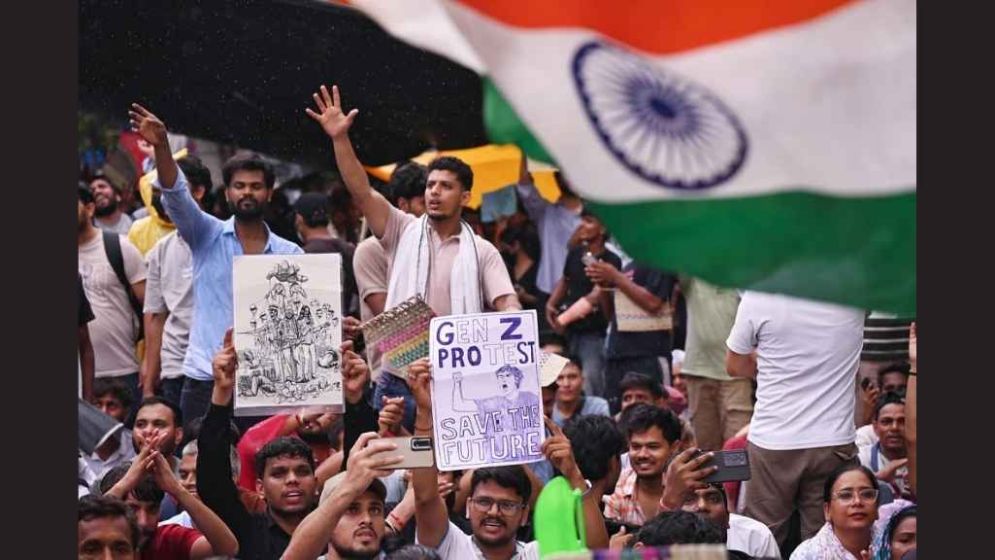
The Cockroach Janta Party's ongoing protest movement in New Delhi on Friday. Photo: Collected
It's well past noon, and thousands of young men and women, are sitting under the hazy Delhi sun, joining a protest which has been ongoing for quite some time with renewed vigour on Friday after the Cockroach Janata Party (CJP) called for a nation-wide stir to pressure the government into accepting their demand for Education Minister Dharmendra Pradhan's resignation.
The narrow lane which curves towards Jantar Mantar, the early 18th century observatory built by Sawai Man Singh of Jaipur, from the opulent Imperial Hotel on Janpath has been barricaded.
Riot police have drawn themselves in three-deep ragged columns. But boys and girls, some students at universities in and around Delhi, or even from far off places ranging from Guwahati to Pune, keep walking in, wriggling past the police lines to join their compatriots in a protest which has caught the attention of the world.
"I came because they brutally beat up students for no reason on Monday... the education system is broken. Students were protesting that and demanding fair play in competitive exams ... why should they be treated like criminals?" asked Kaustav Dutt, 21, an engineering school student from Ghaziabad.
The protest started by CJP some weeks ago was to demonstrate against paper leakages and irregularities in the highly competitive National Eligibility Entrance Test held in May this year for admission to medical and dental schools across the country. It gained momentum after the police cracked down on protestors on Monday, chasing and beating many of them, leading scores hospitalized, including many with eye and head injuries.
However, for India's youth, the flawed test and the clash with the police were the proverbial last straw on the camel's back. While India's youth population, education levels and GDP have been booming since the 1990s, job opportunities have not been able to keep pace, creating deep-rooted frustration which was perhaps waiting for a spark to come to the fore.
The country has some 367 million people aged between 15 and 29, which is arguably the largest youth population anywhere in the world. This was long hailed as "India's youth dividend". However, harnessing that 'dividend" has proven to be a not-so-easy task.
While India's GDP has been growing at one of the fastest rates for any major global economy at times at over 7 per cent, the latest Centre for Monitoring Indian Economy data shows that the unemployment rate has been consistently high and stood at around 6.64 per cent in June this year.
Graduate unemployment is even higher. A study by Azim Premji University, released this year, says unemployment among graduates in the 25- to 29-year-old age group is about 20 per cent.
"What these demonstrations suggest is that we have not succeeded in converting the country's much-vaunted demographic dividend into the economic mobility that a better-educated generation had been promised," Dr Biswajit Dhar, former professor of Economics from the prestigious Jawaharlal Nehru University, told UNI.
Between 2004-05 and 2023, while approximately 5 million graduates were added each year, only around 2.8 million found employment, said the study entitled 'State of Working India 2026'. And out of these, an even smaller share entered salaried employment, resulting in rising graduate unemployment and slowing earnings growth.
20 "Even where there are jobs, the starting salary is so low that our parents have to support us,' said Priti Mishra, a post-graduate from Kanpur who stays at a paying guest tenement in South East Delhi and is trying her luck in getting a job by giving various competitive examinations for government and university service.