



 For all latest news, follow the Daily Sun's Google News channel.


New rail connection between India, Nepal to reduce transit costs
Kolkata remains Nepal's nearest seaport
The Kathmandu Post, Kathmandu
Published: 21 Jul 2026, 11:22 PM
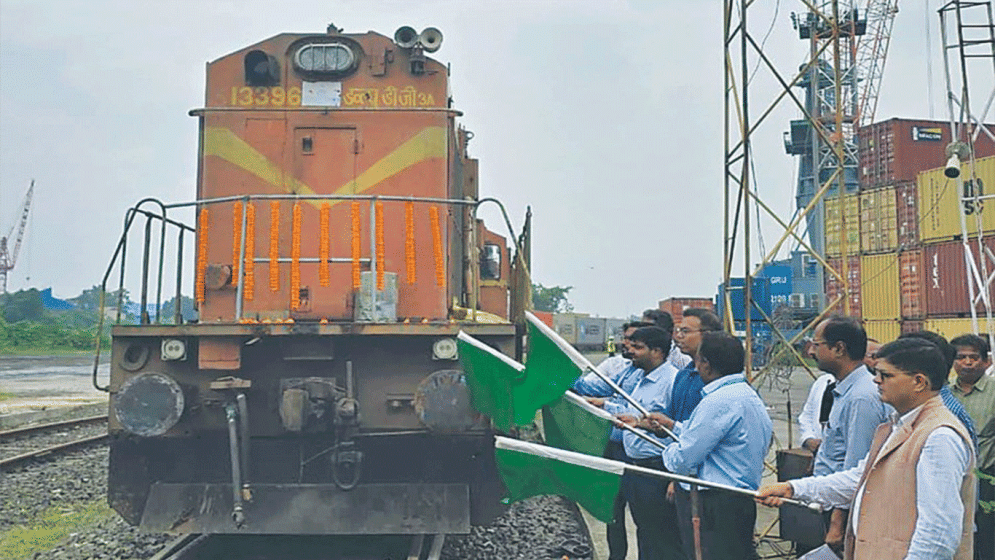
Officials in Kolkata flag off the first direct freight train to Biratnagar on Friday. The service, the only direct rail freight link to Nepal after Birgunj, is expected to reduce transport costs significantly. Photo: Collected
The first-ever rail cargo service from Kolkata, India, to Biratnagar officially began on Friday, marking a major milestone in Nepal's transit and trade logistics by extending direct rail access beyond Birgunj for the first time.
Under the Nepal-India Transit Treaty, goods imported
from third countries are transported through Indian territory to Nepal's
border. In line with the treaty, which allows Nepal to use Indian road, rail
and inland waterways for third-country imports and exports, rail cargo transportation
from Kolkata to Biratnagar has now commenced, The Kathmandu Post reported.
On 4 November 2025, India's Central Board of
Indirect Taxes and Customs (CBIC), under the Department of Revenue, amended the
Electronic Cargo Tracking System (ECTS) Regulations, expanding the scope of
rail cargo movement from the ports of Kolkata, Haldia and Visakhapatnam.
"The amendment expanded the scope of rail cargo
movement from the Indian ports of Kolkata, Haldia and Visakhapatnam, allowing
cargo destined for Nepal to be transported by rail up to the Biratnagar
Customs," according to a statement issued by the Consulate General of
Nepal in Kolkata.
Nepal has approved a letter of exchange amending the
protocol of the Nepal-India Transit Treaty 2023, which allows the import of all
types of goods–both containerised and bulk cargo–by rail to the Biratnagar
Integrated Check Post (ICP) and Nautanwa, near Bhairahawa.
Until now, the transit treaty permitted rail cargo
movement only to the Birgunj ICP. The amended protocol allows all cargo trains
to operate through Biratnagar ICP and Nautanwa. Previously, only four
commodities–coal, clinker, cement and fertiliser–could be transported by rail
from third countries.
The new arrangement is expected to significantly
reduce logistics costs, as transporting goods by rail is cheaper than by road.
Trade experts say direct transportation of goods
from Visakhapatnam to Biratnagar ICP will cut logistics costs by around 15% to
20%.
Currently, cargo arriving at Birgunj from
Visakhapatnam is reloaded onto trucks for delivery to Biratnagar. Many traders
also rely on road transport from Kolkata, which is costlier and more
time-consuming.
India remains Nepal's largest trading partner.
According to the Department of Customs, Nepal exported goods worth 224.68 billion
rupees to India in the previous fiscal year, while imports from India totalled 1.07
trillion rupees, resulting in a trade deficit of 846.51 billion rupees.
Kolkata remains Nepal's nearest seaport.
India and Nepal first signed the Treaty of Trade and
Transit in 1960, which granted Nepal transit access through Indian territory.
The treaty has since been renewed periodically and was most recently revised in
June 2023 for seven years, with provision for an automatic renewal for another
seven years.
India continues to provide transit facilities for
almost all of Nepal's third-country trade. Nepal's overseas trade is primarily
routed through the ports of Kolkata, Haldia and Visakhapatnam, while trade with
Bhutan and Bangladesh also passes through Indian territory.
A letter of exchange operationalising Visakhapatnam
Port was signed in February 2016 during the Nepal prime minister's visit to
India. Corresponding amendments to the Railway Services Agreement enabled
transit traffic between Visakhapatnam and Nepal's Inland Container Depot in
Birgunj, making the port an important supplementary gateway for Nepal's
overseas trade.
On 26 February, Nepal and India finalised the
procedural framework for transporting cargo by rail from Kolkata and Haldia to
the Nepal Customs Yard in Biratnagar via the Jogbani Customs Yard in India.
The inaugural rail cargo service from Kolkata Port
to Biratnagar was formally flagged off on Friday by Nepal's Consul General in
Kolkata Jhakka Prasad Acharya, along with officials from Kolkata Customs,
Kolkata Port and the Container Corporation of India Limited (CONCOR).
The inaugural shipment, carried on a CONCOR rail
rake, consists of 40 high-capacity 40-foot Maersk Line containers carrying
crude canola grains imported from a third country for Swastik Oil Industries of
Nepal. The containers are fitted with Electronic Cargo Tracking System devices.
With the service now operational through the Jogbani
Integrated Check Post to Biratnagar, up to 45 forty-foot containers can be
transported directly to Biratnagar by rail in a single trip.
According to the Consulate General, rail transport
is safer, more reliable and less expensive than road transport, with cargo
expected to reach Biratnagar in around 24 hours, improving the efficiency of
imports.
The launch paves the way for regular commercial
movement of both containerised and bulk cargo by rail to eastern Nepal.
Officials say the new arrangement will reduce demurrage charges at ports,
container detention fees and additional road transport costs, lowering overall
logistics expenses and improving the competitiveness of Nepali industries.