


 For all latest news, follow the Daily Sun's Google News channel.


Israel demarcates expanded Lebanon occupation zone, challenging US-Iran pact
Reuters, Tel Aviv
Published: 18 Jun 2026, 10:26 PM
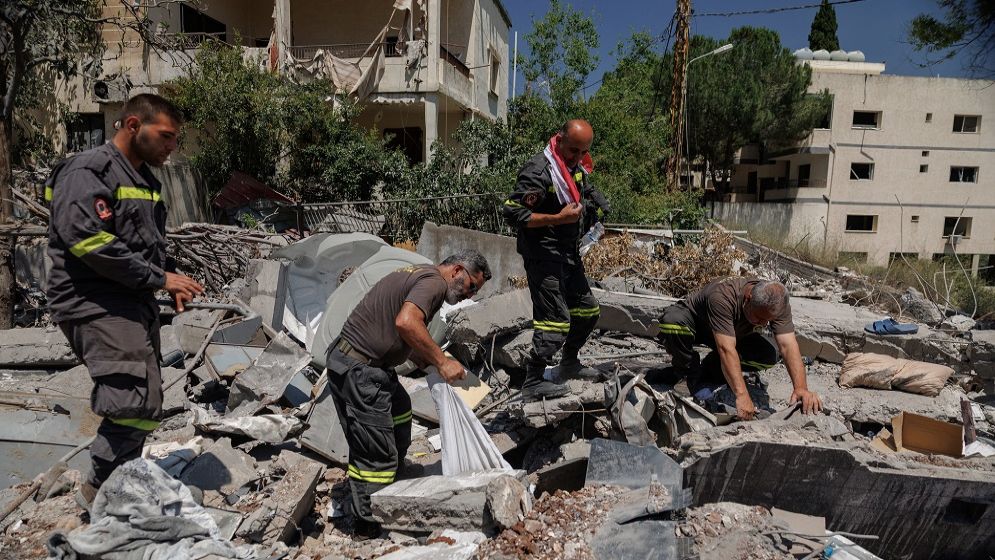
Members of the government-run Lebanese Civil Defense, the country's primary firefighting, first aid, and rescue force, search for belongings among the rubble while inspecting their headquarters destroyed in Israeli strikes in Nabatieh, Lebanon, 17 June 2026. Photo: Reuters
Israel published a map on Thursday showing an expanded
military control zone in southern Lebanon and said it would not rule out
carrying out attacks beyond it, challenging the terms of a US-Iran pact that
calls for Lebanon's sovereignty to be respected.
A senior Israeli official said Israel was holding
"stubborn negotiations" with US President Donald Trump's
administration over keeping its troops deployed 10 km (6.2 miles) into southern
Lebanon as it pursues the Iran-backed Hezbollah militia.
An interim pact signed on Wednesday to end the US-Israeli
war with Iran calls for an end to fighting on all fronts, including in Lebanon,
and for parties to ensure "the territorial integrity and sovereignty of
Lebanon."
Israel has rejected calls to withdraw troops from southern
Lebanon, which it invaded in March in response to rocket fire by Hezbollah.
Israeli attacks and the destruction of villages have killed thousands and set
off a displacement crisis.
Hezbollah has continued to launch attacks on Israeli
positions in the south this week, including with explosive drones that have
killed and injured troops.
The military, which in April published a map marking its
so-called buffer zone in southern Lebanon, released a new map that shows its
troops are operating several kilometres deeper into the country, including near
the Hezbollah stronghold of Nabatieh north of the Litani River.
Israeli troops have been operating in some of those areas
for several weeks, but the military had not yet published a map showing the
expanded zone of control, which it marked in dark red in the map published on
Thursday.
An Israeli military official said the military "will
continue to remove threats (to) soldiers and the civilians of the State of
Israel that are identified beyond the security zone," in effect saying it
could carry out attacks deeper into Lebanon.
In a televised speech on Wednesday, Hezbollah chief Naim
Qassem rejected the notion of Israeli security zones in Lebanese territory.
"No yellow zones, no red zones, and no green zones.
Israel must leave, and it will leave," he said.
Iran deal has exposed tensions between Netanyahu, Trump
Israeli Prime Minister Benjamin Netanyahu and Trump have
repeatedly clashed in recent weeks as the US president sought to extricate
himself from the war against Iran he jointly launched with his longtime Israeli
ally.
Israeli officials have voiced anger with the US-Iran pact,
which the two signed on Wednesday, saying it didn't go far enough to address
Israeli concerns over Iran's nuclear program and would tie down their military
operations in Lebanon.
In his first comments since the pact's signing, Netanyahu
said Israel appreciated its relationship with the US but that it needed to
maintain security for people living in northern Israeli towns that came under
Hezbollah rocket fire during the war.
"This requires maintaining the security strip in
southern Lebanon, it requires that we not leave there as long as Israel's
security needs require it," Netanyahu said.
Trump has made no secret of his frustration with Netanyahu
and has criticized Israel's military actions in Lebanon, saying it was
unnecessary to bomb entire apartment buildings to hunt Hezbollah militants.
But there has been no indication that Trump's commentary
will translate into concrete actions -- such as withholding military aid or
slowing arms shipments -- that could force Israel to rethink its military
tactics.
Israel, Lebanon holding negotiations in Washington
Israel describes the territory it has seized in Lebanon,
Gaza and Syria as "buffer zones" between it and its enemies, a core
facet of Israel's recent security policy.
Danny Citrinowicz, a retired Israeli military intelligence
officer and senior researcher at the Institute for National Security Studies
think tank in Tel Aviv, said the timing of the new Lebanon map published by the
military was significant.
By demarcating its zone of control, Israel is saying
"we're going to stay here, this is our place, we're not going to withdraw
from here," Citrinowicz said.
The map's release also comes ahead of a round of US-mediated
Israel-Lebanon talks, scheduled for next week in Washington.
Israeli officials, speaking anonymously, say Israel has held
out the possibility of withdrawing from the south if talks with Lebanon
progress. Israel is seeking Hezbollah's disarmament from those talks, while
Lebanon has sought Israel's withdrawal.
Jonathan Rynhold, a senior researcher at Israel's Bar-Ilan
University, said the US-Iran pact appeared to leave Israel some "wiggle
room" given Hezbollah, a non-state actor, holds sway and power in the
country.
"(It) implies that Hezbollah should not be able to hold
weapons because that is a threat to the sovereignty of the government of
Lebanon," Rynhold said.