


 For all latest news, follow the Daily Sun's Google News channel.


China moves to block entrance to disputed South China Sea shoal
Reuters, Hong Kong
Published: 15 Apr 2026, 08:05 PM
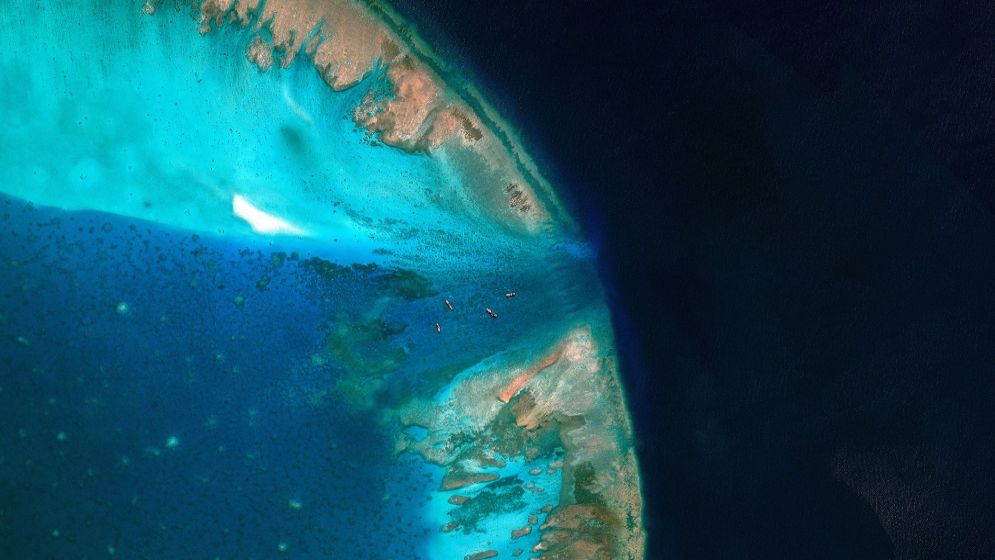
China is employing ships and a barrier to tighten control of
the entrance to the Scarborough Shoal in the South China Sea amid roiling
tension with the Philippines over the disputed feature, satellite imagery
obtained by Reuters shows.
Scarborough is one of Asia's most hotly disputed maritime
sites, where some diplomats and analysts fear long-running frictions and
confrontations could degenerate into armed conflict.
The presence of four fishing boats, a Chinese naval or coast
guard ship and a new floating barrier comes as the Philippines sends its own
coast guard and fisheries vessels to support its fishermen frequently driven
away by larger Chinese patrols.
Photographs taken on 10 and 11 April show the fishing boats
anchored along the entrance to the shoal, in addition to a floating barrier
stretching across it in the 11 April image.
Satellite image provider Vantor, formerly Maxar
Technologies, said a probable Chinese naval or coast guard patrol vessel can be
glimpsed just outside the entrance on 10 April.
China's defence ministry did not immediately respond to
Reuters' requests for comment on the deployment to the entrance to the shoal or
its timing.
Traditionally rich fishing ground
The traditionally rich fishing ground of the Scarborough
Shoal lies entirely within the Philippines' exclusive economic zone, but China
also claims it as part of its territory.
Last year, China approved establishment of a national nature
reserve there, alarming Philippine security officials, who called the move a
"clear pretext for occupation".
Jay Tarriela, a spokesperson for the Philippine coast guard,
told Reuters on Wednesday the Chinese government had installed a 352-m
(1,150-ft) floating barrier at the entrance on 10 and 11 April.
"Six Chinese maritime militia vessels were observed
within the shoal, while three others were spotted outside, seemingly
obstructing the entrance to BDM," he said.
He was referring to the shoal by its Philippine name of Bajo
de Masinloc, while China calls it Huangyan Island.
While the Philippines coast guard has cut barriers in the
past, Tarriela said the Chinese side appear to have removed the latest one
since the weekend, but the Philippine Navy says its patrols continue.
"According to our assessment in the past, they
consistently exhibit suspicion whenever they monitor a group of Filipino
fishing boats," Tarriela added.
Ten Chinese coast guard vessels were sighted at the shoal
from 5 to 12 April, Philippine Navy spokesperson Roy Trinidad said on Tuesday.
Sovereignty has never been established
Despite the competing claims, sovereignty has never been
established and the shoal is effectively under Beijing's control even if
Philippine boats still try to operate there.
In January, the militaries of the Philippines and the United
States sailed together at the shoal in the 11th such drill by the treaty
allies.
Military engagements between them have soared under
Philippine President Ferdinand Marcos Jr, who has pivoted closer to Washington
in response to China's growing presence in the busy waterway of the South China
Sea.
Thousands of troops from both countries are set to begin
large-scale exercises across the Philippine archipelago this month, including
in Zambales, whose coast is about 120 nautical miles from the Scarborough
Shoal.
Diplomats say the drills and broader tensions are being
closely watched amid fears that China could take advantage of perceptions that
the US is distracted by the Iran conflict and its effort to re-open the vital
Straits of Hormuz waterway.
China has kept a deployment of coast guard and fishing
trawlers at the shoal since seizing it in 2012 after a standoff with the
Philippines.
Manila has said Chinese maritime militia operate some
trawlers at the shoal and other disputed areas of the South China Sea, but
Beijing has never acknowledged this.
A landmark 2016 ruling on various South China Sea issues by
the Permanent Court of Arbitration backed Manila, but establishing sovereignty
over Scarborough Shoal was outside its scope.
The court said Beijing's blockade there violated
international law as it was a traditional fishing ground for several countries,
including China, the Philippines and Vietnam.