


 For all latest news, follow the Daily Sun's Google News channel.


In historic first, Trump attends Supreme Court arguments
Reuters, WASHINGTON
Published: 01 Apr 2026, 08:53 PM
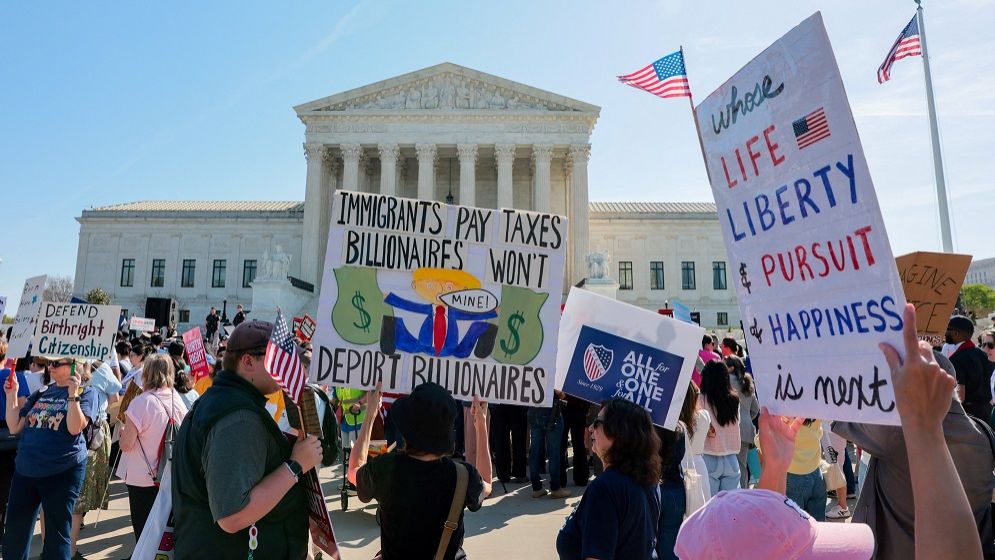
Demonstrators hold placards outside the US Supreme Court building as the court hears oral arguments on the legality of the Trump administration's effort to limit birthright citizenship for the children of immigrants, in Washington, DC, US, 1 April 2026. Photo: REUTERS
President Donald Trump made a historic visit to the US
Supreme Court on Wednesday to attend arguments over the legality of a policy he
considers crucial to his hardline approach toward immigration – a directive he
signed on his first day back in office that would limit birthright citizenship.
Trump was driven by motorcade from the White House and
arrived before the arguments, wearing a red tie and dark suit. He was seated in
the first row of the public section of seating in the ornate courtroom. Trump
and other attendees rose to their feet as the court marshal made the customary
announcement beginning with "Oyez! Oyez! Oyez!" – meaning "Hear
ye!" – to mark the beginning of the court session.
Chief Justice John Roberts did not acknowledge Trump's
presence before announcing the beginning of arguments in the case known as
Trump v. Barbara.
Outside the neoclassical courthouse on Capitol Hill,
demonstrators gathered ahead of the arguments, some holding anti-Trump signs
including ones reading "Trump must go now."
Above Trump in the courtroom were friezes featuring symbols
and personages of law and order, from the biblical figure Moses bearing the Ten
Commandments to the Chinese philosopher Confucius through former Chief Justice
John Marshall whose opinion in a landmark decision established the Supreme Court's
power of judicial review.
Trump faced forward toward the bench where the nine justices
were seated as applicants to the Supreme Court bar were identified by name,
raised their right hand and swore an oath stating that "as an attorney and
as a counselor of this Court, I will conduct myself uprightly and according to
law, and that I will support the Constitution of the United States."
There appeared to be more security personnel than usual in
the courtroom.
The Supreme Court has backed Trump in a series of rulings
issued on an emergency basis since he returned to the presidency last year.
Those decisions came on matters including immigration, mass federal layoffs,
cutting foreign aid, dismantling the Education Department, banning transgender
people from the military and other areas.
But the court on 20 February ruled against Trump in a major
case testing the legality of the sweeping global tariffs he imposed last year
under a law meant for use in national emergencies. Since the tariffs ruling,
Trump has lashed out repeatedly at the Supreme Court and the six justices who
ruled against him in that case.
Trump is the first sitting president to attend an oral
argument at the Supreme Court, according to Clare Cushman, the resident
historian at the Supreme Court Historical Society. There are examples of 19th
century presidents arguing cases before the court – though not while in office –
including John Quincy Adams, Grover Cleveland and Benjamin Harrison. William
Howard Taft, who served as president from 1909 to 1913, later became the chief
justice on the Supreme Court.
Trump's motorcade drove from the White House along
Constitution Avenue and then Independence Avenue, passing the Washington
Monument and the National Mall, with crowds watching from the sidewalk.
The Supreme Court's 6-3 conservative majority includes three
justices appointed by Trump during his first term in office – Neil Gorsuch in
2017, Brett Kavanaugh in 2018 and Amy Coney Barrett in 2020.
Barrett's appointment gave the court its current conservative
super-majority and ushered in an epoch in which the court has moved American
law dramatically to the right including rulings rolling back abortion rights,
rejecting race-conscious collegiate admissions policies, limiting the power of
U.S. regulatory agencies and more.
Trump and senior officials in his administration often have
denounced judges who have issued rulings against his policies, sometimes in
highly personal terms.
‘They sicken me'
Three of the court's six conservative justices – Chief
Justice John Roberts as well as Gorsuch and Barrett - joined with the court's
three liberal members in ruling that Trump had overstepped his authority in
imposing tariffs.
Trump was incensed at Gorsuch and Barrett in particular,
calling them on the day of that ruling "an embarrassment to their
families." And last week, Trump kept up his condemnation of his two
appointees, saying that "they sicken me because they're bad for our
country."
Trump after the tariffs ruling said he was
"ashamed" of the three conservative justices who ruled against him,
calling them "fools and lapdogs for the RINOs and the radical-left
Democrats." RINO, meaning "Republican in name only," is a term
sometimes used by conservative Republicans to insult fellow Republicans viewed
as disloyal to the party.
Trump after the ruling also claimed that the court "has
been swayed by foreign interests," but declined to provide any evidence.
A lower court blocked Trump's executive order directing US
agencies not to recognize the citizenship of children born in the United States
if neither parent is an American citizen or legal permanent resident, also
called a "green card" holder.
Trump's administration has said that granting citizenship to
virtually anyone born on US soil has created incentives for illegal immigration
and led to "birth tourism," by which foreigners travel to the United
States to give birth and secure citizenship for their children.
Trump wrote on social media last year: "Birthright
Citizenship was not meant for people taking vacations to become permanent
Citizens of the United States of America, and bringing their families with
them, all the time laughing at the 'SUCKERS' that we are!"
Trump added: "But the drug cartels love it! We are, for
the sake of being politically correct, a STUPID Country but, in actuality, this
is the exact opposite of being politically correct, and it is yet another point
that leads to the dysfunction of America."