


 For all latest news, follow the Daily Sun's Google News channel.


Moscow moves to cement Myanmar’s post-election regime with military might
Daily Sun Report
Published: 04 Feb 2026, 07:15 PM
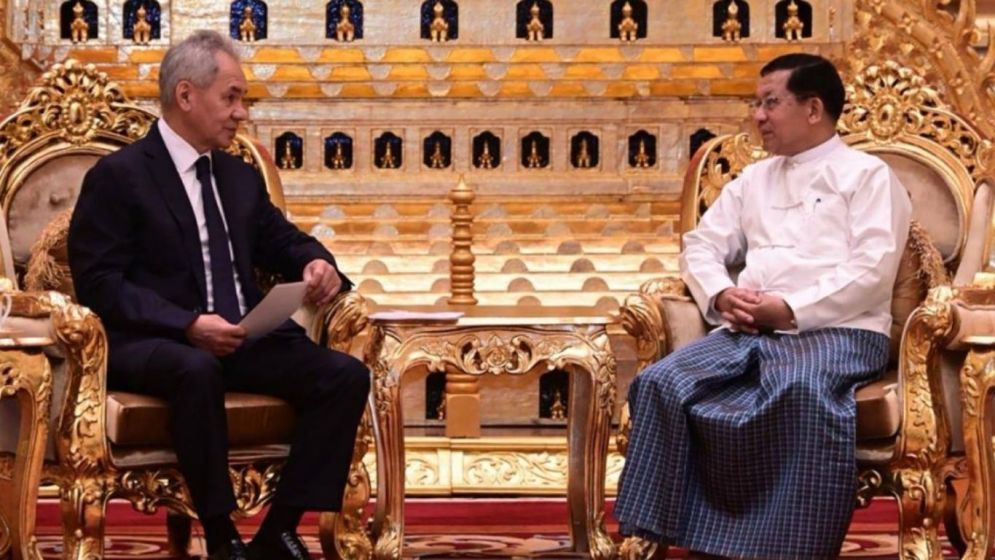
Russian Security Council Secretary Sergei Shoigu met with coup leader and acting president Min Aung Hlaing on Tuesday.
Fresh from high-level talks in Beijing, Russia’s top security official landed in Naypyitaw on Monday to cement military ties with Myanmar ahead of its post-election transition, reports The Irrawaddy.
Russian
Security Council Secretary Sergei Shoigu met with coup leader and acting
president Min Aung Hlaing on Tuesday, signing a five-year security pact with
the junta—Moscow’s key ally in Southeast Asia.
Shoigu
conveyed congratulations from President Vladimir Putin on the recent poll,
claiming the “the elections are recognized as having taken place in accordance
with international law.”
In
reality, the process was condemned as a sham by the UN, ASEAN, most Western
governments, and Myanmar pro-democracy groups.
The
election wrapped up on 25 January, with the military-backed United Solidarity
and Development Party declaring victory in a vote marked by low turnout, the
exclusion of vast swathes of territory, and junta airstrikes that killed at
least 170 civilians, the UN said.
The
Russian Security Council said talks with junta officials would cover national
and regional security, military cooperation, trade and economic ties, and
“coordination of approaches on the international stage.” Cooperation between
intelligence, justice, and law enforcement agencies would also be on the
agenda, it added.
Moscow’s
endorsement of the poll provides the post-election regime with crucial
diplomatic cover amid international doubt over its legitimacy. Beijing, the
junta’s other key ally, has followed suit.
Shoigu
is no stranger to Myanmar, having visited the country several times while
serving as Russian defense minister from 2012 to 2024, establishing strong ties
with Min Aung Hlaing.
He
met the putschist army chief less than two weeks before the 2021 coup, when Min
Aung Hlaing described Russia as “a loyal friend.”
On
his latest visit, Shoigu highlighted ongoing international pressure on both
Russia and Myanmar in talks with National Security Advisor Tin Aung San,
pledging Moscow’s support to help protect “Myanmar’s sovereignty.”
On
Monday, the two sides signed a five-year Military Cooperation Agreement during
talks between junta Deputy Defense Minister Maj Gen Aung Myo Thant and his
Russian counterpart, Vasilii Osmakov.
While
details of the pact were not released, the context suggests an emphasis on
industrial integration, procurement of additional Russian military hardware,
technology transfers, and maintenance of jet fighters, helicopters, and armored
vehicles for the Myanmar military.
The
junta’s alignment with Russia includes vocal support for its invasion of
Ukraine, putting Myanmar at odds with much of the international community,
which has condemned the attack and imposed sanctions on Moscow. In 2023,
Ukraine and Myanmar analysts reported evidence that 120mm mortar rounds
produced in Myanmar were being used by Russian forces in Ukraine.
Russia
is a key supplier of military hardware to Myanmar, including fighter jets,
helicopters, and air defense systems. Shoigu’s visit is seen as a bid to cement
these defense contracts amid Myanmar’s domestic political transition.
However,
Myanmar is more than just a customer for Russian arms; it serves as a strategic
anchor in Southeast Asia, providing Moscow with a diplomatic ally and a friendly
port.
The
high-level Russian visit appears aimed at solidifying Moscow’s influence in the
region before Myanmar’s new government assumes power. Analysts said that by
consolidating bilateral ties now, Russia aims to gain a greater foothold in
Southeast Asia, with Myanmar serving as its primary gateway.
In
Beijing, ahead of his trip to Myanmar, Shoigu met with Chinese Foreign Minister
Wang Yi to reaffirm Russia’s support for Beijing’s claim over Taiwan.
China
has forged closer ties with Russia despite international condemnation of its
attack on Ukraine, declaring their strategic partnership has “no limits”.
Shoigu
said Russia remained vigilant over Japan’s “accelerated militarization,” citing
record defense spending under Prime Minister Takaichi and her remarks that a
Chinese attack on Taiwan could prompt Tokyo to respond militarily. Her words
prompted an angry response from Beijing, further heightening regional tensions.
Russia
is also “closely monitoring the policy of accelerated militarization being
pursued in Japan,” Shoigu told Wang.
Back
in Naypyitaw, facing mounting condemnation over its military-staged election
and ongoing violence, the regime appears to be consolidating support from its
two key allies as the generals prepare to swap their uniforms for parliamentary
suits.