


 For all latest news, follow the Daily Sun's Google News channel.


Syrian army continues advance against Kurdish-held towns
Reuters, Syria
Published: 18 Jan 2026, 04:34 AM
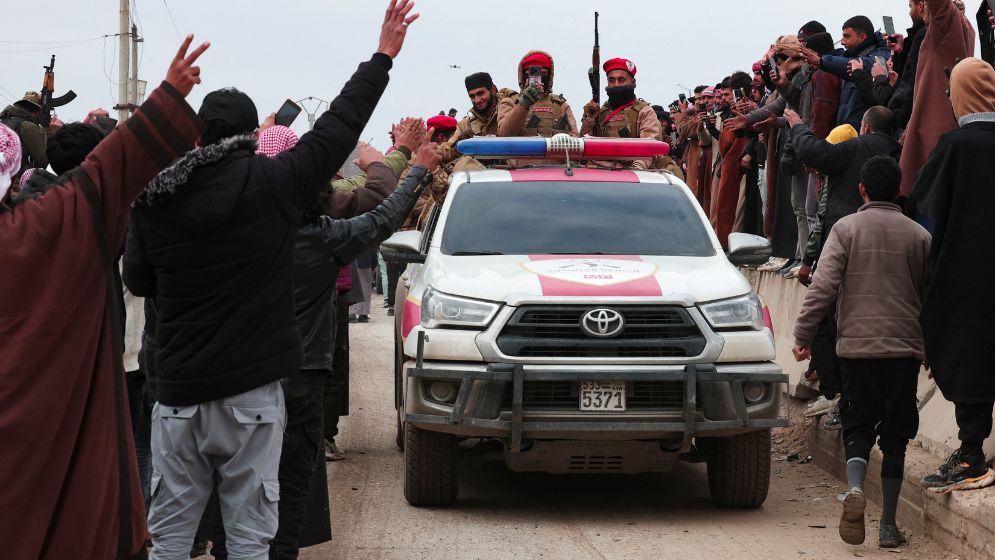
People welcome Syrian army following the withdrawal of the Kurdish-led Syrian Democratic Forces (SDF) in Maskanah, Syria, 17 January 2026. Photo: REUTERS
The Syrian army continued its push into Kurdish-held
territory on Saturday, despite US calls to halt its advance in towns in the
area in Syria's north.
State media said the army took over the major Freedom dam
(formerly known as the Baath) west of the Syrian city of Raqaa, as well as the
military airport in the city of Tabqa.
Syrian Kurdish authorities had not acknowledged their loss
of control over those strategic points, and it was unclear if fighting was
still ongoing.
For days, Syrian troops had amassed around a cluster of
villages that lie just west of the winding Euphrates and had called on the
Kurdish-led Syrian Democratic Forces stationed there to redeploy their forces
on the opposite bank of the river. They have been clashing over strategic posts
and oilfields along the Euphrates River.
SDF fighters withdrew from the area early on Saturday as a
gesture of goodwill - but then accused Syrian troops of violating the agreement
by continuing to push further east into towns and oilfields not included in the
deal.
Brad Cooper, who heads the US military's Central Command,
said in a written statement posted on X that Syrian troops should "cease
any offensive actions in areas" between the city of Aleppo and the town of
Tabqa, approximately 160 kilometres (100 miles) further east.
Arab residents rejoice at troops' arrival
The initial withdrawal deal included the main town of Deir
Hafer and some surrounding villages whose residents are predominantly Arab. The
SDF withdrew on Saturday and Syrian troops moved in relatively smoothly, with
residents celebrating their arrival.
"It happened with the least amount of losses. There's
been enough blood in this country, Syria. We have sacrificed and lost enough -
people are tired of it," Hussein al-Khalaf, a resident of Deir Hafer, told
Reuters.
The Syrian Petroleum Company said that the nearby oilfields
of Rasafa and Sufyan had been captured by Syrian troops and could now be
brought back online.
SDF forces had withdrawn east, some on foot, towards the
flashpoint town of Tabqa - downstream but still on the western side of the
river and near a hydroelectric dam, a crucial source of power.
But when Syria's army announced it aimed to capture Tabqa
next, the SDF said that was not part of the original deal and that it would
fight to keep the town, as well as another oilfield in its vicinity.
Syria's army said four of its troops had been killed in
attacks by Kurdish militants, and the SDF said some of its own fighters had
been killed, but did not give a number.
US-led coalition planes flew over the flashpoint towns,
releasing warning flares, according to a Syrian security source.
The US has had to recalibrate its Syria policy to balance
years of backing for the SDF - which fought against the Islamic State - against
Washington's new support for Syrian President Ahmed al-Sharaa, whose rebel
forces ousted dictator Bashar al-Assad in late 2024.
Main oilfields are still under Kurdish control
To try to end the fighting, US envoy Tom Barrack traveled to
Erbil in northern Iraq on Saturday to meet with both Abdi and Iraqi Kurdish
leader Masoud Barzani, according to two Kurdish sources. There was no immediate
comment from Barrack's spokesperson.
The latest violence has deepened the faultline between the
government led by Sharaa, who has vowed to reunify the fractured country after
14 years of war, and local Kurdish authorities wary of his Islamist-led
administration.
The two sides engaged in months of talks last year to
integrate Kurdish-run military and civilian bodies into Syrian state
institutions by the end of 2025, repeatedly saying that they wanted to resolve
disputes diplomatically.
But after the deadline passed with little progress, clashes
broke out earlier this month in the northern city of Aleppo and ended with a
withdrawal of Kurdish fighters.
Syrian troops then amassed around towns in the north and
east to pressure Kurdish authorities into making concessions in the deadlocked
talks with Damascus.
Kurdish authorities still hold Arab-majority areas in the
country's east that are home to some of Syria's largest oil and gas fields.
Arab tribal leaders in SDF-held territory have told Reuters they are ready to
take up arms against the Kurdish force if Syria's army issues orders to do so.
Kurdish fears have been deepened by bouts of sectarian
violence last year, when nearly 1,500 Alawites were killed by
government-aligned forces in western Syria and hundreds of Druze were killed in
southern Syria, some in execution-style killings.