


 For all latest news, follow the Daily Sun's Google News channel.


No quick wins in tapping Venezuela's oil reserves
Political instability could hinder foreign investment into Venezuela's oil sector
Reuters
Published: 04 Jan 2026, 12:38 PM
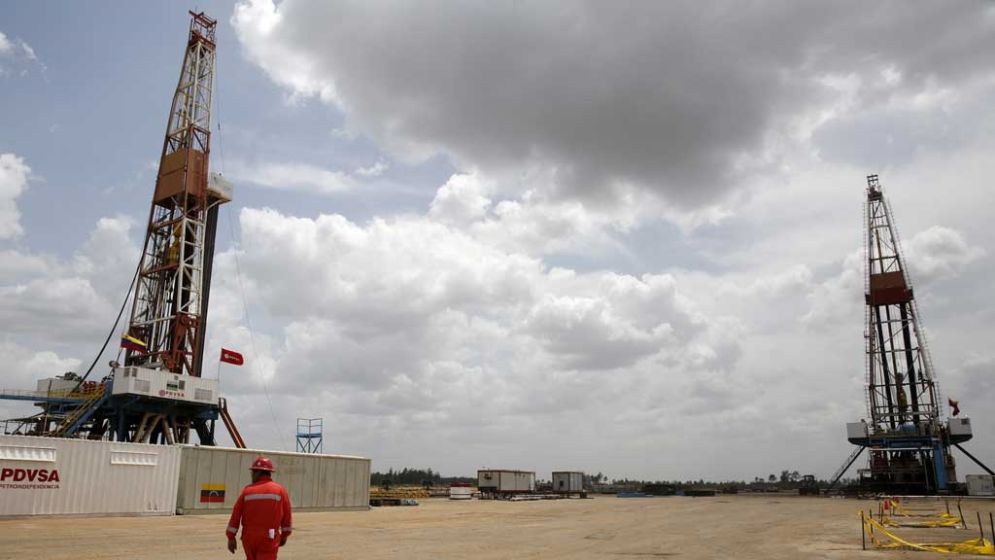
An oilfield worker walks next to drilling rigs at an oil well operated by Venezuela's state oil company PDVSA, in the oil rich Orinoco belt, near Morichal at the state of Monagas Apr 16, 2015. REUTERS
Venezuela is unlikely to see any meaningful boost to crude output for years even if US oil majors do invest the billions of dollars in the country that President Donald Trump promised just hours following Nicolás Maduro's capture by US forces.
The South American country may have the world's largest estimated oil reserves, but output has plummeted over the past decades amid mismanagement and a lack of investment from foreign firms after Venezuela nationalised oil operations in the 2000s that included the assets of Exxon Mobil and ConocoPhillips.
Any companies that might want to invest there would need to deal with security concerns, dilapidated infrastructure, questions about the legality of the US operation to snatch Maduro and the potential for long-term political instability, analysts told Reuters.
American firms won't return until they know for sure they will be paid and will have at least a minimal amount of security, said Mark Christian, director of business development at CHRIS Well Consulting. He also said the companies would not go back until sanctions against the country are removed.
Venezuela would also have to reform its laws to allow for larger investment by foreign oil companies.
Venezuela nationalized the industry in the 1970s, and in the 2000s ordered a forced migration to joint ventures controlled by its state oil company, PDVSA. Most companies negotiated exits and migrated, including Chevron, while a handful of others did not reach deals and filed for arbitration.
THERE IS A LOT THAT COULD GO WRONG
"I f Trump et al can produce a peaceful transition with little resistance, then in five to seven years there is a significant oil-production ramp up as infrastructure is repaired and investments get sorted out," Thomas O'Donnell, an energy and geopolitical strategist, told Reuters, adding that heavy crude produced in the country works well with US Gulf Coast refineries and can also be blended with lighter oil produced from fracking.
But that would depend on everything going right, and there's a lot that could go wrong.
"A botched political transition that has a feeling of US dominance can lead to years of resistance," O'Donnell said, noting armed groups of citizens and guerrilla groups that operate in the country.
Chevron would be positioned to benefit the most from any potential oil opening in Venezuela, said Francisco Monaldi, director of the Latin America Energy Program at Rice University's Baker Institute in Houston. Other US oil companies would be paying close attention to political stability and would wait to see how the operational environment and contract framework unfolded, he added.
Venezuela - a founding member of OPEC with Iran, Iraq, Kuwait and Saudi Arabia - produced as much as 3.5 million barrels per day in the 1970s, which at the time represented over 7% of global oil output. Production fell below 2 million bpd during the 2010s and averaged around 1.1 million bpd last year, or just 1% of global production.
CHEVRON IS THE ONLY US OIL MAJOR OPERATING IN VENEZUELA
Chevron is the only American major currently operating in Venezuela. Conoco has been seeking billions for the takeover of three oil projects nearly two decades ago, while Exxon was also involved in lengthy arbitration cases against Venezuela after it exited the country nearly two decades ago.
"The company that probably will be very interested in going back is Conoco, because they are owed more than $10 billion, and it's unlikely that they will get paid without going back into the country," Monaldi said. Exxon could also return, but is not owed as much money, he added.
"ConocoPhillips is monitoring developments in Venezuela and their potential implications for global energy supply and stability. It would be premature to speculate on any future business activities or investments," a company spokesperson said in emailed comments to Reuters.
Chevron, which exports around 150,000 bpd of crude from Venezuela to the US Gulf Coast, has had to carefully maneuver with the Trump administration in an effort to maintain its presence in the country over the past year. CEO Mike Wirth said in December that he had spoken with the Trump administration about what he said was the importance of maintaining an American presence in the country through multiple political cycles.
The oil firm has been in Venezuela for over 100 years and said on Saturday that it is focused on the safety and well-being of its employees, in addition to the integrity of its assets. "We continue to operate in full compliance with all relevant laws and regulations,” a Chevron spokesperson said in an emailed response to questions.
Exxon did not immediately respond to questions from Reuters.
OPEC and allies will meet on Sunday and are expected to maintain current oil output policy. The group has been increasing production since last year, stoking concerns of a global supply glut, but has agreed to pause oil output hikes for January, February and March.
Ed Hirs, an energy fellow at University of Houston, said recent events in Venezuela would have little impact on US prices for oil and gasoline for now, with much of the country's production going to Cuba and China at the moment. He also said that history is full of recent examples of American excursions that didn't produce notable results for US companies.
"Trump now joins the history of US presidents who have overthrown regimes of oil-rich countries. Bush with Iraq. Obama with Libya. In those cases, the United States has received zero benefit from the oil. I’m afraid that history will repeat itself in Venezuela," Hirs said.
Oil tankers chartered by Chevron had been among the few to set sail from Venezuela over the past month, following Trump's December announcement of a " blockade " of sanctioned tankers entering and leaving the country. The country had exported around 921,000 bpd in November, with much of that going to China.
That's perhaps where one quick win could emerge, if Trump is able to restart the flow of Venezuelan crude into the US Gulf, potentially boosting refiners like Valero VLO in the process. At the moment, it appears that just the opposite is happening.
HOW THE OPERATION WAS CARRIED OUT
More than 150 American aircraft were deployed to disable Venezuelan air defences before helicopters delivered troops to Maduro’s compound.
The raid began at 2 a.m. local time and lasted two hours and twenty minutes. Maduro and his wife were then flown to New York City to face federal drug charges under a new indictment.
WHO CLAIMS POWER IN VENEZUELA NOW
After the attack, Vice-President Delcy Rodríguez was sworn in as interim president at a private ceremony in Caracas.
“There is only one president in this country, and his name is Nicolás Maduro Moros,” she said in a national address, quoted by The New York Times.
Opposition leader María Corina Machado called for Edmundo González to be recognised as president and said the opposition was prepared “to enforce our mandate and take power.”
President Trump said his secretary of state Marco Rubio had spoken with Rodríguez and that “she’s essentially willing to do what we think is necessary to make Venezuela great again.” He said Machado did not have enough support to lead the country.
WHY THE UNITED STATES SAYS IT INTERVENED
A federal court in New York has charged Maduro, his wife and four others with offences including narco-terrorism and cocaine conspiracy, similar to an earlier 2020 indictment.
At his news conference, President Trump said the United States would “run the country” until a “safe, proper and judicious transition” is put in place. He also spoke about opening Venezuela’s state-controlled oil sector to US companies.
“We are going to run the country right. It’s going to make a lot of money,” he said.
REACTION INSIDE VENEZUELA
State-run television showed anti-US protests in several cities, including Caracas, where Maduro supporters called the raid illegal and described his transfer as kidnapping.
The Times also reported that the capture was supported by a CIA source inside the Venezuelan government who had tracked Maduro’s movements.
Before the strike, the US military had built up troops, ships and aircraft in the Caribbean and carried out operations against vessels and tankers linked to Venezuela, disrupting the country’s oil revenues.
There were no clear signs of a US military occupation on Saturday afternoon, and Maduro-aligned officials continued to appear in government roles.
Both Rodríguez and the opposition are now pressing competing claims to power, while the United States says it will oversee a transition process.