



 For all latest news, follow the Daily Sun's Google News channel.


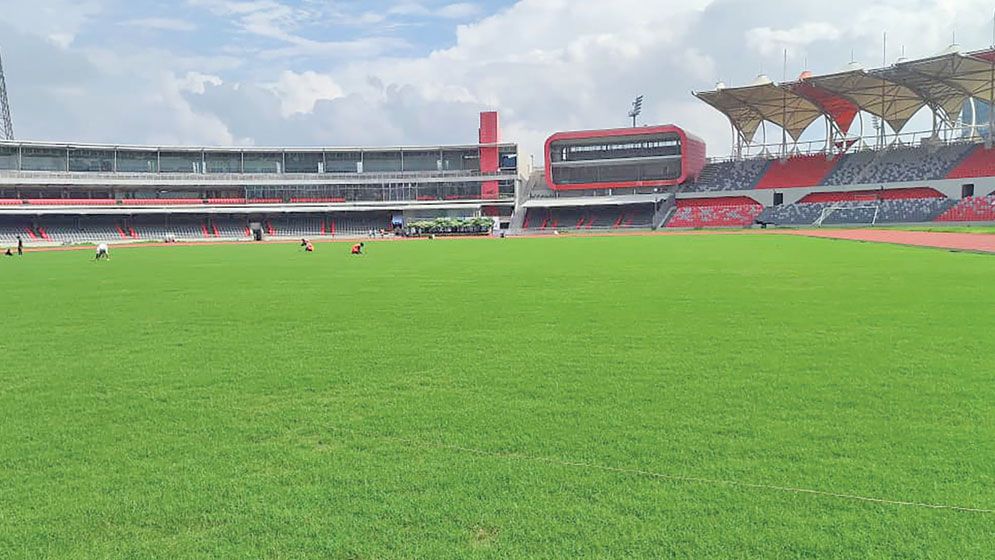
Following a long four and a half year wait, the National Stadium’s galleries got its old life back. But after only eight months and renovation costing in the region of hundreds of crores of Taka, the venue is now gasping for breath. Despite the mega project of Tk158 crore, the neglect shown towards the life of the stadium – the lush green field – was a source of pure frustration. However, the clouds of dejection are slowly dissipating.
Swatting aside previous concerns of mud and waterlogging for good, the field has taken a completely new look – one that is modern and scientific. The project, carried out under the supervision of the Bangladesh Football Federation at a cost of Tk62 lakhs in order to meet FIFA standards, is nearing completion. The new grass has already been growing for a month and 28 days. Engineer Shakhawat Hossain, head of operations at Metaphor Sports - the firm overseeing the work - has provided the promising update that the fully prepared pitch is expected to be handed over to the federation by 20 August.
The most relieving news is that there is absolutely no soil in this new field, the grass is being cultivated with great care entirely on sand. Previously, the use of soil on the top layer meant the field would turn into a quagmire on rainy days, causing immense hardship for the players. However, he said that the use of sand this time around will prevent that from happening. At the same time, there is permanent relief from the nuisance of earthworms or weeds in the soil. Previously, the field required frequent rolling due to earthworms, but that will no longer be necessary.
Unlike soil-based fields, sand-based ones do not harbour weed seeds. However, to prevent the spread of seeds carried by the wind, he has issued instructions to cut down the grass once every week or 10 days, thereby minimising the chance of new weed growth to virtually zero.
The biggest drawback of the previous pitch was its ineffective drainage system. While water cleared from the centre in seven and a half minutes, it took an hour and 17 minutes to drain from the sidelines. Yet, FIFA’s strict regulations state that the pitch must be playable within half an hour of heavy rainfall. To provide a permanent solution, the 13 old, dilapidated pipes have been replaced with 42 new, state-of-the-art perforated pipes wrapped in geotextile filters along the sidelines. As a result, water will flow directly into the main drain without carrying sand or silt.
There is a lack of international-standard venues in the capital. Apart from the National Stadium in Gulistan, another venue of international quality is the Bashundhara Kings Arena. However, the BFF plans to host the entire forthcoming SAFF Championship in November at the National Stadium. Furthermore, the federation is considering holding a four-nation tournament at the same venue during the upcoming FIFA window.
It is clear that the new turf will face significant pressure. Additionally, if the field remains operational, different sporting events could be hosted there throughout the year. Keeping this in mind, the “Bermuda” grass was planted. Elucidating the reason behind choosing Bermuda grass - despite the prevalence of “Zoysia” grass in the Asian region - Engineer Sakhawat noted: “In Singapore, some fields are surfaced entirely with Zoysia grass, but very few games are held there. We went for Bermuda grass because the fields in our country face a lot of pressure due to a shortage of grounds. Also, it has a very fast recovery time.”