



 For all latest news, follow the Daily Sun's Google News channel.


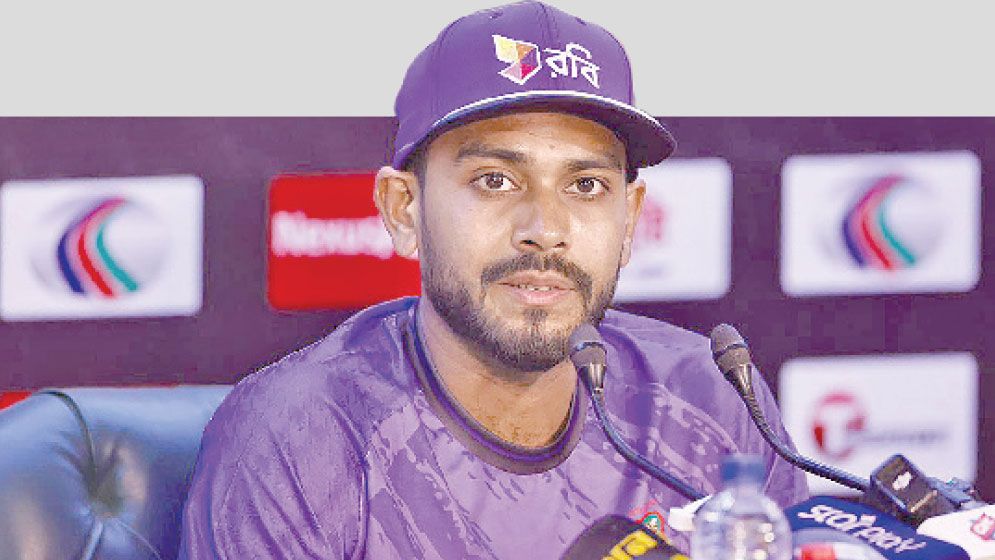
Bangladesh One Day International captain Mehidy Hasan Miraz can count himself fortunate.
Amid the frenzy of the ongoing FIFA World Cup, where one day star Brazilian forward Neymar announced his retirement and the next saw one of the greatest athletes of all time, Cristiano Ronaldo, possibly make his final appearance on football's biggest stage, Miraz's latest captaincy blowups in Zimbabwe may not dominate sporting discussions back home.
Yet Bangladesh's defeat in the opening ODI of the three-match series at Harare Sports Club on Monday has once again put the spotlight on his leadership.
Bangladesh failed to chase a modest target of 142 on a lively, bouncy surface despite reducing Zimbabwe to 70-8 earlier in the day.
The Tigers arrived in Zimbabwe on the back of four consecutive ODI series victories at home under Miraz, but the conditions also exposed the vulnerability of Bangladesh's leadership group in away matches.
It was Miraz's 11th ODI as captain away from home, and his 10th defeat.
His only victory came against Sri Lanka in Colombo in July last year when Tanvir Islam produced extraordinary figures of 5-39.
On Monday, however, Bangladesh's disappointing batting was only part of the story.
Speedsters Taskin Ahmed and Nahid Rana made full use of the fresh Harare surface and the new white Kookaburra ball, reducing Zimbabwe to a precarious 70-8 with hostile fast bowling.
At that stage, Miraz switched to spin from both ends bringing Rishad Hossain and himself, allowing tailenders Richard Ngarava and Newman Nyamhuri to frustrate Bangladesh with a resilient 63-run partnership for the ninth wicket — Zimbabwe's highest ninth-wicket stand against the Tigers.
Nahid eventually returned to dismiss Ngarava for 27 before Miraz removed Nyamhuri for a team-best 33 as Zimbabwe were bowled out for 141 in 36.4 overs.
It ultimately proved enough.
Miraz himself admitted afterwards that Bangladesh could have managed that phase better. "We can improve in a few areas. Their 63-run partnership for the ninth wicket was crucial. Those were important runs," he said during the post-match presentation.
A former Bangladesh captain, speaking on condition of anonymity, believed Miraz's prolonged use of spin was a tactical error.
"Miraz could have killed the game with his fast bowlers," he told Daily Sun. "They were still fresh. He could have continued with them and bowled Zimbabwe out for under 100. When you're on top, you have to maintain that intensity." Zimbabwe captain Ngarava, leading his country in ODIs for the first time, appeared to learn that lesson quickly. He used all four of his seamers aggressively as Bangladesh were bowled out for 116 in 33.1 overs, handing Zimbabwe a 25-run victory and a 1-0 series lead.
For Miraz, questions over tactical decisions are not new. There has been a recurring pattern during his tenure in which bowling options who have performed well have not been trusted consistently in subsequent matches.
Shamim Hossain Patwary was arguably the first example.
The left-hander played a key role in Bangladesh's only away ODI victory under Miraz, returning remarkable figures of 1-22 after bowling nine consecutive overs in Colombo last year. Yet in the following ODI at Pallekele, Shamim bowled only four overs.
He was then left out of the first two ODIs against Afghanistan.
When he returned for the third match of that series, he bowled just two overs and subsequently left out from the ODI side.
Rishad experienced something similar.
The leg-spinner claimed career-best figures of 6-35 against the West Indies in October last year, finishing the series with 12 wickets as Bangladesh secured a 2-1 series victory.
However, Rishad has not completed his full quota in an ODI since that series before eventually being dropped for the New Zealand and Australia matches.
Saif Hassan, who regularly bowls off-spin in domestic cricket, was trusted by Miraz to bowl the Super Over against the Windies.
Since then, however, he has delivered only three overs across the next eight ODIs he played. Mosaddek Hossain Saikat may be the latest example. The all-rounder marked his return by scoring a match-winning fifty and claiming 2-37 from his full allocation of 10 overs. In the following match, he bowled only two overs, followed by six in the next game of the series. He was not given a single over in Harare despite Bangladesh searching for breakthroughs after Zimbabwe's lower-order fought back. Whether these decisions are merely tactical calls based on match situations or part of a broader captaincy approach is open for debate. What is becoming increasingly difficult to ignore, however, is the pattern.
Bangladesh have repeatedly unearthed bowling options capable of influencing games, only for those resources to be underutilised soon afterwards.