



 For all latest news, follow the Daily Sun's Google News channel.


Look down. That is where the truth lives.
Not in the pre-tournament pressers, not in the tactical dissertations delivered in air-conditioned media centres, not in the carefully translated sound bites about "respecting every opponent." 
Look at the manager's feet as he walks out to the dugout at this World Cup, and you will understand his football long before a ball has been kicked. There is a type of coach who has spawned in this World Cup out of nowhere. This kind of particular tactician wear dark casual clothes and almost invariably, on his feet, white sneakers are there.
Clean, neutral, inoffensive.
Designed to match everything precisely because they commit to nothing. Think of Gareth Southgate's years of beige and navy, so perfectly coordinated with his football that it became a national joke.
Think of the technically immaculate European coaches who arrive at World Cups with laminated tactical sheets and interchangeable aesthetics — slim-cut, muted, assembled.
These men dress as though they have run their wardrobe through the same efficiency model they apply to their defensive shape.
Nothing rebellious. Nothing that does not serve the structure.
This is not a coincidence of fashion. This is a style statement that offers a peek into the coaches’ psyche.
The World Cup, of all tournaments, should resist this tendency.
It is the one competition where culture is supposed to announce itself — where the friction between different footballing civilisations produces something that a domestic league season, with its grinding repetition, cannot manufacture.
The Africans play differently from the South Americans, who play differently from the Europeans, who play differently from the Asians.
Or at least, they used to.
Increasingly, they arrive wearing the same ideas in the same dark clothes with the same white sneakers, having absorbed the same coaching certifications, watched the same analytical videos, attended the same UEFA symposiums. The World Cup, once an explosion of footballing pluralism, is becoming a very large, very expensive domestic league.
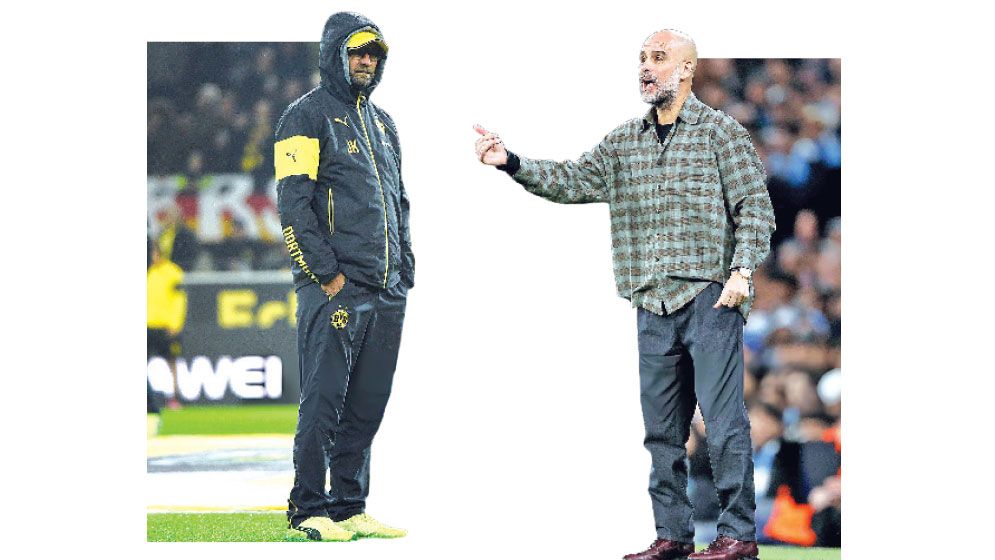
Then there is Jurgen Klopp, whose shadow stretches over this tournament even in his retirement from club management.
For a decade, Klopp stood on touchlines in baseball caps and gilets, the general impression of a man who had come to watch and instead ended up in charge.
His celebrations were violent and unplanned.
He dressed like a fan, and his football played like one — expansive, emotional, built on the fury of the press and the joy of the transition, a system that was in fact an anti-system, one that embraced chaos rather than suppressing it.
The managers who have absorbed his influence without taking into heart his spirit arrive at this World Cup in their white sneakers, running high presses that have been sanded down to the point where the original passion that animated them has been replaced by a careful mechanical replica.
Pep Guardiola is the tournament's other ghost.
In his early years at Barcelona, he appeared in waistcoats — slim, considered, almost dandyish, the wardrobe of a man who understood that elegance could be a form of conviction. His football reflected this as it used to be intricate, specific, tailored to the players in front of him.
His Barca played differently from his Bayern Munich, which played differently from his Manchester City.
He built cathedrals, not templates. The coaches who have arrived at this World Cup wearing his ideas but not his sensibility have built templates. They have mistaken the furniture for the architecture.
What Klopp and Guardiola shared, beneath the surface difference of their aesthetics, was a point  of view. Klopp's was emotional, human, gloriously messy.
Guardiola's was cerebral, exacting, quietly vain in the best sense.
Neither was neutral. Neither could be mistaken for the other on a touchline even from a great distance, and neither could their football.
The white sneaker managers here in North America are interchangeable at 50 metres. Pull one from his dugout and seat another in his place, and the shape on the pitch would barely flicker.
Lionel Scaloni is the tournament's most compelling counter-argument, and his wardrobe is accordingly unclassifiable — he has the look of a man still surprised to find himself here, which is perhaps exactly right.
Argentina under Scaloni play football that does not quite fit any category the analysts have prepared.
They slow matches down and then detonate them.
They score from what commentators call "nothing," which really means they score from places the defensive algorithm was not covering because no spreadsheet told it to cover there. Scaloni listens to his players when they say they are uncomfortable. He changes. He dresses to match his players, not his ego.
This is what the World Cup is supposed to feel like. A barbecue, not a board meeting.
The game has always lived in the gap between what was planned and what actually happened.
That gap is where football's soul resides. Martin Scorsese, discussing his method, once said that he gives his actors time to find the character — that the plot will take care of itself, but the soul of a performance cannot be scripted in advance.
The greatest moments in cinema, like the greatest moments in football, were not in the original plan.
They arrived because someone was trusted enough to go off it. The white sneaker managers are closing the gap, one clean, neutral, inoffensive outfit at a time. They have come to the most gloriously unpredictable tournament in world sport and brought with them the tools of predictability.
Look at the feet. Look at the pitch.
At this World Cup, they are telling the same story.
The question is whether anyone will be brave enough to tell a different one.