


 For all latest news, follow the Daily Sun's Google News channel.


Why Riders are reliving 2025’s ghosts
Daily Sun Report, Sylhet
Published: 14 Jan 2026, 12:00 AM
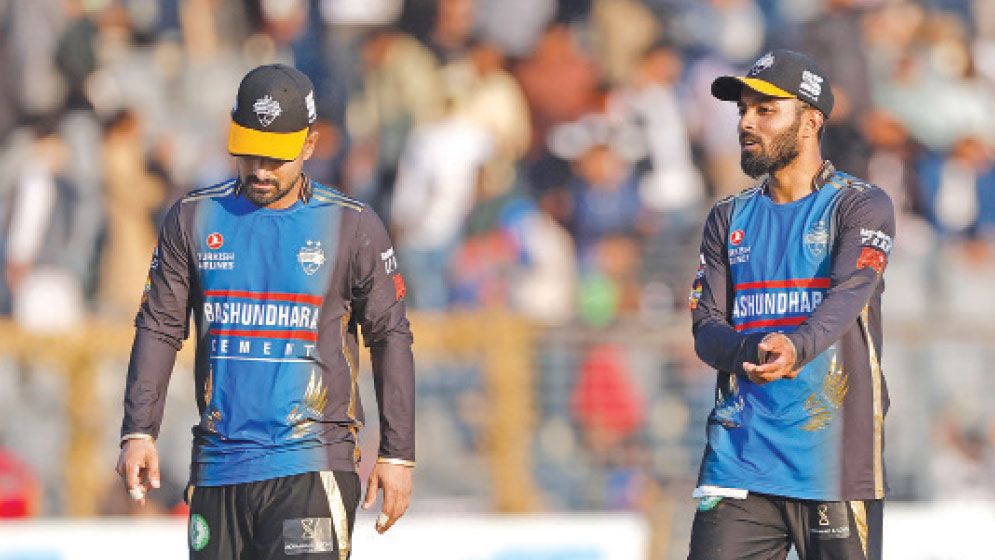
PHOTO : TANVIN TAMIM
As the Sylhet International Cricket Stadium (SICS) falls silent and the Bashundhara Cement Bangladesh Premier League (BPL) 2026 caravan prepares for the move to Dhaka, the Rangpur Riders find themselves in the grip of a troubling narrative.
In the early weeks of the tournament, the Riders looked like a well-oiled machine, bulldozing their way to four wins in five games. But as the Sylhet phase concludes, the engine has suddenly stalled.
Three consecutive defeats—culminating in a humiliating 114-run collapse against Sylhet Titans on Monday—suggest that Rangpur isn’t just losing form; they are losing their tactical identity. For the Riders’ faithful, this might feel like a dark case of déjà vu.
In 2025, Rangpur famously won eight straight games before “falling off a cliff,” losing five on the trot to exit the tournament.
Coach Mickey Arthur’s preseason mandate was simple: “Avoid the late-season collapse.” Yet, here they are, stumbling into the Dhaka phase with the exact same symptoms.
The Curious Case of Dawid Malan on the Bench
The most debated analytical point of this slump is the sidelining of Dawid Malan.
Statistically, Malan’s 2026 campaign has been a paradox: 203 runs at a solid average of 40.6, but a strike rate of just 105.72. On the flat, high-scoring decks of Sylhet, benching him for “intent” seemed logical to many.
However, the analysis of the last three matches reveals a massive flaw in that logic. Without Malan to anchor one end, Rangpur’s “intent-heavy” top order has become brittle. In his absence, the Riders have lacked a “stabilizer” to navigate the tricky middle-over transitions. By trying to fix a strike-rate problem, the management inadvertently broke the team’s reliability.
The Middle-Over Paralysis
The tactical “smoking gun” was the match against Rajshahi Warriors. Rangpur didn’t suffer a traditional batting crumble; instead, they “stagnated” in plain sight.
Towhid Hridoy’s unbeaten 97 was a masterclass in clean hitting, yet it was marred by a tactical vacuum. Between his explosive start and final-over fireworks, the team endured a staggering 30-ball boundary drought in the middle overs.
On the true-batting surface of Sylhet, those five overs of “safe” cricket were the difference between a par score of 178 and a match-winning total of 200-plus.
Captain Nurul Hasan Sohan’s post-match admission was telling: the inability to rotate strike or find the fence in the middle overs left them roughly 25 runs short. This wasn’t an inevitable collapse; it was a failure of “Plan B”—the inability to manipulate the field and manufacture runs when opposition bowlers like Moeen Ali and Nasum Ahmed hit their lengths.
The Road Forward: Balance or Panic?
Mickey Arthur has doubled down, promising a “full-strength” XI for their Dhaka phase starting Friday the 16th. The return of Faheem Ashraf and the resumption of Kyle Mayers’ bowling duties are intended to bring “total balance.”
But balance is more than just personnel; it’s a mental shift. As the tournament moves to Mirpur, Rangpur must decide if they are going to chase the “ghost” of high-intent T20 or return to the “cricket smarts” that won them matches.
If Litton Das and the middle order cannot find a way to score between the boundaries, the “Dhaka Drift” might just turn into a 2025-style freefall.