


 For all latest news, follow the Daily Sun's Google News channel.


Construction dust, vehicle emissions pollute Dhaka's affluent neighbourhoods
Agargaon, Gulshan, Banani, Baridhara and Dhanmondi among city's most polluted areas
Daily Sun Report, Dhaka
Published: 08 Nov 2026, 10:14 AM
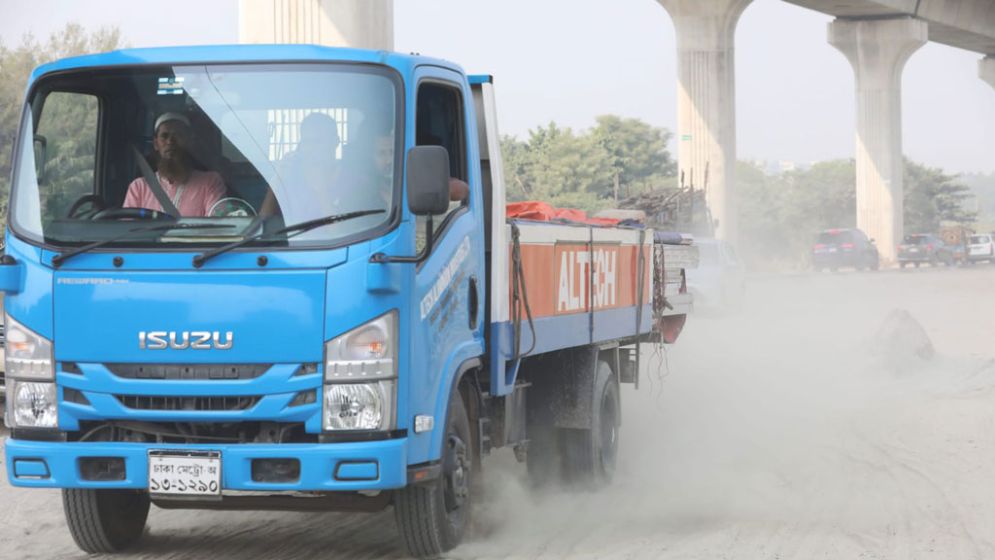
Photo : Collected
Despite a recent drop in temperatures following last week's heatwave, Dhaka's air quality remains unhealthy, with construction dust, vehicle emissions and other pollutants continuing to pose serious health risks.
The capital ranked third among the world's most polluted cities on Saturday evening, according to Switzerland-based air quality monitoring organisation IQAir. Kuwait City and Kolkata occupied the first and second positions, respectively.
Dhaka recorded an Air Quality Index (AQI) score of 164 at the time, placing its air quality in the 'unhealthy' category.
The pollution is not limited to densely populated or industrial areas. Several upscale neighbourhoods, including Gulshan, Banani, Baridhara and Dhanmondi, along with Pragati Sarani, have recently appeared among the capital's 10 most polluted monitoring locations.
Experts warn that continued deterioration in air quality could eventually undermine the appeal of these otherwise sought-after residential and commercial neighbourhoods.
According to the AQI classification, scores of 0–50 indicate 'good' air quality, 51–100 'moderate', 101–150 'unhealthy for sensitive groups', 151–200 'unhealthy', 201–300 'very unhealthy' and above 300 'hazardous'.
IQAir data showed that the area near the Bangladesh Institute of Development Studies (BIDS) in Agargaon recorded the highest pollution level among Dhaka's monitoring locations, with an AQI score of 186 on Saturday evening.
Baridhara Park Road ranked second with a score of 168. Pragati Sarani in Badda and Becharam Deuri each recorded 167, while Baridhara Lakeside and Dhanmondi scored 161 each.
Gulshan Lake Park recorded an AQI of 160, Eastern Housing in Banani 156 and the Grace International School area in Gulshan-2 scored 151. All these locations fell into the 'unhealthy' category.
Experts attribute pollution in Gulshan, Banani and Dhanmondi to both local activities and emissions from surrounding neighbourhoods.
Smoke from cooking with traditional clay stoves and burning waste in Karail slum may contribute to pollution in Gulshan and Banani, while emissions from Kamrangirchar could affect air quality in Dhanmondi. Similarly, dust generated by excavation and construction work along Pragati Sarani may worsen pollution in Baridhara.
Prof Dr Ahmad Kamruzzaman Majumder, dean of the Faculty of Science and head of the Department of Environmental Science at Stamford University Bangladesh, told Bonik Barta that several geographical and environmental factors contribute to prolonged air pollution in upscale neighbourhoods near lakes.
He explained that high humidity and water vapour above water bodies can affect the movement of particulate matter, including PM2.5 and PM10. These particles may combine with water vapour, become heavier and remain suspended closer to the ground.
He also pointed to temperature inversion during winter, when cooler air near lakes remains close to the ground while warmer air above acts like a lid, trapping vehicle emissions and dust near the surface.
Dr Mohammad Enayet Hossain, associate professor of the Department of Soil, Water and Environment at Dhaka University, said the concentration of high-rise buildings in Gulshan and Banani plays a significant role in trapping pollutants.
He said that closely spaced high-rise buildings obstruct natural airflow, creating what scientists call the 'urban canyon effect'.
When humidity is high and smoke from nearby vehicles and informal settlements enters the area, the buildings prevent polluted air from dispersing. As a result, harmful particles accumulate near ground level, significantly increasing local pollution, he explained.
Concerned stakeholders warn that these affluent neighbourhoods could lose their residential appeal if the pollution problem remains unaddressed. They stressed that the government must take effective measures to improve Dhaka's environmental quality.
Barrister Omar Sadat, president of the Gulshan Society, blamed emissions from private vehicles for much of the air pollution in Gulshan and Banani.
"We can stop almost everything, but we cannot stop the air. As people of Bangladesh, we are accepting this pollution, but it is reducing our life expectancy," he said.
He said taking action against vehicles without valid fitness certificates could help reduce pollution, adding that corruption at the Bangladesh Road Transport Authority (BRTA) must also be addressed to enforce regulations effectively.
He pointed out that a large number of unfit vehicles emitting black smoke continue to operate on Dhaka's roads, making vehicle emissions a priority area for pollution control.
Apart from vehicle emissions, ongoing construction activities are also contributing to deteriorating air quality in these neighbourhoods, stakeholders said.
They noted that construction sites often fail to adopt adequate dust-control measures, allowing particulate matter to spread into surrounding areas. Although regulations require construction operators to take protective measures to prevent dust pollution, enforcement remains weak.
Source: Bonik Barta