


 For all latest news, follow the Daily Sun's Google News channel.


DU Public Administration Department holds two-day international conference
Daily Sun Report, DU
Published: 04 Oct 2026, 07:58 PM
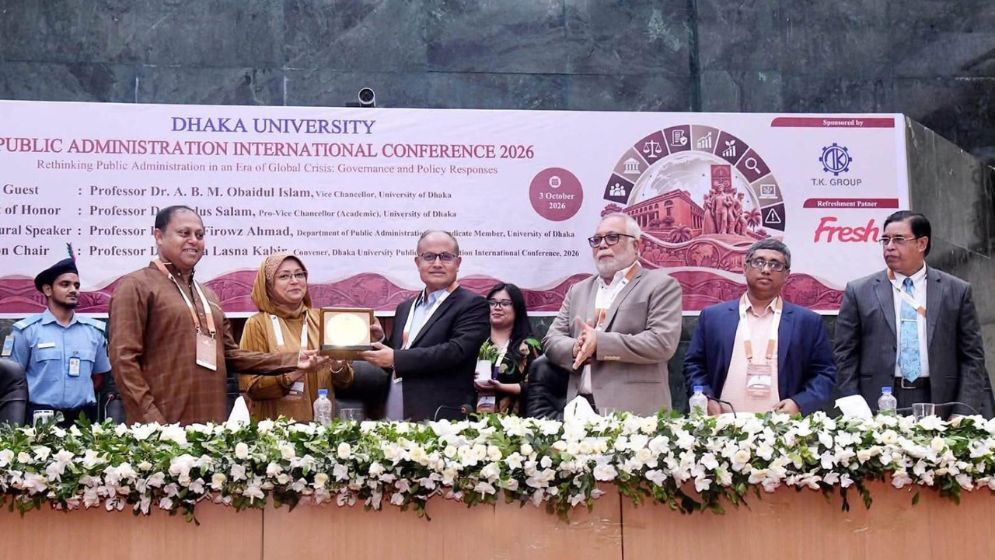
Photo: Daily Sun
The Department of Public Administration at Dhaka University (DU) has concluded a two-day international conference focusing on the role of public administration in addressing global crises and responding to changing governance, policy and technological challenges.
The closing session of the ‘International Conference on Public Administration-2026’ was held at the Nabab Nawab Ali Chowdhury Senate Bhaban auditorium on Sunday.
The conference featured the theme ‘Rethinking
Public Administration in an Era of Global Crisis: Governance and Policy
Responses’.
A total of 180 research papers were submitted by researchers
from 12 countries. Following a review process, the organisers selected 76
papers for presentation across 15 academic sessions. Teachers and researchers
from 14 universities in Bangladesh and 15 universities abroad, along with
representatives of professional organisations and research institutions, took
part in the conference.
Prof Syeda Lasna Kabir, chairperson of the Department of Public Administration and convener of the conference, presided over the closing session.
Former DU vice-chancellor Prof Niaz Ahmed Khan attended the programme
as the chief guest, while Zeng Xiangyu, associate professor at Sichuan
University, China, attended as the guest of honour.
Rector of the Bangladesh Public Administration Training Centre (BPATC) Sayeed Mahbub Khan, Secretary of the South Asian Network for Public Administration (SANPA) Mohammad Mizanur Rahman and DU Public Administration Department Prof Musleh Uddin Ahmed attended the programme as special guests.
Emeritus Prof Ahmed Shafiqul Haque of McMaster University, Canada, delivered
the closing speech.
Researchers, teachers and students from DU’s Department of Public Administration, as well as academics and researchers from home and abroad, participated in different sessions throughout the conference.
The
sessions examined global crisis management, governance, policy formulation,
administrative reform, technological change and the role of public
administration in a changing global environment.
Speaking as the chief guest, Prof Niaz Ahmed Khan said
public administration was a discipline that had ample reasons to be celebrated.
He called for more research into contemporary challenges facing Bangladesh,
particularly cyber-related issues.
‘The department should move forward in a way that produces
skilled researchers on the one hand and qualified civil servants on the other,’
he said. ‘It is highly commendable that the department has shown the courage to
organise such an international conference by bringing together academics and
researchers while keeping political considerations aside,’ he added.
Guest of honour Dr Zeng Xiangyu highlighted the importance
of different dimensions of governance and building a shared future for
effective public administration. He stressed greater cooperation and knowledge
exchange among countries by sharing administrative experiences and practices.
Special guest Sayeed Mahbub Khan said the BPATC was
committed to developing effective and practical training programmes in
coordination with relevant institutions to strengthen public-sector management
and ethical leadership.
‘Through these initiatives, we are focusing on developing
skilled, responsible and ethical human resources,’ he said.
SANPA Secretary Mohammad Mizanur Rahman said South Asian
countries faced different experiences and challenges in public administration.
He pointed to China’s development over the past several decades and said
research into its own public administration system and the implementation of
research findings had played an important role in that progress.
‘We need more discussion and research to identify Bangladesh’s
problems and find effective solutions to them,’ he said.
Prof Musleh Uddin Ahmed said fundamental changes were taking place in technology, management and administration, requiring greater transparency and accountability in public institutions.
‘Necessary changes should be made at both national and local
levels in the use of digital technology,’ he said, adding that administrative
structures also needed to evolve alongside technological changes to remain
aligned with public expectations and changing realities.
In his closing speech, Emeritus Prof Ahmed Shafiqul Haque
said researchers had not only identified various problems in public
administration but had also proposed possible solutions.
‘Now is the time to move towards implementing these research
findings and proposals,’ he said.
He added that financial resources alone were not sufficient for effective implementation, stressing the need for skilled and adequate manpower.
He also underscored the importance of rebuilding public trust and
strengthening global cooperation for the sustainable recovery of public
institutions.
In her concluding remarks, Prof Syeda Lasna Kabir said
institutions in the modern world needed to be not only efficient but also
capable of adapting to changing circumstances.
‘They need to be innovative as well as responsible.
Alongside addressing crises, they must learn from crises and use those lessons
to transform and improve themselves,’ she said.
‘To rethink public administration, we need to build
institutions and knowledge bases that can learn, adapt, innovate and give the
highest priority to public interest in line with the changing world,’ she
added.
Prof Syeda Lasna Kabir also announced plans to publish a
book containing selected research papers presented at the conference.