


 For all latest news, follow the Daily Sun's Google News channel.


How Prophet Muhammad (PBUH) helped his wives with household chores
Daily Sun Report, Dhaka
Published: 10 Oct 2026, 10:23 AM
Representational Image
Islam should be evaluated based on the principles laid down in the Holy Quran and the Sunnah, rather than the behaviour of Muslims today, according to a discussion on women's rights and responsibilities in marriage.
The discussion argues that Islam does not place greater emphasis on a wife's responsibilities than on a husband's. Rather, Prophet Muhammad (Sallallahu Alaihi Wasallam) repeatedly emphasised women's rights and instructed men to treat their wives with kindness and fairness.
Several hadiths highlight the Prophet's teachings on the issue. “The best among you is the one who is best to his wife,” the Prophet said, according to a hadith reported by Tirmidhi.
In another hadith reported by Muslim, he advised men not to harbour hatred towards believing women merely because of a disliked characteristic, noting that they might appreciate another quality in them.
The Prophet also advised his followers to accept his counsel regarding women and treat them fairly, according to a hadith reported by Tirmidhi.
These teachings reflect the emphasis Islam places on women's rights and men's responsibilities towards their wives. A significant portion of the Prophet's final sermon, delivered during the Farewell Hajj, also addressed men's obligations towards their wives.
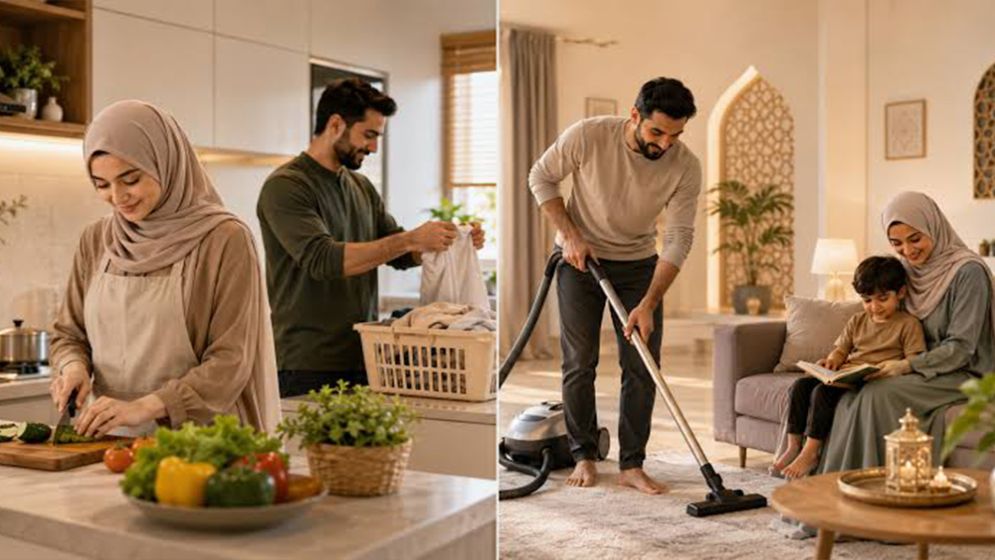
Despite his numerous responsibilities, Prophet Muhammad (Sallallahu Alaihi Wasallam) personally performed various household chores. Accounts of his life describe him mending his sandals, sewing his clothes, milking goats and attending to his own tasks.
According to the discussion, there is no established example in the Sunnah of the Prophet instructing any of his wives to perform such household tasks.
His wives, however, voluntarily carried out domestic work without specific instructions from him.
Hazrat Aisha (may Allah be pleased with her) reported that the Prophet used to mend his sandals, sew his clothes and perform household chores as other people did. The narration is cited in Ibn Hibban's collection of hadiths (Hadith 6440).
Another narration attributed to Aisha, cited in Shamail al-Tirmidhi (Hadith 343), describes the Prophet as a person who attended to his own needs, removed lice from his clothes, milked goats and performed his own tasks.
These accounts underscore the importance of kindness, mutual respect and shared responsibility in family life, as reflected in the reported teachings and practices of Prophet Muhammad (Sallallahu Alaihi Wasallam).