


 For all latest news, follow the Daily Sun's Google News channel.


Using Artificial Intelligence to grasp the essence of the Qur’an
Mufti Mahmud Hasan
Published: 27 Jul 2025, 03:17 PM
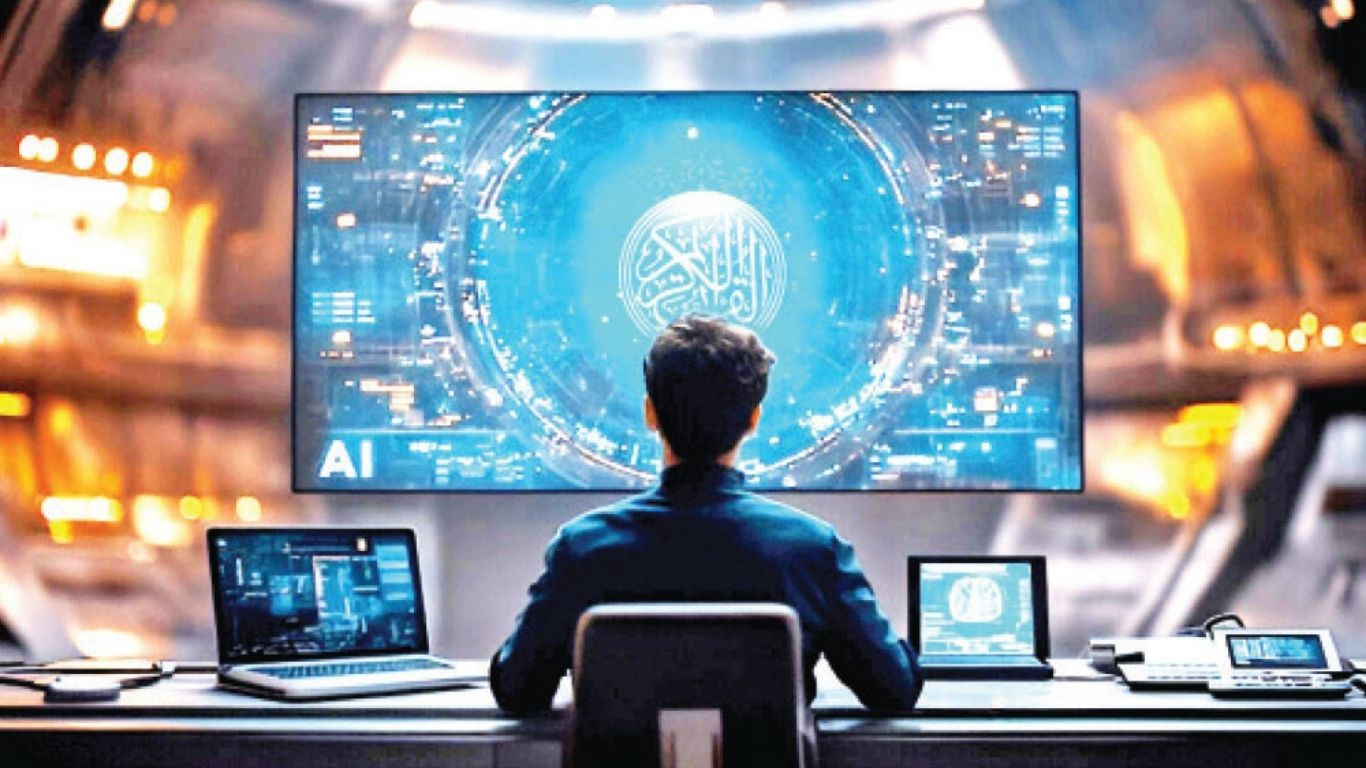
The Holy Qur’an is the divine speech of Allah, revealed to the final Prophet Muhammad (peace be upon him) through revelation for the guidance of mankind and jinn until the Day of Judgment. The true essence of the Qur’an is only what was understood by the Prophet (peace be upon him) and his noble companions (may Allah be pleased with them). Interpreting the Qur’an demands great caution and deep knowledge. It is not something anyone can undertake by simply reading a translation and applying personal reasoning.
Nowadays, Artificial Intelligence (AI) has become a buzzword, and it is often presented to the public in a way that suggests it has surpassed even human intelligence. Alarmingly, a deliberate effort is underway to undermine Islamic knowledge systems using AI. Under the guise of producing a “modern” interpretation of the Qur’an, there are attempts to promote AI-generated commentary. Regrettably, some Muslims—perhaps unknowingly—are becoming complicit in this flawed initiative.
These individuals are using AI tools to interpret the Qur’an. However, they lack a clear understanding of the intricacies and limitations of modern science and technology. This may be why they are unintentionally encouraging this erroneous direction.
They are, in effect, employing AI for Qur’anic exegesis. It is crucial to understand a few key questions in this context:
· What does the use of AI in Qur’anic knowledge entail?
· What is the actual capacity of AI in this regard?
· Can AI truly comprehend the message of the Qur’an, and would such interpretations be acceptable to Muslims?
Let us, therefore, explore these questions to better understand current realities, technological boundaries, and our responsibility to safeguard the sanctity of the Qur’an.
The practical use of AI in Qur’anic knowledge
A question may arise: hasn’t the computer already brought numerous benefits to Qur’anic scholarship? Indeed, computers have made Qur’anic printing easier, allowed quick searches for verses or topics, and enabled instant access through mobile apps. Various recitations can now be heard through software. Applications even display verses in real time as they are recited. AI can instantly generate explanations and opinions on Qur’anic matters, and even offer summaries.
Some are now proposing that AI can be used to translate the Qur’an into every language and help uncover meanings previously unknown. But should AI really be used to interpret the Qur’an?
The answer lies in understanding AI’s fundamental function: it generates text based on prediction, not genuine understanding or creativity. Large Language Models (LLMs), like those used in AI, predict what the next word might be based on existing data patterns. They do not possess true insight or comprehension.
When AI generates translations or commentaries of the Qur’an, it is essentially forming guesses about what might come next in a sentence. To an average reader, it may seem as though the machine is offering deep insights—but this is an illusion.
Yes, if data from established Tafsir texts is fed into a computer and it is programmed to retrieve and display referenced material upon request, this would be a valid use of technology in Islamic scholarship. However, if AI begins to generate interpretations or translations independently—based merely on its language model—such output is not acceptable.
The inherent limitations of AI
Professor Yann LeCun, a pioneering figure in AI and currently Chief AI Scientist at Meta, once remarked that despite their perceived intelligence, AI models haven’t even reached the level of a cat’s intelligence. AI is a pattern-recognising machine with no true consciousness or judgement. It simply rearranges learned information from its training data.
Knowledge is not confined to mere language or literacy. For instance, all English literary works—novels, poetry, research—have been written using a finite dictionary. But could anyone dismiss Oscar Wilde’s writing by claiming it’s just rearranged dictionary words? Of course not. Such a statement would be absurd.
To suggest the Qur’an is merely a collection of Arabic dictionary words is far more dangerous and erroneous. The Qur’an is the divine speech of Allah. It is not merely an arrangement of letters and words, but a sacred revelation sent as guidance for humanity and jinn.
Consider modern legal systems. The constitutions of the US, UK or Canada are written in English. Yet no one would claim that they are meaningless because they use dictionary words. Likewise, even if an AI generates flawless legal judgments in perfect language, those rulings have no legal weight, because AI holds no moral or legal authority.
The same principle applies to the Qur’an, Hadith, Fiqh and other Islamic sciences. Their authenticity and authority rest on faith, revelation, trustworthiness, scholarly consensus, and a tradition passed down with integrity—not just on linguistic formulation.
Final thoughts
The beneficial use of science and technology within the framework of Shariah has always been permitted—and at times encouraged—by Islamic scholars. However, unrestricted use that harms the faith is unacceptable. Limited and appropriate application of AI is permissible, but believing in its authority for religious interpretation is wrong.
Anyone claiming AI can offer accurate exegesis of Qur’anic verses or determine Shariah rulings is gravely mistaken. AI is a tool—it does not possess the insight, faith, or spiritual refinement of the companions and righteous scholars of the early generations.
Therefore, the transmission of Islamic knowledge must continue in the authentic manner passed down from the best generations, through certified chains of transmission and responsible scholarship. Our duty is to confine AI to its appropriate domain and not to assign it roles beyond its legitimate function.