


 For all latest news, follow the Daily Sun's Google News channel.


BRAC University confers honorary fellowship on Australian philosopher Peter Singer
Daily Sun Report, Dhaka
Published: 29 Oct 2026, 08:59 PM
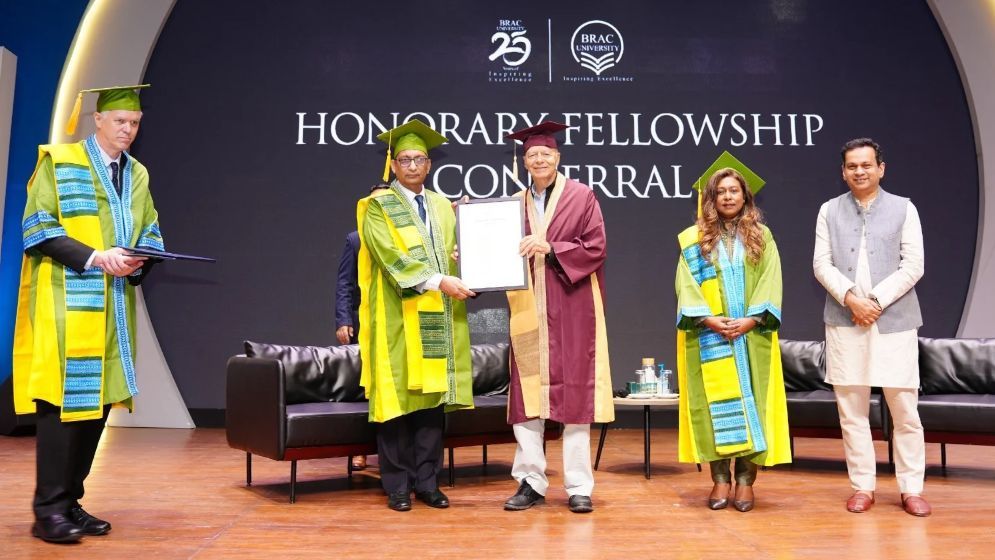
Photo: Courtesy
BRAC University on Thursday conferred its inaugural honorary fellowship on Prof Peter Singer, the philosopher whose work on effective altruism, bioethics and animal rights has shaped global debate on ethics and responsibility towards others.
Tamara Hasan Abed, chairperson of the Board of Trustees, and Vice-Chancellor Prof Syed Ferhat Anwar presented the fellowship on the university’s Merul Badda campus in Dhaka, according to a press release.
The honorary fellowship is the highest honour the university can offer and was conferred in memory of Sir Fazle Hasan Abed, founder of BRAC and BRAC University.
The citation, read out by Prof Anwar, recognised Prof Singer’s contributions to moral philosophy, international development and social impact, including his 1972 essay, his 1975 book Animal Liberation, his role as founder and chair of the board of The Life You Can Save, and more than 50 books.
It noted that his work “resonates with the vision” of Sir Fazle Hasan Abed, and that the Fellowship reflects the university’s commitment to academic excellence and societal impact.
“Your work asks a simple question: when we have the means to help, what should we do? That question has particular meaning for BRAC University,” said Tamara.
She added that the university wants its students to ask what they will do with the opportunities their education gives them and who might benefit from the choices they make.
Welcoming him in the year of his 80th birthday, she said, “We are so honoured to welcome you to Bangladesh for the very first time, and to BRAC University as one of our own.”
Accepting the fellowship, Prof Singer said it was particularly meaningful that it came from a university founded on the ideals of Sir Fazle Hasan Abed and one that is a community of scholars “searching for truth, searching for knowledge, allowing free inquiry and free expression”.
Prior to the fellowship conferment, Prof Singer and BRAC Executive Director Asif Saleh sat for a fireside chat.
Saleh recalled that in November 1971, Prof Singer was a young philosopher at Oxford, watching news of the crackdown in Bengal and the millions of refugees crossing into India.
The essay he wrote in response, “Famine, Affluence and Morality”, was published in 1972 and began five decades of work on what people in wealthy countries owe those living in poverty, he said.
Prof Singer, who is visiting Bangladesh for the first time, said he had seen “a vigorous country, which is bustling with activity” and called its progress “an inspiring success story”.
During his visit, he saw firsthand BRAC’s ultra-poor graduation programme.
Explaining effective altruism, Prof Singer said the movement hopes people will make doing good for others one of their important aims, and that the “effective” part is essential.
He pointed to the ultra-poor graduation programme as an illustration, tested in pilot studies, evaluated and scaled once the evidence supported it, including in several other countries.
On the topic of profit for good, Prof Singer said capitalism can be reformed, and that he has recently helped form Profit for Good, an initiative to encourage business owners to put part of their profits towards good purposes.
“We are encouraging companies to commit to donating at least 10% of their profits to those good causes. And we’re encouraging consumers to look out for those companies,” he said.
Prof Singer explained that Profit for Good was founded together with the School of Moral Ambition, a Dutch organisation established by the historian Rutger Bregman, which now also has an office in New York City.
The school runs courses for entrepreneurs who wish to change the direction of their ambition.
“It would be good if their ambitions were not only directed to their self-interest, but also in a more ethical direction,” he said.
Having retired from Princeton two years ago, he said he now wants to use his time less for writing and to “play a more active role” on the priorities that will have the biggest impact.
Prof Singer, who hosts a podcast called Lives Well Lived, cited recent guests who had each donated a kidney to a stranger as an example of altruism.
“These people said, well, I also know that I can do fine on one kidney, the risk of having only one kidney is very small, so I’d like to help one of these strangers,” he said.
Asked by Saleh about the impact of artificial intelligence on countries such as Bangladesh, Prof Singer described a real dilemma.
On the benefit side, he said that through AI “people all over the world, all they need is an internet connection, and they can get high-level advice on healthcare”.
At the same time, he said AI will cause significant dislocation in employment, and that preventing wealth from simply moving from workers to technology companies in affluent countries is something “we need to do our very best to guard against”.
One possible step, he suggested, is requiring companies whose technology leads to unemployment to contribute to a universal basic income.
But because employment also gives people activity and purpose, he said, societies should continue to value work that machines do not do.
Referring to what he saw at Aarong, he noted that handprinting and hand embroidery of clothing still provide employment.
“There is something distinctive and special about handprinting, about hand embroidery, of clothing,” he said. Machines, he said, can be used for what they do well “without detracting from the value we have in our lives”.
Australian High Commissioner to Bangladesh Susan Ryle was present as a guest at the ceremony.