


 For all latest news, follow the Daily Sun's Google News channel.


DUCSU presents report on hundreds of works completed throughout the year
Daily Sun Report, DU
Published: 17 Sep 2026, 08:31 PM
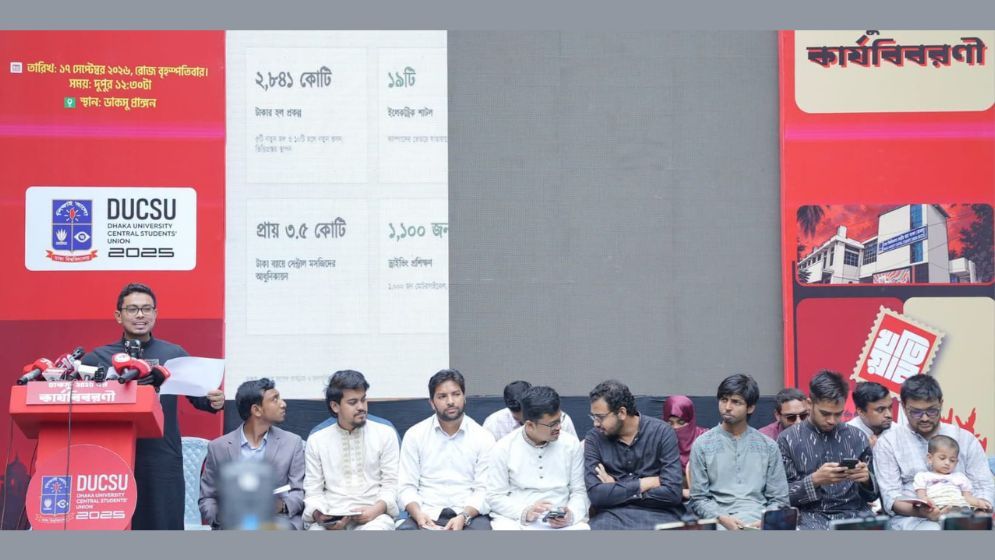
Photo: Daily Sun
Dhaka University Central Students' Union (DUCSU) leaders have presented detailed activity reports outlining around 1,000 completed works over the past year to mark the completion of their one-year tenure.
DUCSU Vice-President (VP) Abu Shadik Kayem and General
Secretary (GS) SM Farhad highlighted key aspects of the publication at a
programme organized in front of DUCSU building on Thursday (17 September), with
presence of the other DUCSU representatives.
The report spans major sectors including transportation,
housing, healthcare, education, research, sports, culture, legal assistance, campus
cleanliness and security.
Speaking at the event, VP Abu Shadik Kayem termed
maintaining a violence-free environment as their biggest achievement. "If
you ask what DUCSU's biggest achievement this time is, I will say, a
violence-free campus. We have not shown power to anyone for a single second in
the entire year since we took office," he said.
Addressing the hall accommodation crisis, Shadik Kayem said,
"Work on a Tk2,841-crore mega project is currently underway, with funding
release procedures expedited following discussions with authorities."
He expressed optimism that the residential crisis will abate upon completion of the project within the next 1 to 1.5 years.
Additionally, approval has been secured to construct a 1,500-seat
female hall worth Tk2,440 crore funded by the Chinese government, with
construction targeted for completion within a year.
The VP outlined structural and policy measures, including a
new seat allocation system aimed at removing non-students from residential
halls and automating hall allotment similar to the BUET model.
Emergency earthquake renovation funds have also been
sanctioned, including Tk6.5 crore for Salimullah Muslim Hall, Tk8.1 lakh for
Haji Muhammad Muhsin Hall and Tk20 lakh for Shahidullah Hall.
To streamline campus transit, DUCSU leaders announced plans
to construct five new halls and 10 buildings, launch a shuttle service,
establish fare charts, issue standardized uniforms, and draft a driver registry
of campus vehicles.
However, they noted that several transport and traffic
initiatives such as traffic coordination with the Dhaka Metropolitan Police
(DMP) at eight campus gates, deploying registered rickshaws, appointing police
security, and procuring two minibuses and two microbuses through vehicle
auctions- remained standstill due to government changes and lack of cooperation
from university administration and the BNP government.
In the health and welfare sector, DUCSU modernized medical
centres, established mental support initiatives, provided legal aid to over 400
students, and initiated air-conditioned reading rooms across 13 halls.
Projects targeting female students included introducing
maternity leave, establishing day-care centres, setting up gymnasiums, and
allocating specific budgets for breastfeeding rooms.
Proposals to tackle sexual harassment and cyberbullying were
submitted to the DMP Commissioner, alongside legal aid provided to over 100
affected students.
Regarding academic reforms, DUCSU pushed for a teacher
evaluation system despite non-cooperation from university authority. Following
approval by the SMT and Academic Council, the proposal stalled in the
syndicate, prompting DUCSU to launch an independent online platform for teacher
evaluation.
Other academic measures included driving training, research
support, central library expansions, registrar office service simplification,
alumni engagement, and student scholarships.
On sports and environment, DUCSU upgraded the physical
education centre, organized athletic competitions, and improved cafeteria food
standards.
Initiatives to install dustbins, control noise pollution, remove the unsafe foot-over bridge at Kabi Sufia Kamal Hall, and renovate passenger shelters were completed, though subsidized TCB food sales at TSC cafeteria remain pending.
In culture and publication, DUCSU published over 30
subject-based books and magazines, coordinated hall union activities, and
marked the anniversary of the July Revolution. Internationally, leaders met
foreign ambassadors to represent student rights and heritage preservation.
DUCSU leaders noted several stalled welfare projects
including computer labs in all halls, AI training, internships, job fairs,
innovation hubs, digital surveys, central playground renovations, and city
corporation infrastructure work- blaming non-cooperation from the university
administration and the government.
Shadik Kayem said, "In the previous DUCSU, there was a
division and clash between the hall union and the central union in the politics
centered on the student parliament. Noting that the situation on the campus has
changed after the current DUCSU was elected, he said, violence on the campus
has come down to zero during our period. Despite various efforts after the
change of power, no student organization has been able to take over the halls
of the university."
DUCSU GS SM Farhad said, "All the DUCSU members and
hall union members sit together twice a year and presented details of their
activities. We tried our best to ensure accountability and to fulfill students
welfare-centered activities. We are still working on implementing initiatives
that depend on administrative approval and government cooperation. Our work
will continue."