


 For all latest news, follow the Daily Sun's Google News channel.


DUCSU to host 2nd int’l conference on July Revolution Sunday
Daily Sun Report, DU
Published: 18 Jul 2026, 02:44 AM
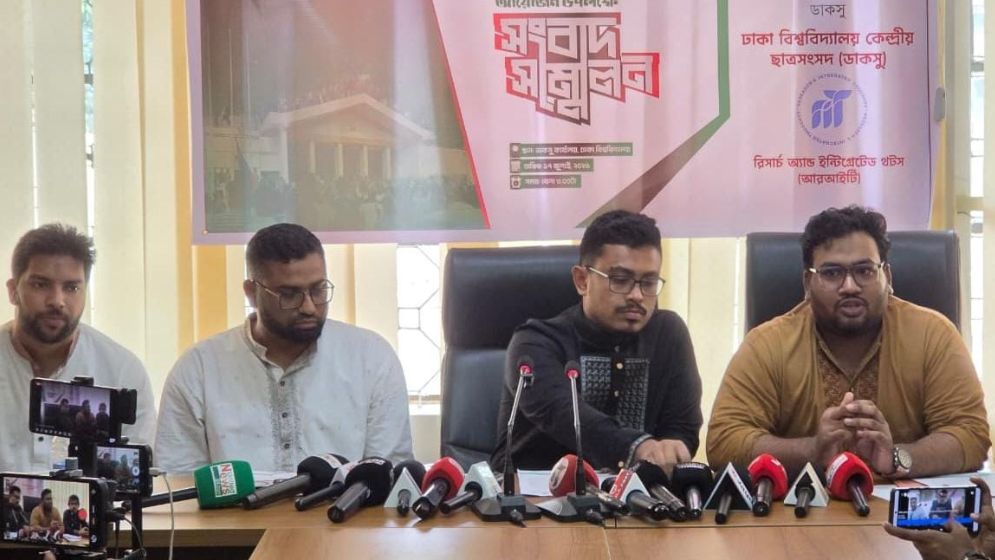
Photo: Daily Sun
Dhaka University Central Students' Union (DUCSU) will host the Second International Conference on July Revolution (ICJR-2, 2026) at the university’s Senate Building on Sunday.
The day-long event marks the second anniversary of the July Revolution, organisers announced at a press conference at the DUCSU Bhaban on 17 July.
DUCSU VP Shadik Kayem, Executive Member Miftahul Hossain Al Maruf, and representative of Research and Integrated Thought (RIT) Ekram Uddin spoke at the press briefing.
DUCSU Student Transport Secretary Asif Abdullah and Career Development Secretary Mazharul Islam were also present.
The theme for this year's conference is "Legacy of July Revolution 2024: Accountability, Reforms and the Future of Bangladesh."
The discussions will focus on the political, social, economic, legal, and institutional impacts of the revolution.
Local and international researchers, teachers, policymakers, and civil society representatives will exchange views on the reforms needed to build a democratic, accountable, inclusive, and rights-based Bangladesh.
Several institutions are collaborating to organise the event, including Dhaka-based research institute RIT, DUCSU, Youth for Better Future Society, University of Regina in Canada, International Islamic University Chittagong, and the School of Social Sciences at Nanyang Technological University in Singapore.
Various justice, human rights, civil society, and community-based non-profit organisations are also associated with the conference.
Rokeya Begum, a member of parliament and mother of July martyr Jabir Ibrahim, will share her thoughts at the inaugural session. Prof HM Mosharraf Hossain, the convener of ICJR-2 and chairman of the Dhaka University finance department, will deliver the inaugural speech.
Education Minister ANM Ehsanul Hoque Milon will attend the conference as the chief guest.
Special guests include Prof AFM Khalid Hossain, former adviser to the Ministry of Religious Affairs; Huma Khan, representative of the Office of the United Nations High Commissioner for Human Rights in Syria; Prof ABM Obaidul Islam, vice-chancellor of Dhaka University; Prof Niaz Ahmed Khan, former DU VC; and Moinul Islam Chowdhury, former chairman of the National Human Rights Commission.
Other notable guests include Shafiqul Alam, former press secretary to the then chief adviser; Prof Niaz Asadullah from the University of Reading, UK; Kabirul Islam, former secretary to the Ministry of Education; Yusuf Ali, an associate professor involved in the medical care of the July movement victims; Supreme Court lawyer Mohammad Shishir Monir; and Prof Ilias Mollah, MP from the Faridpur-1 constituency.
Ambassadors from various countries will also participate in a special protocol session.
More than 15 experts will take part in over five panel discussions. Speakers include Associate Prof Md Saidul Islam from Nanyang Technological University, Singapore; Prof AKM Warsul Karim, dean of the School of Business and Economics at North South University; Syeda Sultana Razia, a professor at the chemical engineering department of Bangladesh University of Engineering and Technology; Takian Fakhrul, an associate professor at the chemical engineering department of Bangladesh University of Engineering and Technology; Usama Al-Ajami, an associate professor at the public administration department of Dhaka University.
Mohammad Ismail, chairman of RIT and a professor at the applied chemistry and chemical engineering department of Dhaka University, will chair the first plenary session. Muhammad Asadullah, an associate professor at the University of Regina, Canada, will present the conference declaration, while Ekram Uddin, executive director of RIT, will deliver the closing speech.
Alongside the keynote discussions, researchers will present 80 selected research papers during the conference.
The organisers expressed hope that the conference will serve as an important platform for data-driven and research-based discussions on the unfinished business of the July Revolution, institutional reforms, accountability, human rights protection, and the future of Bangladesh.