



 For all latest news, follow the Daily Sun's Google News channel.


BSEC moves to revive direct listing after 11 years
Draft rules set share-offloading, profitability requirements to bring large companies to capital market

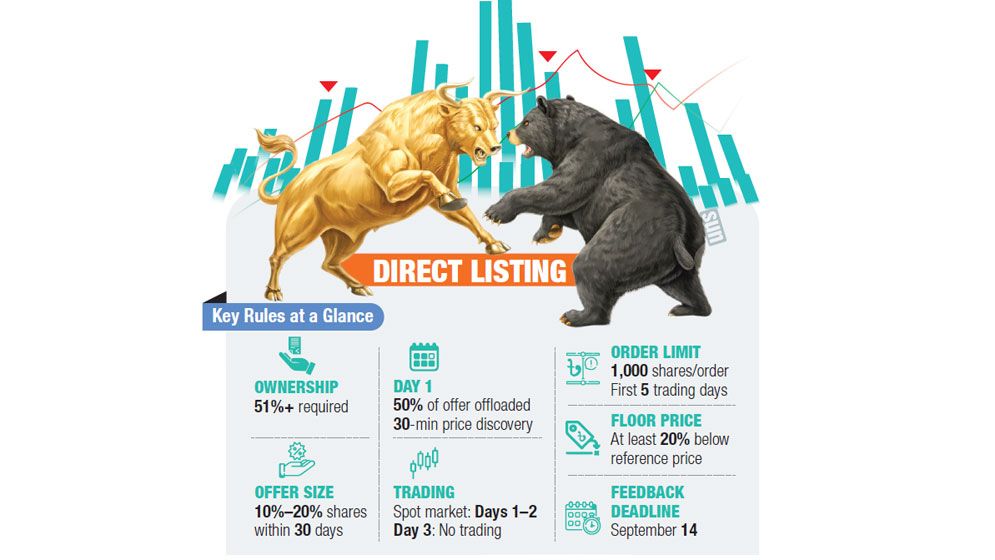
After nearly 11 years, the Bangladesh Securities and Exchange Commission (BSEC) has taken steps to reintroduce direct listing in the country’s capital market.
The direct listing system was in effect from 2006 to 2015 before being discontinued. The BSEC has now proposed bringing it back in 2026 as part of efforts to attract large and established companies to the capital market.
Under the proposed framework, not every company will be eligible for direct listing. Companies will have to meet a range of financial, operational, corporate governance and disclosure requirements, with particular emphasis on offloading shares held by existing shareholders, price determination, information disclosure, loan-default status, profitability and transparency of financial statements.
In a notice published on its website on 1 September 2026, the BSEC sought public feedback on the draft Bangladesh Securities and Exchange Commission (Direct Listing of Securities on the Stock Exchange) Rules, 2026. Comments, suggestions and objections may be submitted within two weeks of the notice’s publication.
Under the proposed rules, direct listing means listing a company on the main board of a stock exchange by offloading shares held by existing shareholders through the stock exchange, without raising funds through an IPO by issuing new shares.
Large portion of shares to be offloaded within first 30 days
For offerors of companies in specified government-owned, government-related or foreign-owned categories, at least 10% of the shares must be collectively offloaded within 30 trading days.
For companies in other specified categories, the minimum will be 20%. At least 50% of the total shares proposed to be offloaded must be offered on the first trading day, with the remaining shares offloaded over the following 29 trading days.
The commission may relax this requirement in certain cases based on an application from the company and a recommendation from the stock exchange.
However, offerors will not be allowed to sell more than 50% of their existing shareholdings, in aggregate, before the AGM held after one full accounting year following the listing.
They will also be barred from purchasing or acquiring shares of the company for one year from the date of direct listing.
Special restrictions during first five days
During the first two days of direct listing, shares will be traded in the spot market until noon.
Trading will be suspended on the third day for distribution and settlement, with the normal settlement system resuming on the fourth trading day.
General investors, including institutional investors, will not be allowed to sell the shares during the first two days. In addition, no single buy or sell order exceeding 1,000 shares will be permitted during the first five trading days.
Companies eligible for direct listing
The draft rules identify several categories of companies that may be eligible for direct listing.
These include companies wholly owned by the government or at least 51% government-owned, companies in which the government directly or indirectly owns at least 10% of the paid-up capital, and companies wholly owned or at least 51% owned by foreign shareholders.
Telecommunications and ICT service providers, ICT infrastructure providers and manufacturers licensed by the Bangladesh Telecommunication Regulatory Commission (BTRC), with paid-up capital of at least Tk300 crore, may also be eligible.
Banks, financial institutions and insurance companies that have been operating for at least three years are also included. Companies with annual turnover or total assets of at least Tk500 crore may likewise qualify.
Stock exchanges, depositories, and clearing and settlement companies registered with the commission, as well as other companies specified by the BSEC, may also be eligible.
Multiple conditions before listing
A company seeking direct listing must be a public limited company and must have been carrying on business continuously for at least the preceding three years.
It must have generated profit from its core operations in each of the preceding two financial years and must not have any accumulated loss.
However, the commission may relax certain conditions based on an application from the company and a recommendation from the stock exchange.
The company must also have positive cash flow from operating activities in the latest financial year and hold its annual general meeting (AGM) regularly.
Another key condition is that, during the two years immediately preceding its application for direct listing, the company must not have raised capital in exchange for cash through banking channels from anyone other than existing shareholders. Bonus and rights issues will be excluded from this restriction.
The company must also undertake to comply with the commission’s corporate governance requirements within one year of listing.
Neither the company nor its sponsors or directors can be classified as loan defaulters in the latest Credit Information Bureau (CIB) report of Bangladesh Bank.
Floor price to guide price discovery
For direct listing, the company will determine the floor price of its shares in consultation with the share sellers. Under the proposed rules, the floor price must be at least 20% below the reference price.
The first 30 minutes of the first trading day will be designated as the “price discovery period”, during which investors can submit bids to purchase shares.
Offerors, however, will not be allowed to place sell orders or offer prices during this period.
After the price discovery period, the offeror may determine or revise the selling price in accordance with the floor price and other applicable rules.
Detailed disclosures mandatory for investors
Before direct listing, the company will have to publish a detailed “information document” containing information on the identities, qualifications, experience, business interests, relationships, conflicts of interest and remuneration of its directors, sponsors, officers and key management personnel.
The document must also disclose details of material related-party and connected-party transactions over the previous five years, significant loans, share options, material transactions involving directors or related persons, and the company’s corporate governance practices.
In addition, the merchant banker’s valuation report must disclose the valuation methodology, key assumptions, financial and non-financial parameters, per-share value and sensitivity analysis.
Material litigation, fines, penalties and regulatory matters involving the company must also be disclosed.