



 For all latest news, follow the Daily Sun's Google News channel.


File Photo
Bangladesh’s latest SAFF Championship disappointment has exposed deeper problems in the country’s football, with former internationals questioning the team’s selection, tactical preparation and lack of cohesion after the hosts crashed out in the semifinals on home soil.
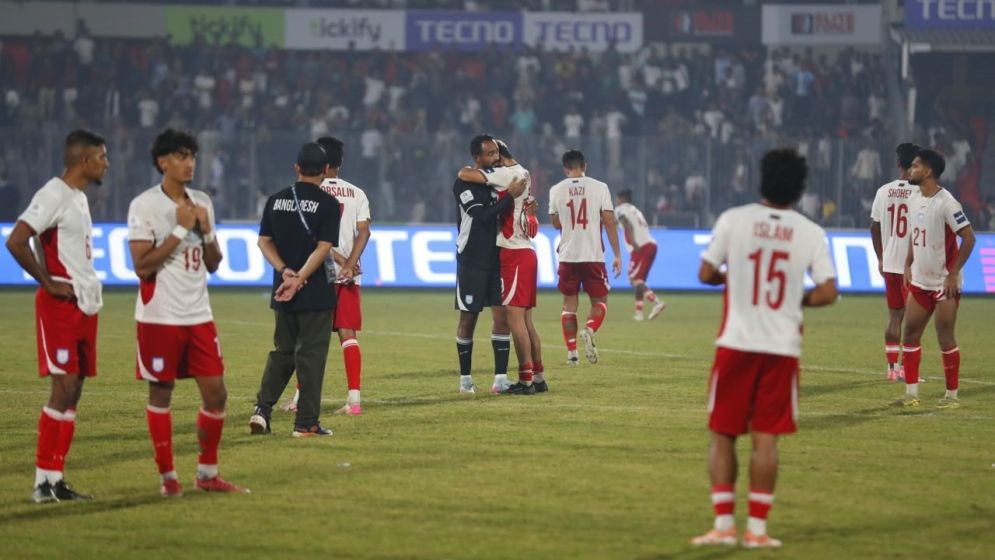
The national team entered the 2026 tournament hoping to end a 23-year wait for the regional title and reach the final for the first time since 2005. They made a promising start, beating Bhutan 1-0 before producing an emphatic 4-0 victory over Sri Lanka to finish top of Group A with a perfect record. However, their campaign ended in heartbreak on 14 November, when Pakistan scored five minutes before the final whistle to secure a 1-0 semi-final victory at the National Stadium.
The defeat, which came despite Bangladesh enjoying more possession, prompted former players to question why the team could not turn their control of the ball into meaningful attacking opportunities. They also argued that the problems went beyond one match, pointing to poor domestic structures and inadequate preparation as major obstacles to sustained progress.
“We kept the ball under reasonable control, but we did not make any positive attacks. There was no coordination between our two wingers and the striker. We hardly saw the crosses or through balls that should have been coming from the wide areas,” Sabbir told Daily Sun.
He particularly questioned the understanding between Farhaan Ali Wahid and Rakib Hossain, arguing that the wide players failed to provide the service needed to trouble Pakistan’s defence.
He also pointed to the considerable gap between midfield and attack, while suggesting that the team lacked clarity over the striker’s positioning and movement.
Sabbir believed Bangladesh should have managed the closing stages more intelligently after conceding the decisive goal with only five minutes remaining. The players, he said, needed to keep possession, allow their teammates to move up the pitch and use long balls to put pressure on Pakistan in the opposition half, while also preparing for the possibility of extra time.
For Sabbir, however, the semi-final defeat was only a symptom of a much bigger problem: the absence of a long-term development plan.
“Bangladesh does not have a proper long-term master plan. Look at the standard of our Bangladesh Football League. With that level of domestic football, how can we expect to win the SAFF Championship, let alone compete for the ASEAN Cup?” he said.
He urged the Bangladesh Football Federation (BFF) to expand competitive football beyond the professional leagues by reviving district competitions and establishing school, college and university tournaments in collaboration with the relevant authorities.
Sabbir estimated that around 500,000 people play football in the country but argued that the lack of regular competitions prevents many from developing their potential. He said he had discussed a proposed master plan with the sports minister, although meaningful progress could take two to three years.
He also called for a more selective approach to recruiting diaspora footballers, saying overseas-based players should strengthen rather than replace domestic talent.
“We need to develop our own players while also bringing in diaspora footballers. But we should target those playing in good European teams or professional leagues who cannot get regular opportunities there. Simply bringing in any overseas-born player will not guarantee better results,” he said.
Former national team striker Imtiaz Ahmed Nakib was more critical of the team’s selection and management. He questioned the decision to include injured players while several domestic footballers, including those performing well in the Dhaka league, were not given opportunities.
“I believe there were serious mistakes in selection. Five injured players were included in the squad, while many players from the Dhaka league were not given opportunities. It was poor management from the coach to the rest of the set-up. That is why we did not get the result we wanted,” Nakib said.
He also questioned the commitment of some foreign coaches, suggesting that not all came to Bangladesh with the right priorities. He insisted that the national team needed better judgement and more careful planning in its selection and preparation.
Former full-back Firoj Mahmud Titu, who represented Bangladesh from 1999 to 2007 and scored against FR Yugoslavia in the 2001 Sahara Cup, said the semi-final defeat was particularly painful because it happened in front of the home crowd.
“Failure is failure, whether it happens at home or away. But failing on home soil hurts the most,” said Titu, a member of Bangladesh’s 2003 SAFF Championship-winning team.
He attended the Pakistan match with his family and said the disappointment had affected his children as well. The anger in the stands, he added, reflected the frustration of supporters who had waited more than two decades for another regional triumph.
Titu believes diaspora players can bring valuable exposure to modern football but said they need time to build an understanding with locally developed players. He stressed that strengthening the domestic pipeline must remain the priority.
“We need to spread football and sports across every district, upazila and union. That is how we can bring the younger generation into sport and develop our talent,” he said.
Former midfielder Zakir Hossain also highlighted the importance of team preparation, particularly when overseas-based players such as Hamza Choudhury and Shamit Shome are involved.
“However good the players are, if they do not train together in camp and prepare as a team, they cannot survive. That is how it works in every country,” Zakir said.
He argued that the players needed to spend more time together to develop combinations, understanding and a stronger emotional connection with the national side.
“If we just bring players in to play matches like guest appearances, we cannot expect the right results,” he added.
Bangladesh’s group-stage victories showed their potential, but the semi-final defeat to Pakistan once again exposed the gap between promising performances and the ability to deliver when the pressure is greatest. For the former stars, the way forward is clear: better preparation, stronger domestic competition and a coherent development plan must come before another pursuit of short-term success.