


 For all latest news, follow the Daily Sun's Google News channel.


Tears, apologies and pointed fingers after SAFF heartbreak
Daily Sun Report, Dhaka
Published: 15 Nov 2026, 07:50 PM
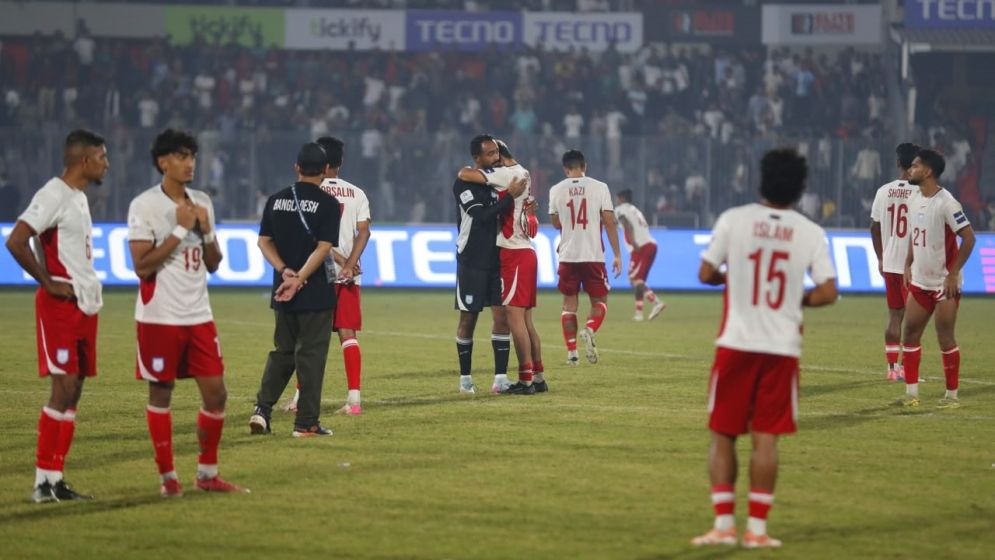
Photo - Tanvin Tamim
The 1-0 semifinal defeat on Saturday night to lower-ranked Pakistan once again prolonged the men in red and green's 21-year wait to play in the final of the SAFF Championship, South Asia's top-tier men's football tournament.
A day after the nightmare, the booters departed the team hotel on Sunday morning with few words to say and no smiles to offer. For goalkeeper Mehedi Hasan Srabon, the man blamed for the defeat after conceding the lone goal of the match, the departure was particularly difficult.
The 21-year-old was the first to leave, seemingly in a hurry to avoid the waiting media, though he accepted responsibility and apologised to his teammates, coaches and supporters in a Facebook post on Sunday.
"I dreamed of celebrating with you all last night, not writing these words with a heavy heart. An unfortunate slip changed everything, and I know the disappointment it caused. I take this moment as a painful lesson. My sincere apologies to my team-mates, coaches and every supporter. I'm truly sorry, Bangladesh," he wrote.
While Srabon was dealing with the guilt of his mistake, midfielder Jamal Bhuyan had a different frustration to share. The midfielder was unhappy with the timing of his introduction, having come on only in the second minute of stoppage time when Bangladesh were already chasing the game.
"I thought I would be brought on much earlier, but we came on in the second minute of added time. I spoke about it a lot after the match. I was very angry," Jamal told reporters before leaving the hotel.
The veteran also questioned the team's tactical approach against Pakistan, particularly its failure to break down a five-man defence that Bangladesh had expected to face.
He further said the management also needed to take responsibility, pointing to the failure to rest key players during the 2-0 victory over Sri Lanka, just days before the semifinal.
"It's not only the players who need to learn from this. The management also needs to learn. When we were 2-0 ahead against Sri Lanka, we should have considered resting some important players. Everyone is important, but a player like Hamza needed rest because we had another match just 48 hours later. There were some mistakes, but ultimately the decision on who plays is the coach's," he added.
Assistant coach Hasan Al Mamun admitted there had been a delay in bringing on Jamal and two other substitutes, although the original plan was to introduce them during the final 30 minutes.
Defender Saad Uddin's absence was another major setback, with Mamun noting that injuries also forced the coaching staff to abandon their plan of resting Hamza Choudhury against Pakistan and severely impacted the team's defensive stability.
The assistant coach also pointed to Bangladesh's failure to make the most of their first-half opportunities, particularly Rakib Hossain's one-on-one chance. He felt an early goal could have changed the course of the contest, as it had in some of Bangladesh's earlier matches.
Mamun further suggested that fatigue may have affected Bangladesh after a demanding schedule. The hosts had around 72 hours to recover, while Pakistan had more time and brought on five fresh players.
Concurring with the coach, midfielder Quazem Shah Kirmanee also admitted that the shorter recovery period could have played a part, but refused to use it as an excuse.
"Maybe it could have been a factor because we only had two or three days of rest before the game. Pakistan had a little more rest. But I don't want to blame it on that. We weren't fully prepared for the game. They were a very strong team, but it was not our day," he said.
Quazem also felt Pakistan's different defensive system made the match difficult, but said Bangladesh had to take responsibility for failing to convert their chances.
The midfielder admitted the mood among the players was low when they left the hotel, but said they had to accept the disappointment and move forward.
For Quazem, the tournament had also been a personal achievement after a difficult period. He was grateful to have played well and, above all, to have experienced the support of a packed National Stadium.
"Personally, I went through a very difficult time, but Alhamdulillah, I was able to play well. In the last game, the whole stadium was full. It was remarkable; we won't get this feeling anywhere else. We are very grateful to the fans for sticking with us, we can do better in the future," he added.