


 For all latest news, follow the Daily Sun's Google News channel.


FIFA WORLD CUP 2026
THE LAST WALTZ AT THE MEADOWLANDS
Sabbib Bin Sattear, Dhaka
Published: 19 Jul 2026, 12:00 AM
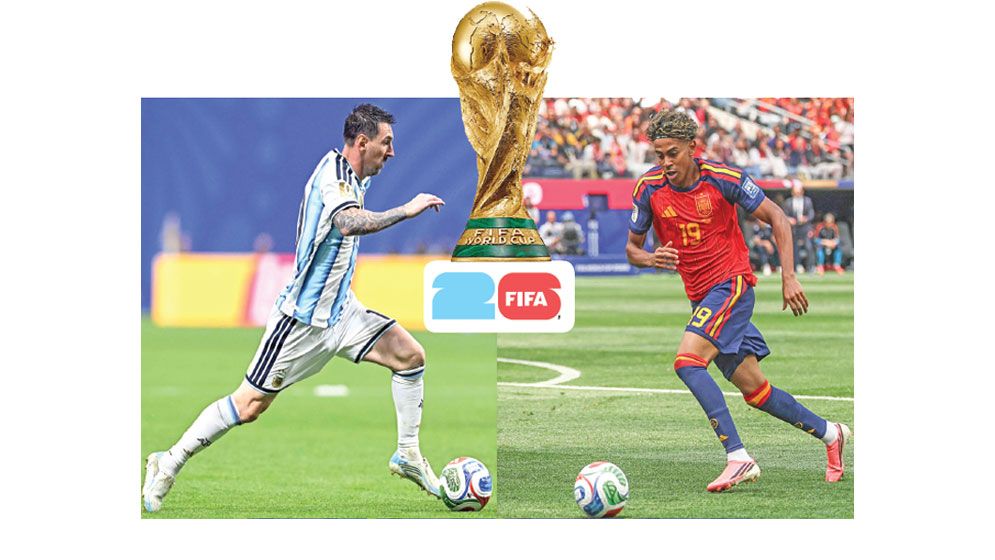
This silence that is descending on Jersey is not so unfamiliar to them. They know it all too well. The hush before a hurricane, the stillness before a verdict in courts. This weekend, the silence belongs to football.
On Sunday, MetLife Stadium in East Rutherford, New Jersey will host the 2026 FIFA World Cup final. Across the Hudson, the skyline glitters indifferent as ever. But inside the bars and bodegas of Queens, in the Argentine flags draped from apartment windows in Jackson Heights, in the red jerseys spotted outside Penn Station, the city has already chosen its religion for the week.
Spain or Argentina. La Furia Roja or La Albiceleste. One of them will be crowned world champions in front of over 80,000 people. The script could not have been written better. It could only have been lived.
Spain arrived at this final the way great teams do with inevitability. La Seleccion cruised through the tournament conceding just one goal in seven matches, holding the high-octane attacks of Portugal, Belgium, and France to precious little, while receiving timely interventions from Mikel Oyarzabal and Mikel Merino. Their system does not depend on individual brilliance. It manufactures advantages through positional play, pressing, and a midfield that suffocates opposition build-up before it starts. In their semi-final, they dismantled France with the clinical ease of a surgeon with no panic, no flourish, just function elevated to art.
The attack typically runs through Lamine Yamal on the right flank in Luis de la Fuente's hybrid 4-2-3-1 shape, with goalscoring support from Oyarzabal, who has five goals this summer. Rodri, Spain's captain and midfield general, has looked back to his best after struggling with recovery from an Anterior Cruciate Ligament rupture domestically, while Fabian Ruiz and Dani Olmo have provided quality around him. This is a team in full command of its identity.
Argentina took the harder road, the only road Lionel Messi has ever known.
It took extra time against Cape Verde in the round of 32 and Switzerland in the quarter-final, while they had to come from behind late to beat Egypt, who led 2-0 in the 78th minute, and England, who led 1-0 in the 85th minute. For any other team, this would spell cause for concern. For Argentina, it reads like a habit — a compulsion to flirt with catastrophe before pulling free. They do not win cleanly. They win completely.
And at the centre of it all stands the man who refuses to recede into legend while there is still a game to be played. Messi, 39 years old, leads the Golden Boot race with eight goals and four assists, dominating games despite spending nearly two-thirds of his time on the field walking. The walking has become its own mythology now, the economy of movement that makes every burst, every turn, every thread of a pass feel like something borrowed from another dimension.
If Argentina win, Messi becomes the first captain to successfully defend the World Cup since Cafu with Brazil in 2002, and the first player to lead back-to-back World Cup victories since Pele in 1958 and 1962.
And on the other side is Yamal. Only 19 years old. One of the tournament's highlights has been watching the Barcelona teenager take on titan after titan. The boy who once appeared in a photograph as a toddler alongside a young Messi now stands ninety minutes away from surpassing him.
If Spain win, Yamal will be the youngest player to win the World Cup in the modern era. The torch does not get passed with ceremony in football. It gets taken.