


 For all latest news, follow the Daily Sun's Google News channel.


COLLECTED PHOTO
On the map of India, Goa presents a profound geographical and cultural paradox.
While it stands as the nation’s smallest state by landmass, its footprint on the global tourism map and its historical weight are immense.
Fringed by the azure waters of the Arabian Sea, this coastal enclave holds within its soil centuries of complex colonial history.
It is within this historic setting that the eighth Women's SAFF Championship is currently ongoing.
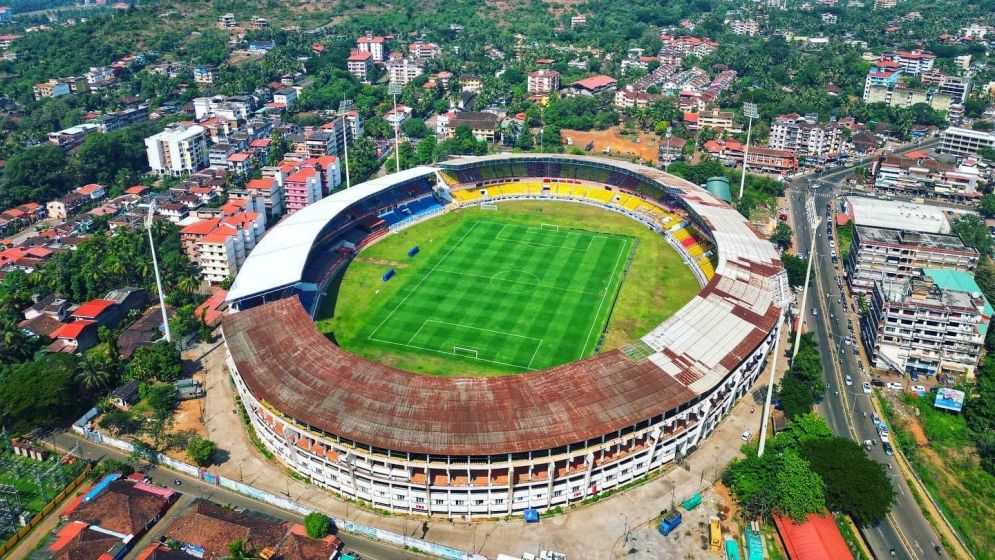
Yet, despite a succession of high-octane international fixtures at the Pandit Jawaharlal Nehru Stadium in Margao, including matches featuring the defending champions Bangladesh, the response from the stands has been unexpectedly muted.
The conclusion of the group stage has seen cavernous expanses of empty seats, a striking contradiction for a region where football is traditionally woven into the very fabric of identity.
The roots of this unique territory trace back to 1498 with the maritime arrival of Vasco da Gama, followed by the establishment of a Portuguese colonial regime under Afonso de Albuquerque in 1510.
This European occupation endured for over four and a half centuries, leaving an indelible architectural and cultural imprint that dictates modern Goan life.
UNESCO World Heritage sites such as the Basilica of Bom Jesus and the Se Cathedral stand as silent, grand sentinels of this era.
It is precisely this intersection of continental history, distinct architecture, and sun-drenched coastlines that draws millions of global travellers annually.
Demographically, tourism divides the state into two distinct zones.
North Goa operates as an insomniac festival of neon lights, pulsating nightclubs, and crowded beaches where life moves at an unyielding pace.
Conversely, South Goa remains profoundly introspective a sanctuary of slow-paced rural life, emerald landscapes, and undisturbed sands.
Here, local life moves with the rhythm of the tides, and the few foreign nationals encountered are typically engaged in long-term professional projects rather than transient leisure.
Yet, despite the stark contrast between the northern glitter and the southern stillness, a singular obsession unifies the entire territory.
While the rest of India is consumed by the crack of willow on leather, where cricket dictates the national pulse, Goa belongs entirely to the beautiful game.
From the sun-baked sands of the coast to the dusty clearings of inland villages, football remains an unproclaimed state religion.
Modernity has introduced synthetic, floodlit mini-turfs nestled within urban alleyways, transforming the Goan landscape into an outpost of South American or Iberian passion once twilight falls.
This contrast between the empty stadium seats and the local fervour is not lost on the residents.
"It is honestly a surreal sight to witness an international tournament played before such quiet stands," observes Sheldon D’Souza, a second-year undergraduate at the nearby Don Bosco College of Engineering in Fatorda. "If this were a local Goa Professional League derby or an Indian Super League fixture involving our own boys, the atmosphere would be absolutely deafening. The passion for the sport here in the villages is absolute, but there is a clear disconnect between the local fan base and how this particular tournament has engaged with the community."
D’Souza's assessment cuts to the core of Goan football culture, which is backed by an intricate institutional framework governed by the Goa Football Association.
The state oversees well over a hundred registered clubs across three competitive tiers.
At the apex lies the elite Goa Professional League, where 14 top-tier teams contest a historic domestic crown.
The genesis and survival of these institutions form the true bedrock of the region's footballing heritage, with the oldest clubs tracing their origins to the twilight of colonial rule.
The foundations of this modern club culture were laid in the port city of Vasco da Gama, roughly 30 kilometres north of Margao.
In 1951, local enthusiasts established Vasco SC, an institution that quickly became a symbol of Goan identity.
Five years later, in 1956, the visionary industrialist VM Salgaocar founded Salgaocar FC.
These pioneering clubs operated as vital symbols of regional pride during a tense geopolitical era.
Salgaocar would eventually script history as the first Goan outfit to secure the prestigious Federation Cup in 1983, followed by the National Football League title in the 1998-99 campaign and an I-League triumph in 2011.
Their commitment to youth academies remains legendary for fuelling the national team pipeline.
Further north, 35 kilometres from Margao in the state capital of Panaji, Dempo Sporting Club was established in 1968.
Originally contested as Bicholim FC before its acquisition by the prominent Dempo Group, the club pioneered an era of unprecedented tactical dominance in the 2000s under the stewardship of master tactician Armando Colaco.
Emulating a signature short-passing, high-tempo philosophy that critics fondly labelled the "Goan Barcelona," Dempo claimed a record five national league titles.
They also broke new ground on the continent, becoming one of the first Indian clubs to grace the semi-finals of the AFC Cup, firmly etching their name into the annals of Asian football history.
While those institutional giants operate across the state, Churchill Brothers FC remain the exclusive romantic property of Margao.
Formed in 1988 from the rustic foundations of Varca Club by the influential Alemao family, the team embodies the gritty, working-class ethos of South Goa.
Supported by an intensely passionate local demographic, the club secured top-flight glory with I-League titles in 2008-09 and 2012-13.
Known for their uncompromising style and deeply emotional connection to the local fanbase, they continue to serve as a stubborn custodian of Goan representation in the national second tier.
The contemporary era found its voice in 2014 with the advent of the franchise-led Indian Super League and the birth of FC Goa.
Known affectionately as "The Gaurs," the club quickly became a cultural touchstone for the younger generation of fans.
Making the Pandit Jawaharlal Nehru Stadium in Fatorda their impregnable fortress, they captured the ISL League Winners Shield in the 2019-20 season.
Under the initial technical guidance of Brazilian icon Zico and a succession of European managers, FC Goa carved out a historic milestone as the first Indian club to compete directly in the group stages of the prestigious AFC Champions League, bridging Goan heritage with the modern global game.
The underlying currents of Goan football, however, extend far beyond these prominent frontrunners.
The sport is deeply intertwined with a historical affinity for European football, maintaining a lingering, ancestral loyalty toward Portuguese footballing culture.
Every local club, from the 14 elite professional sides to the dozens of amateur village teams, is fiercely protected by its community.
It is an enduring legacy that ensures that while an isolated regional tournament may occasionally struggle to capture the immediate imagination of the local populace, the intrinsic romance of the sport along the Konkan coast remains entirely immortal.