


 For all latest news, follow the Daily Sun's Google News channel.


Pride over plays
CWAB revolt rattles BCB
Muhammad Jubair, Dhaka
Published: 15 Jan 2026, 10:34 PM

TANVIN TAMIM PHOTO
It was coming.
That was the feeling most reporters had after the sudden press conference of M Najmul Islam under the fading lights of the media center at the Mirpur Sher-e Bangla National Cricket Stadium on Wednesday, when journalists gathered for what they assumed would be an informal discussion with the outgoing chairman of the Bangladesh Cricket Board’s (BCB) Finance Committee.
Najmul, who had overseen the BCB’s financial operations until the previous Thursday, initially struck a casual chord. He spoke off-the-record about Bangladesh’s stake in the International Cricket Council revenue model, explaining the intricate machinery of global cricket finance.
Yet, within minutes, the atmosphere shifted.
What began as a seemingly friendly chat rapidly escalated into remarks that would send shockwaves across the nation’s cricketing landscape.
Najmul began to question the players’ commitment to the game, downplaying their hard-won achievements and challenging their fundamental role in the growth of Bangladesh cricket.
Observers recall the tone as blunt, dismissive, and, at times, overtly mocking. Stunned reporters watched as these statements were then repeated on-record, in front of more than 20 cameras, in an even sharper, harsher register.
The tipping point arrived when Najmul addressed the potential financial fallout of a boycott of the ICC Men’s T20 World Cup. He dismissed the players’ concerns with a callous shrug, making it clear that while the board would suffer no loss, the players alone would shoulder the ruinous consequences.
Then came the remark that ignited a national outcry. Mocking the very value of the athletes, he asked: “If they go somewhere and cannot do anything…Do we ask for that money back from them? Do we? Answer me.”
Even the reporters who dared to question him were drawn into the verbal crossfire.
Within hours, Najmul’s words spread like wildfire. Current and former cricketers described his statements as insulting, demeaning, and a direct assault on the pride and dignity of those who wear the national colours.
Sensing a looming mutiny, the BCB scrambled to issue a clarification, stating that Najmul’s comments “should not be interpreted as representing the views or policies of the board” and stressing that remarks made outside authorised channels were purely personal.
But the damage was done. The fuse was lit, and the Cricketers’ Welfare Association of Bangladesh (CWAB) responded with clinical decisiveness.
On Thursday morning, the Hotel Sheraton in Banani became the epicentre of a historic confrontation. The lobby teemed with players and officials, all awaiting a signal: would they report to Mirpur, or would the bats remain in their bags? Fans gathered at the stadium, broadcasters were in position, and the opening match of the Dhaka phase between Chattogram Royals and Noakhali Express was scheduled for a 1:00pm start.
Yet,
for several tense hours, the stadium remained eerily silent as uncertainty
gripped the nation’s premier domestic tournament.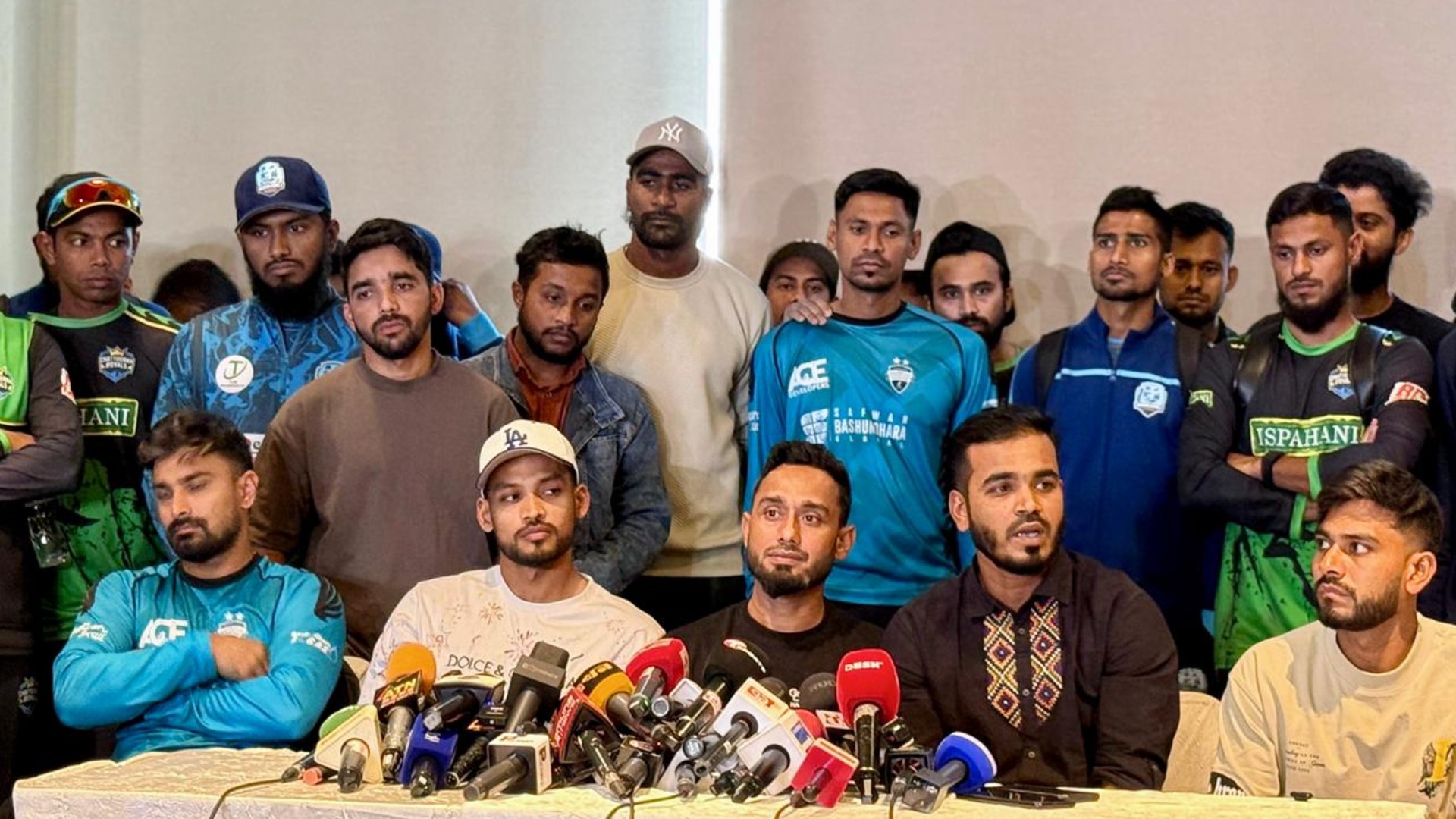
At 11:30 am, following an emergency session, CWAB President Mohammad Mithun emerged alongside 30 to 40 of the country’s elite cricketers.
The line-up was a visual testament to the gravity of the crisis: Test captain Najmul Hossain Shanto, ODI captain Mehidy Hasan Miraz, and T20I captain Litton Das stood shoulder-to-shoulder with senior stars Mominul Haque, Mustafizur Rahman, Taskin Ahmed, and Nurul Hasan Sohan.
What followed was a 40-minute press conference that electrified the sporting world.
Mithun and CWAB outlined five non-negotiable demands for halting a full-scale boycott:
1. Resolving the ongoing crisis in Dhaka First Division cricket that has left players and clubs frustrated.
2. Addressing sexual harassment allegations against women cricketers and ensuring safe and supportive conditions for female athletes.
3. Improving opportunities and facilities for women players, acknowledging their critical role in the growth of Bangladesh cricket.
4. Najmul Islam’s resignation from his post as BCB finance committee chairman, demanded as a matter of principle and respect.
5. A clear explanation from the BCB regarding the unannounced exclusion of nine players from the BPL, a move players described as opaque and unfair.
Speaking
to the press, Mithun’s rhetoric was as sharp as the players' resolve.
“For a long time, we have only been hearing the word ‘procedure, procedure, procedure,’” he said.
“They asked for 48 hours, but if he does not resign after that window, we still have to stop playing. So what is the point of going back now only to stop again?”
He placed the burden of the tournament’s survival squarely on the board’s shoulders.
The players’ return to the field came with a strict ultimatum: the BCB must issue a public commitment that Najmul Islam would be stripped of all official capacities within 48 hours.
“If
he remains, then the players will stop playing and no responsibility will fall
on us. The BCB will take full responsibility,” Mithun warned.
While Mithun acknowledged the board’s initial disciplinary steps, he made it clear that procedural platitudes were no longer sufficient to restore broken trust.
The show of unity proved irresistible.
Faced with the total collapse of the BPL, the BCB acted with uncharacteristic speed. Within hours of the press conference, following an emergency online meeting, Najmul was relieved of all his responsibilities.
The press conference showcased the deep pride and unity among Bangladesh’s cricketers. The players’ message was clear: respect and dignity are non-negotiable.
For the athletes, cricket is not merely a profession; it is a source of identity and national pride. When that pride is undermined, a strong collective response is inevitable. Bangladesh cricket had to learn that lesson harshly.