


 For all latest news, follow the Daily Sun's Google News channel.


Home-grown AI solutions to drive economic growth
AI Business Summit calls for stronger govt-industry-academia collaboration to develop local technologies, boost productivity and create jobs
Daily Sun Report, Dhaka
Published: 09 Nov 2026, 12:00 AM
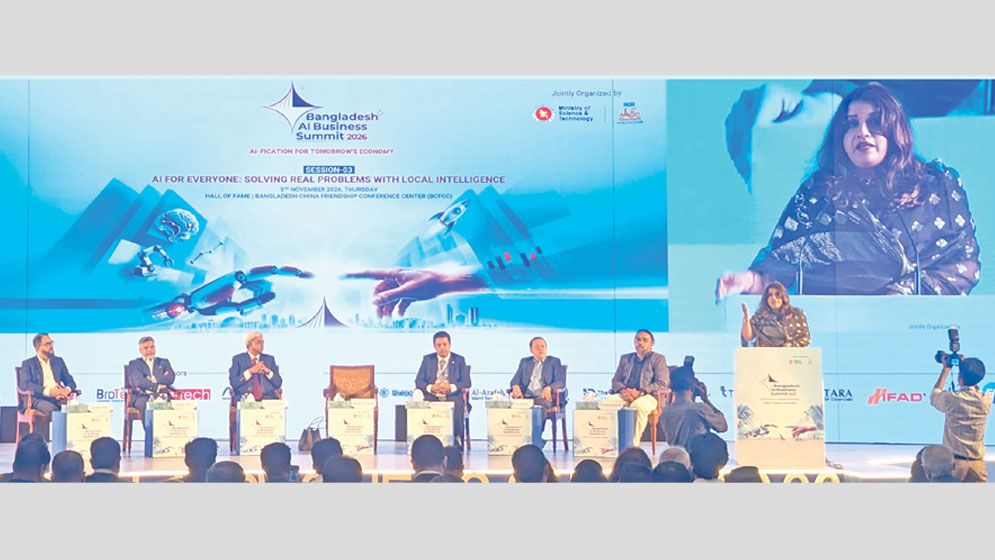
State Minister for Foreign Affairs Shama Obaed Islam speaks at the AI Business Summit at the Bangladesh-China Friendship Conference Centre in Dhaka on Thursday. The day-long event is jointly organised by DCCI and the Ministry of Science and Technology. PHOTO: DAILY SUN
Bangladesh is looking beyond adopting artificial intelligence (AI) to developing its own solutions, as policymakers, business leaders and academics call for a national ecosystem that can turn local talent, research and innovation into economic opportunities.
The focus is shifting towards developing AI technologies tailored to local needs to strengthen industries, improve productivity and create jobs, rather than relying solely on imported solutions.
The call came at the country’s first AI Business Summit 2026, where participants stressed the need for stronger collaboration among the government, industry, universities and research institutions to build a home-grown AI ecosystem.
Jointly organised by the Dhaka Chamber of Commerce and Industry (DCCI) and the Ministry of Science and Technology, the day-long summit was held at the Bangladesh-China Friendship Conference Centre in Dhaka on Thursday under the theme “AI-fication for Tomorrow’s Economy”.
The event brought together policymakers, ministers, entrepreneurs, investors, researchers and academics to discuss how AI could transform Bangladesh’s economy and how the country could develop its own technological capabilities.
President Mirza Fakhrul Islam Alamgir attended the inaugural session as chief guest, while Science and Technology Minister Fakir Mahbub Anam also addressed the gathering.
DCCI President Taskeen Ahmed said AI was transforming business operations, industrial production and institutional decision-making. Although its use in Bangladesh was gradually expanding through automation and digital services, the country needed stronger capabilities to realise its full potential.
Delivering the keynote address, Dr Zulkarnain Jahangir, assistant professor of management at North South University, said AI-fication meant integrating intelligence into everyday operations across factories, farms, clinics, banks and government offices.
Citing estimates from the International Monetary Fund (IMF), PwC and the World Economic Forum, he said around 40% of jobs worldwide were exposed to AI.
He said the technology could add US$15.7 trillion to global GDP by 2030 and generate 78 million net new jobs, with 170 million jobs created and 92 million displaced.
Speakers stressed that Bangladesh’s challenge was not merely to keep pace with the global AI revolution but to develop the skills, research capacity and innovation ecosystem needed to benefit from it.
Bridging academia-industry gap
The second session focused on aligning academic education with industry requirements to develop an AI-ready workforce.
Former DCCI President Rizwan Rahman said academic curricula needed to reflect changing industry demands, with greater emphasis on AI literacy, data analytics and practical problem-solving.
Dr Mahdi Amin, prime minister’s adviser and PMO spokesperson, said the government, industry and academia must collaborate to develop home-grown solutions through research and practical applications.
“We want to build an ecosystem where industry, academia and the government work together to solve our real-life problems through research, innovation and practical applications of technology,” he said.
He said AI could create significant opportunities in garments and textiles, agriculture, pharmaceuticals, financial services, logistics and small and medium enterprises if applications were developed around Bangladesh’s economic needs.
“Talent is not our problem. The real question is whether we are providing the right platform where their potential can flourish,” he said.
Mahdi Amin said the government would expand startup funding and grants for innovative ideas emerging from universities and research institutions, while encouraging small entrepreneurs and expatriate professionals to contribute to innovation and job creation.
Addressing concerns over the technology’s potential risks, he said, “Whether AI will become a threat or an opportunity will depend on how we use and command it.”
Developing AI for local needs
The third session focused on practical innovation and the development of AI applications to address everyday challenges faced by people and businesses in Bangladesh.
Firoz Muhammad Zahidur Rahman, founder and CEO of Loosely Coupled Technologies, demonstrated how locally developed AI solutions could help garment workers upgrade their skills, guide young graduates and support small businesses.
He said home-grown AI should be designed around people’s actual needs, including Bangla-English communication, voice-based interaction and accessibility across different devices and network conditions.
State Minister for Foreign Affairs Shama Obaed Islam, who attended the session as chief guest, said Bangladesh needed AI solutions reflecting its own social and economic realities.
“What we need now is localised intelligence. If everyone, from farmers and workers at the grassroots level to entrepreneurs, students and businesspeople, is to benefit from AI, we must develop and use artificial intelligence in the context of Bangladesh,” she said.
She stressed the importance of reliable data in developing effective AI applications, particularly in agriculture, where the technology could help farmers adapt to climate change.
Electronics, pharmaceuticals, biotechnology, light engineering and green industries could also become promising areas for AI-driven innovation, she said.
Urging young people to become technology creators rather than passive users, Shama said, “Don’t be AI users only; you have to be developers and responsible AI developers.”
She also warned against using AI to spread misinformation or damage reputations, stressing that “Innovation must be responsible”.
Shama said recommendations from the summit should be shared with the Ministry of Science and Technology and other relevant institutions for consideration.
Summing up the discussions, Science and Technology Secretary Md Anwar Hossain proposed establishing a national AI ecosystem through public-private collaboration.
Alongside the summit, an AI Business Expo featured more than 150 stalls showcasing AI-based products and services from local and foreign entrepreneurs. Young innovators from 20 public and private universities also demonstrated their projects.
The expo highlighted Bangladesh’s emerging innovation capacity, while the summit underscored the need to turn individual initiatives into a coordinated national effort to develop locally relevant AI technologies.