


 For all latest news, follow the Daily Sun's Google News channel.


Chip shortage pushes PC prices up, sales plunge 70%
As manufacturers prioritise AI-related production, supplies of conventional memory chips for personal computers have tightened significantly

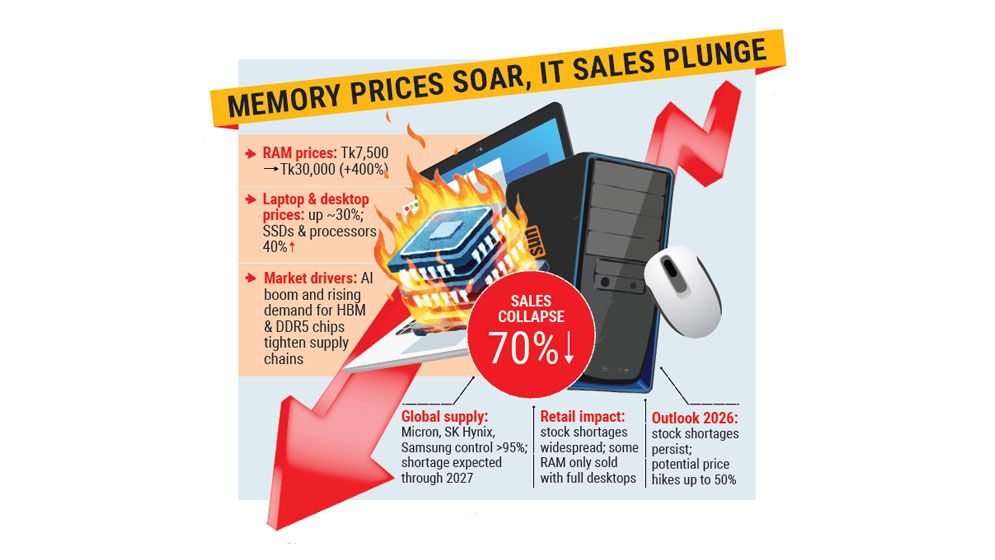
Bangladesh’s IT market is under severe strain as a global shortage of memory chips has pushed component prices to record highs, triggering a sharp collapse in laptop and desktop sales.
Industry insiders say memory chip prices have surged by as much as 400% in recent months.
A RAM module that sold for Tk7,500 in October now costs up to Tk30,000 in December. Prices of SSDs and processors have also risen by around 40%, driving overall laptop and desktop prices up nearly 30%, while sales have plunged by about 70%.
The shortage is largely being driven by the rapid expansion of artificial intelligence (AI), particularly generative AI, which has sharply increased demand for high-bandwidth memory (HBM) and DDR5 chips used in servers.
As manufacturers prioritise AI-related production, supplies of conventional memory chips for personal computers have tightened significantly.
According to Reuters, the global rush to produce AI chips is squeezing the supply of chips used in smartphones and computers, prompting panic buying by some customers.
The global DRAM market is dominated by Micron Technology, SK Hynix and Samsung, which together control more than 95% of supply.
In December, Samsung raised DDR5 RAM prices by over 100%, from US$7 to $19.50 per unit. Tech publication Tom’s Guide reports that the RAM price crisis shows no immediate signs of easing, while SK Hynix has warned that the shortage could persist until late 2027.
Impact on retailers and consumers
Traders across Dhaka report unprecedented declines in sales.
A salesperson at Techvalley Distribution in BCS Computer City, Agargaon, said that by 3:30pm on a recent Friday (weekend), not a single laptop or desktop had been sold, with only Tk9,000 worth of accessories moving. “With 15 employees, paying salaries without sales has become extremely difficult,” he said.
Consumers are also feeling the squeeze. Ahsan Habib, who is shopping for a personal laptop, said his Tk50,000 budget no longer covers models that were affordable just months ago. “A laptop with an Intel Core i3, 8GB RAM and 512GB SSD used to cost Tk48,000. Now it is around Tk55,000,” he said.
Md Nazrul Islam Hazari, director of Bangladesh Computer Samity, described the market as “volatile and unpredictable” over the past four months.
“Purchasing power is down, customers are struggling, and corporate and government orders are becoming increasingly difficult to fulfil at these prices,” he said.
Zettabyte Technologies, which operates outlets at Multiplan Computer City and in Jashore, reported a 60% drop in sales over the past two months.
Raju Debnath, the company’s growth strategies lead, said customers are delaying purchases in hopes of price stabilisation, while those with urgent needs are opting for lower-end configurations.
Sales figures from Multiplan Computer City further illustrate the slowdown. Habib Anik, managing director of PC Geek BD, said only eight laptops were sold up to 17 December, compared with 31 laptops in October. “Laptop prices have increased by around 30%, and demand has fallen sharply,” he said.
A review of Star Tech Ltd’s website shows that RAM from major brands such as Corsair, Kingston and Transcend is largely out of stock, with some models available only as part of complete desktop builds.
Leading global brands including Dell, HP and Lenovo have warned of further price hikes for next-year laptop models, with potential increases of up to 50%.
Traditionally a slow season, October to January has seen an unprecedented downturn this year, with RAM prices jumping as much as 400% in just two months.
Unless global supply conditions improve, analysts warn that elevated prices could persist until 2027, prolonging weak consumer demand and intensifying pressure on Bangladesh’s IT retail sector.