


 For all latest news, follow the Daily Sun's Google News channel.


Guangzhou Fosun Chancheng Hospital draws Bangladeshi patients with tailored treatments
ANM Mohibub Uz Zaman back from Guangzhou, China
Published: 08 Nov 2025, 11:22 PM
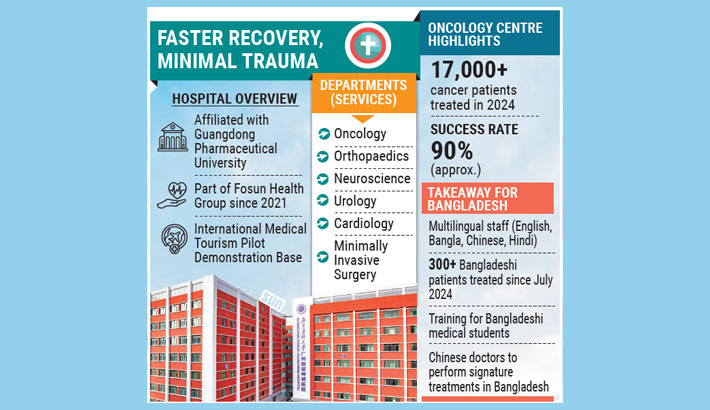
Guangzhou Fosun Chancheng Hospital, a tertiary comprehensive institution affiliated with Guangdong Pharmaceutical University, is rapidly emerging as a preferred destination for international patients seeking cutting-edge care and treatment — particularly those from Bangladesh.
The hospital, which became part of Fosun Health Group in 2021, is committed to delivering personalised and precise treatment solutions for patients worldwide. It has developed core specialty departments in oncology, orthopaedics, neuroscience, urology, cardiology and minimally invasive surgery.
Its oncology centre, a comprehensive hub dedicated to personalised and precision tumour treatment, serves patients from different countries including Bangladesh. A major advantage lies in its implementation of advanced minimally invasive therapies such as cryotherapy, radiofrequency ablation, iodine seed implantation, and vascular interventional therapy.
These techniques are highly beneficial for elderly or frail individuals, offering rapid recovery and minimal trauma (skin puncture-level wounds) along with a high success rate of around 90%. Most treatments are completed quickly, often within 30 minutes, using local anaesthesia.
The centre treated over 17,000 cancer patients in 2024.
Huang Xiaoting, Director of the third affiliated hospital of the Guangdong Pharmaceutical University, said, “Our centre specialises in tumour treatment. One of the reasons behind this is the fact that we have combined the West’s advanced technologies with traditional Chinese methods of treatment. Riding on this combination, we are offering the best services and solutions for the patients.”
Huang added that the hospital plans to collaborate with medical institutions in Bangladesh.
“We have already visited Bangladesh twice and started discussions with several hospitals. In the near future, we hope to establish medical exchange programmes that would allow Bangladeshi medical students to receive training from our hospital. We also plan to send our doctors to Bangladesh to perform some of our signature treatments,” she further said.
Despite the facilities, language barriers often discourage Bangladeshi patients to go to China for treatment purposes.
When asked about communication problems, she said, “Keeping up with the global practice, the staff working in our centre including nurses, doctors, and those involved in operations can speak English very well. Moreover, we have a team who provides translation and interpretation services for those struggling with language.
“In order to make sure that patients do not suffer in any way, we have collaborated with our local universities, under which post-graduate students offer language support for patients whenever required.”
Beyond cancer care, the orthopaedic centre is also attracting Bangladeshi patients with advanced treatments for joint pain, spinal disorders, and fractures. The centre employs minimally invasive arthroscopic surgery and integrates traditional Chinese and Western medicine to ensure quick recuperation.
Rising popularity among Bangladeshi patients
Owing to specialised and bespoke treatments, Guangzhou Fosun Chancheng Hospital is gradually gaining momentum among Bangladeshi patients.
Jane Lyu, Director of International Business Department, said the hospital has served over 300 Bangladeshi patients since July.
“Patients from Vietnam, Malaysia, Indonesia, and Mongolia also visit the hospital for advanced care. Our hospital is open to all, and foreign visitors do not need a medical visa to receive treatment in China,” Jane added.
Doris, Operations Director of the International Medical Centre, said the hospital offers world-class treatment with doctors trained in renowned institutions abroad.
To ensure seamless patient experience, the hospital’s International Medical Centre, which operates using a collaborative Multidisciplinary Team (MDT) approach, has implemented specialised support systems for Bangladeshi visitors.
These include professional interpretation services available in Bengali (alongside Chinese, English, and Hindi), and a personal one-on-one patient assistant to streamline the medical journey.
Furthermore, in a specific effort to serve more Bangladesh patients, the hospital provides common beds with lower costs. The institution has also been recognised for its international standing, having been designated an International Medical Tourism Pilot Demonstration Base in 2023, and is listed as a recommended hospital by foreign embassies and consulates in China.
Even the patients speak highly of the treatments and services available in this hospital.
Zakir Hossain Khan, who has been travelling to China for 13 years, said, “I really like the treatment here. Bangladeshis have already started coming here. Just two weeks ago, when I visited the hospital with another patient, I saw quite a few Bangladeshis receiving treatment here.”
When asked about the cost, he replied, “Of course, it’s slightly higher than in Bangladesh, but not excessively so. Given the quality of treatment, the experience is much better here. Most importantly, doctors, unlike Bangladeshi ones, don’t prescribe unnecessary medication.”
His wife, Umme Habiba, added, “Alhamdulillah, I’m happy with the treatment we’re getting here. They provide good treatment here, give fewer medicines, and offer very good service. The doctors here are also very amicable.”
Future collaboration
Ahmed Suja Khokan, a Bangladeshi entrepreneur in the medical sector, who recently visited Guangzhou Fosun Chancheng Hospital for a regular health check-up, put emphasis on further collaboration in this field between the two countries.
“Medical collaboration between Bangladesh and China could allow Chinese specialists to provide treatment in Bangladesh,” he told the visiting journalist.
Professor Chen Tao, Director of the Oncology Department of Guangzhou Fosun Chancheng Hospital and a Harvard-trained physician, said such collaborations are possible but depend on policy-level cooperation.
The reporter can be reached at [email protected]