


 For all latest news, follow the Daily Sun's Google News channel.


Jhalakathi’s floating guava market draws crowds, foreign tourists
BSS, Jhalakathi
Published: 01 Aug 2025, 11:48 PM
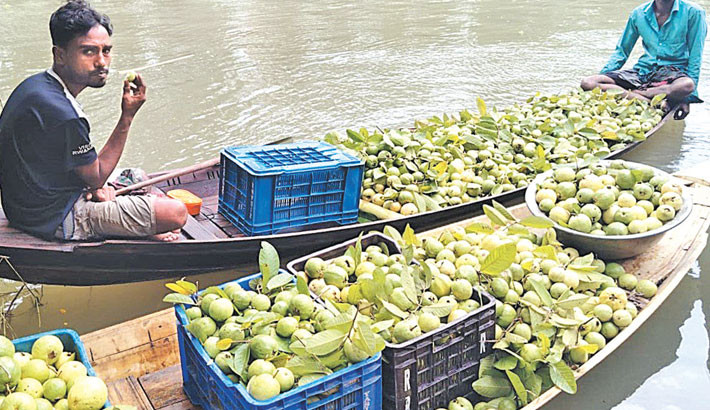
Every year during the guava season, the floating guava market of Bhimruli in Jhalakathi springs to life, drawing in traders, tourists, and foreign dignitaries alike. Unlike conventional markets, this one floats, with boats lining the narrow canals, selling freshly picked guavas from the surrounding orchards.
The market, located in the southern district’s Kirtipasha union, has become a major tourist attraction. Visitors, both local and international, travel by boat through the scenic waterways to experience this vibrant, water-based bazaar. “Wherever you look, it’s green—trees and water all around. It’s peaceful and refreshing,” said Shahriar Rayan, a tourist from Barishal, likening it to floating markets in China and Vietnam.
According to Bhabendranath Haldar, former Union Parishad Chairman and long-time cultivator, guava farming in this area dates back over 200 years. His ancestors were also involved in guava and vegetable cultivation.
Today, the region’s lush orchards also yield amla, bananas, lemons, papayas, mangoes, and various Rabi crops. Many of these are grown in "Kandis," local terms for the small canals that crisscross the guava orchards, allowing tidal water to flow without waterlogging.
The floating market operates daily from 7am to 12pm during the peak guava season, which runs from Ashar to Bhadra (June to August). Farmers, both men and women, arrive by boat to sell their produce, enduring all weather conditions. Even during heavy rains, they remain afloat—literally—hoping for good sales. This year, guava was cultivated on over 600 hectares of land in the district, producing approximately 10,000 kilograms per hectare. Key guava-producing villages include Bhimruli, Mirakathi, Dumuria, Bhairampur, Khejura, and Shankardhabal, among others spread across Kirtipasha, Nabagram, Gavaramchandrapur, Binoykathi, and Shekherhat Unions.
Dr. Abdullah Al Mamun, deputy director of the Jhalakathi District Agricultural Extension Department, confirmed that commercial guava farming also takes place in parts of Pirojpur and Barishal, especially in Banaripara and Nesarabad Upazilas.
However, despite the large-scale production, farmers often struggle with pricing. "Guavas must be sold quickly, as there's no way to store them, not even in cold storage," said UNO Farhana Yassin. The administration is currently exploring ways to process guavas into jams and jellies to extend shelf life and increase profitability.
Women farmers play a significant role in this region’s guava economy. They navigate narrow waterways in small boats, collect guavas from orchards, and participate in sales at the market. Their daily presence adds to the unique atmosphere and cultural significance of the area.
In the market, traders display guavas in square baskets made from banana leaves, while others use large plastic crates loaded onto trawlers. Despite the charm, local businessman Shubhrajit Haldar noted that prices this year have not been satisfactory for farmers.
Bhimruli’s floating guava market is now recognised as the largest in the southern region. Tourists have been flocking in increasing numbers, and in recent years, several foreign diplomats have visited the site.
On 27 July, Algerian Ambassador to Bangladesh Dr Abdelouahab Saidani toured the market. Previously, ambassadors and diplomats from the United States, Japan, India, and Nepal also visited, including former US Ambassador Dan Mozena and Indian High Commissioners Harsh Vardhan Shringla and Riva Ganguly Das.
Kazi Khalilur Rahman, president of the Jhalakathi Press Club, said such high-profile visits help raise awareness and support for developing the region.
Recognising its potential, the district administration has invested in infrastructure around the market. Deputy Commissioner Ashrafur Rahman reported the construction of a watch block, sitting areas, bathing ghat, and stone-paved riverfront funded by the Tourism Board and LGED. A free Wi-Fi zone has also been established.
To maintain a peaceful environment, loud sound systems and DJ parties have been banned.
Plans are underway to further develop tourism by encouraging private investment in hotels and motels. “Improving food quality and lodging for visitors is now a priority,” said a local tourist, who noted these as current weaknesses in the otherwise beautiful experience.
Fatima Tuz Johra, a student at Barishal University, shared, “Every year we visit Bhimruli, and every time it feels special. The boat ride, the orchards, and the natural setting make it unforgettable.”