


 For all latest news, follow the Daily Sun's Google News channel.


MILESTONE SCHOOL TRAGEDY
Could We Prevent Students from Burning in Uniform?
Published: 21 Jul 2025, 11:35 PM

Adnan Akib
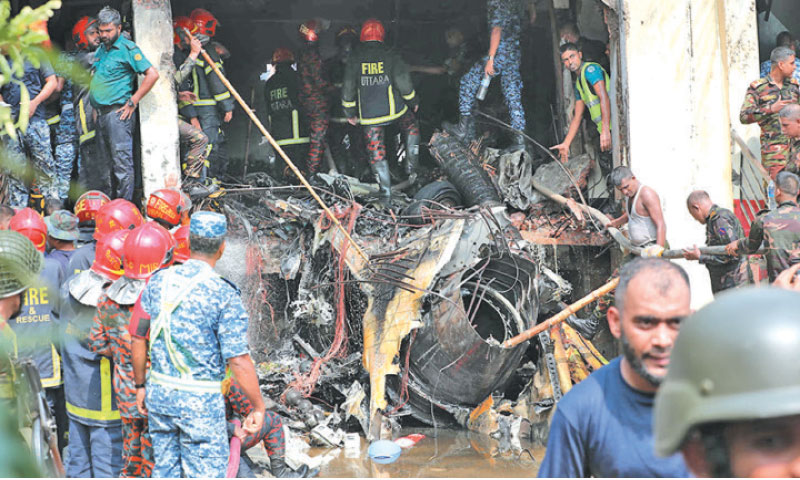
The fright is intense when we see students in burned uniforms being taken to hospitals by emergency workers from their very own campus. Even before we digest our sight, the news hits – 20 people, mostly students, died (till submission of this piece) and over a hundred got injured as a training aircraft crashed into the Milestone College campus in the capital’s Uttara area. As mainstream news outlets and social media feeds are flooding with updates, our fear grows. It grows not just because of the extent of destruction and injuries, but from the unbearable knowledge that all of this could have been avoided had crucial decisions been challenged in time.
Starting from the authorities to the masses, everyone in this city knows that Dhaka is full of chaos with its hospitals overrunning, vehicles not moving freely, and residents living with one anxious eye turned skyward. If it is so, then how could the same city house the most perilous operations such as military drills, flight training and ammunition depots? That too all woven into the heart of civilian life?
By now, we are all too used to what happens after such a disaster. Almost an uncountable number of notes and condolences will pour in from all the powerhouses of the nation. We will also get to see crocodile tears from some in power. But what happens next? Do we plan to change things? Do we execute those plans? Do we develop a system that guarantees that no other citizen will experience the same trauma again?
Yesterday’s aircraft crash incident stripped away all the illusions of citizens’ safety, children’s safety to be more precise. The plane crashed on the Milestone College campus, a place where, on any day, hundreds of students should have only books to worry about.
The death toll is already high and it is assumed that the numbers will go even higher as many victims suffered from unrecoverable burns. Hundreds more could be at risk of losing their young lives. No family deserves this horror and none should accept this as normal. Why not? Because these are not mere accidents. These are decisions that we, or the responsible people of this country, make. These are decisions that can be changed.
An incident similar to yesterday’s catastrophe happened on 15 October 2023. A training aircraft from the Bangladesh Air Force crashed around 1:00pm in Bogura’s Kahalu upazila. Thankfully, the pilots onboard were safe and no civilian was injured as the aircraft landed in a bamboo grove. The aircraft broke through the trees, and its descent ended on the ground, causing some locals to be alarmed only.
That crash was still a tragedy like every aviation accident, but its consequences were mercifully contained – a lesson written painfully clear across our own landscape. It was proven that casualties could be avoided if training aircrafts were flown over less crowded areas.
The misery inflicted on this city yesterday was the result of a system that refused to modernise and decentralise dangerously risky activities. It is already too late for us to call for decentralisation in this country. It is not a matter of administrative tidiness, nor an inconvenience to be shrugged off; it is a demand that we put the dignity and safety of ordinary people above bureaucratic inertia.
The wide skies of northern and southern Bangladesh can offer our military the space it needs to operate training without making urban civilians collateral victims. In doing so, we would give the capital room to breathe and redirect vital investment into the country’s neglected regions. It is a chance not only to save lives, but to inspire new economic hubs, create jobs and strengthen Bangladesh far beyond the city limits.
Besides, we absolutely do not suggest weakening our armed forces in any way or form or reducing their readiness. Rather, we urge the guardians of our nation not to train or test your machines again over our homes, schools or playgrounds.
We firmly believe that heroes like Flight Lieutenant Toukir Islam Sagar, who was flying that crashed aircraft not in war but in training, deserve the grace of open skies – a space where even the worst disaster does not turn into a massacre.
We do not need to trade the calmness of our daily life for the false comfort of tradition. No more sirens must wait before we refuse to accept such tragedies as the price of convenience. The difference between a close call and an irreparable catastrophe is not luck – it is the courage to do what is right.
Decentralisation is not a radical demand. It is the very least that we owe to one another – for our peace of mind, and the memory of every disaster we might have averted. We must act decisively and with compassion before another black cloud rises from our cities.
_____________________________________________
Adnan Akib is an entrepreneur and writer. He can be reached at [email protected]