


 For all latest news, follow the Daily Sun's Google News channel.


July Uprising: Stirring a Nation, Then Stillness
Abida Afsara Golondaz, Student, Department of Mass Communications, UCSI University Malaysia (Bangladesh Campus)
Published: 20 Jul 2025, 12:34 AM
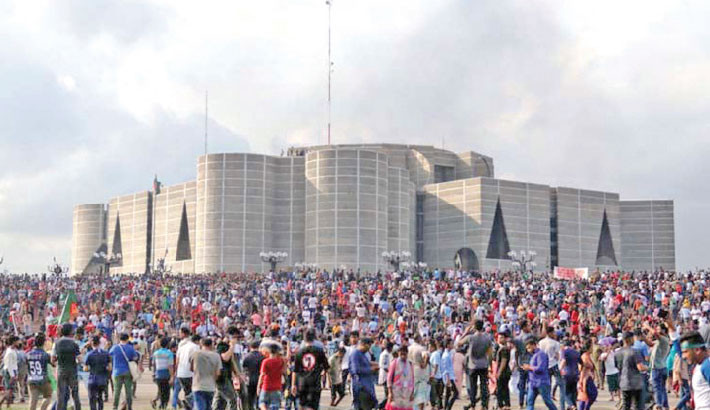
It has been a year since the blood-soaked July days shook our nation. It was a time when our country’s political arena was heavily jerked. What started as a students’ movement for fair opportunity in jobs quickly grew into something huge, something that brought down a fascist government. The demonstration for quota reform soon took the form of a demand for freedom and state reform. However, the promise of reform now appears to have been somewhat replaced with a familiar power game, only cloaked under the pretext of “change”. Many of us now wonder if things are really going to change for the better. Did we get what we hoped for? Or, did our strong feelings just help some people climb to power?
To look back, the reform movement began as a murmur, young voices rising online, quiet resistance in classrooms and at tea stalls, whispers of criticism against injustice echoing through city streets and village lanes. And then, as if struck by the same bolt of courage, thousands came together. Dhaka overflowed with people and banners, and the streets heard a chorus singing of justice. Students, parents, rickshaw pullers, artists, teachers, and factory workers—all these people who had never shared a cause found themselves standing side by side. It felt like Bangladesh had been reborn. There was no single leader, no flag that towered above the others. The July movement belonged to everyone. It was not shaped by manifestos but by the lived pain of rising costs, muffled speech and stolen dignity. People did not march because they had been told to. They marched because they could no longer stay still. For the first time in years, hope did not feel naive. It felt like a right. They were not fighting for themselves but for a Bangladesh where people's voices truly mattered, and where real democracy could finally live.
Our motherland, Bangladesh, once a mix of different cultures and beliefs living in peace, feels a bit broken now. The biggest problem in our country, it often feels like, is dealing with people whose minds just do not seem to grasp things. This "mob", as some call it, has, at times, been used by the new powerful people. We saw this after the uprising. Places like the Liberation War Museum in Dhaka were damaged. Sculptures at Dhaka University were broken. This shows that some bad groups, who do not care about our country's history, might have sneaked into the movement and used it for their own plans.
For women and minority groups, the current situation has brought its own set of problems, often making their existing struggles worse. "For women, Bangladesh was never a place to live. It was only a place to survive," a well-known women's rights activist shared on social media platform Facebook. Violence against women is sadly not new here. But after the big political change, things like mob violence, online harassment, and public shaming have made women feel even less safe. The temporary government set up a commission for women's issues, which is a start, but it has not really stopped the widespread problems of violence against women. The terrible reports of sexual violence across the country remind us of the dangers women face every day.
The main idea of the July uprising was about being held accountable, about having a system where the common person's voice mattered. But a year later, many still feel it is a government run by the powerful, just with new faces.
Currently, in the vacuum left by the collapse of the previous government, we see old players, once sidelined, finding a fresh burst of energy. The Bangladesh Nationalist Party (BNP) and Jamaat-e-Islami, who for years felt crushed under the iron fist of the Awami League, have suddenly found their voices again. They are holding rallies, making statements, and pushing their agendas with a newfound enthusiasm. It is like, when the strong hand of the previous government was removed, they saw their chance. But here is the thing that really gets under your skin: are they truly working for the people, or are they just using this political emptiness for their own gain? It feels like the same old story, where the common citizens, who actually suffered and risked their lives in July, are once again caught in the middle, facing the fallout of these power games.
The Human Rights Support Society (HRSS), in its recent report, reveals a worrying trend in violations of human rights. HRSS reported an alarming rise in incidents of violence against women and children, including rape, as well as political killings, mob lynching, assaults on journalists, custodial deaths, and attacks targeting minorities and religious shrines. In addition to these abuses, the report also highlights a sharp increase in crimes such as extortion, theft, snatching, robbery, and murder. Such persistent violations have upset people's trust in law enforcement agencies in post-uprising Bangladesh. We hoped for new ideas, new ways of doing things, but instead, it feels like we're just recycling the same old political rivalries, and it's the everyday Bangladeshi who pays the price.
As we look back on the first anniversary of the July Uprising, we feel thankful for the way people came together to remove a long-standing government. But we also need to think deeply about where we are now. The calls for change were not just a quick burst of anger. There was a deep desire for a fairer and just Bangladesh. The beauty of a secular and liberal country: the dream of a nation where "my land" means everyone's land. These were the quiet promises hidden within the loud demands of July. We must ask ourselves, as journalists, as citizens, as humans: are we truly moving towards that dream? Or are we letting the strong, raw feelings of a powerful uprising be taken over, twisted, and in the end, betray the very people who gave everything for change?