


 For all latest news, follow the Daily Sun's Google News channel.


Mixed reactions to updated law for women and children, HC challenge likely
Ehsanul Haque Jasim, Dhaka
Published: 26 Mar 2025, 11:18 PM
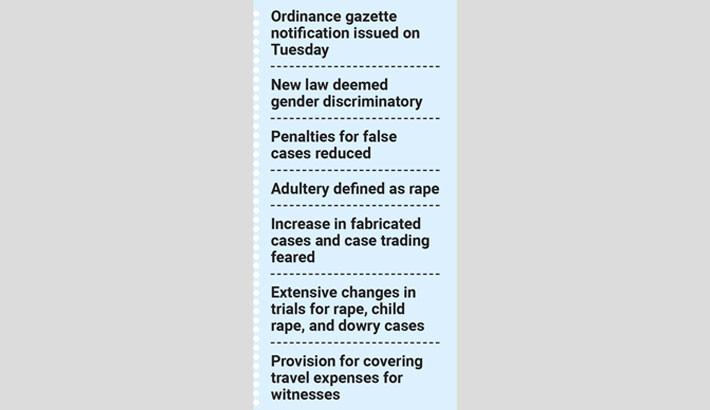
The Women and Children Repression Prevention (Amendment) Ordinance, 2025 has sparked mixed reactions, with critics accusing the law of being gender discriminatory and unconstitutional, while others argue that it is a much-needed step toward ensuring faster justice in cases of rape, child rape, and dowry.
Legal experts have raised concerns that the ordinance could be challenged in the High Court due to its controversial provisions, including the redefinition of adultery as rape.
The ordinance, which was gazetted on Tuesday and signed by Dr Hafiz Ahmed Chowdhury, secretary of the Legislative and Parliamentary Affairs Division, includes measures aimed at expediting the trial process, such as provisions for protecting witnesses and victims, and covering the travel expenses of witnesses.
While some hail these changes as a progressive move, many legal professionals argue that it creates new legal ambiguities, especially with the introduction of adultery as a form of rape.
Zakir Hossain, an additional chief metropolitan magistrate in Dhaka, sees the law as a step forward.
“After a long time, we’ve finally seen a relatively progressive and positive law. Hopefully, this will ensure that repressed women and children receive the justice they deserve more easily,” he said.
However, the law has been criticised for potentially being abused, particularly by women who may file false cases based on personal grievances.
Many opponents of the ordinance are particularly concerned about the provision that defines adultery as rape.
This change, they argue, could lead to gender discrimination and result in men being unfairly targeted in cases of illicit sexual relations, especially where the promise of marriage is involved.
“It’s discriminatory to punish only men for illicit sexual relations on the promise of marriage,” said Advocate Muzahedul Islam Shahin, a lawyer at the Bangladesh Supreme Court.
Advocate Ishrat Hasan, also from the Supreme Court, questioned whether ‘sexual intercourse under the pretext of marriage’ should only be considered a crime for men. “Marriage is not a state matter; it is a religious matter,” she explained.
“The state cannot force anyone to marry or punish them for not marrying by law. Yet, religion speaks of punishment for both men and women in cases of extramarital relations. Defining adultery as rape solely against men creates gender discrimination.”
This issue has raised alarms that the ordinance could face a legal challenge on the grounds of unconstitutional gender bias. A group is reportedly considering filing a writ petition with the High Court, challenging the law’s provisions.
The ordinance also reduces the penalty for filing false and fabricated cases from seven years to a maximum of two years.
While some see this as a move to prevent the misuse of the law, others believe it could encourage more false cases and legal exploitation.
“Reducing the penalty for false cases is concerning,” said Advocate Shahin. “Those harassed by false accusations may not find it easy to seek redress, and this could also encourage more people to misuse the law.”
Another controversial aspect of the new law is its inclusion of “rape upon the promise of marriage”. Prior to the amendment, the law did not consider such cases as rape.
Now, however, there are fears that women, especially those with a vengeful mindset, could use the law to falsely accuse men after a relationship breaks down.
Advocate Kamruzzaman, a lawyer at the Dhaka Judge Court, pointed out that many such cases were previously dismissed by courts due to a lack of legal grounds.
“Now, by redefining adultery as rape, the likelihood of men being falsely accused has increased,” he said.
Advocate Ishrat Hasan emphasised that this change risks punishing only one party in situations where both individuals might share responsibility.
“The assumption that a woman will engage in a physical relationship based on a promise of marriage is problematic,” she said, adding, “There is shared responsibility in a relationship based on mutual consent, and punishing only one party in such situations is unjust.”
While some fear the law may lead to increased blackmail and misuse, others believe that the law should address this behaviour as an immoral act or adultery, rather than equating it to rape.
“Making a promise to marry is a social and moral issue, not one that should be criminalised like rape if the promise is not kept,” argued Ishrat.
She added, “There are many factors, such as personal differences or changing circumstances, that may prevent someone from keeping a marriage promise.”
Despite these concerns, the law does have positive elements, she noted, adding that it includes provisions for creating special tribunals to ensure speedy trials for child rape cases, and for holding police officers accountable in these sensitive matters.
The law also covers the complexities surrounding DNA testing, and includes provisions to protect witnesses and victims.