


 For all latest news, follow the Daily Sun's Google News channel.


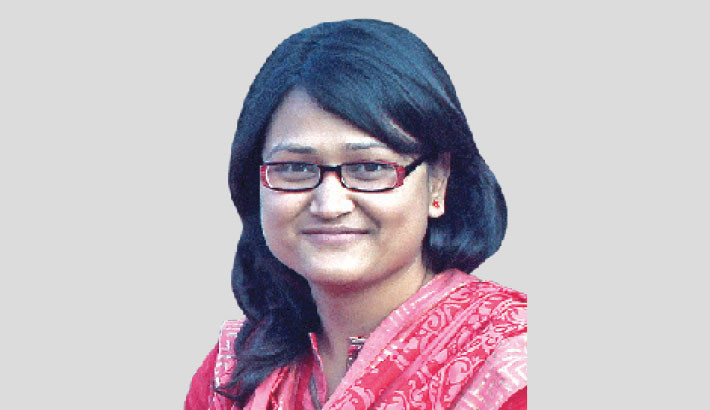
Kaniz Kakon
The night before the revolution’s climax, a young activist named Araf stood amid thousands, his voice hoarse from chanting for justice. The streets of Dhaka had become a sea of determination, each step forward fuelled by the sacrifices of those who refused to accept a future dictated by corruption and oppression. Now, as the banners lower and the protests subside, the real challenge begins: rebuilding a nation that is not just politically transformed but also economically stable and socially inclusive. Political theorists like Samuel Huntington argue that revolutions often succeed in dismantling old regimes but struggle with institutionalising democracy afterward. The real test for Bangladesh lies in whether its youth can transition from protest to governance, ensuring that revolutionary fervour does not collapse into disillusionment. More than just ensuring stability, this transition offers an opportunity to build a new and unique political culture, one that rejects the cycles of authoritarianism and corruption and instead fosters civic engagement, accountability and inclusivity for future generations. However, this path is full of risks, and if certain pitfalls are not avoided, the movement’s original vision could be lost.
One of the most critical lessons comes from studying previous revolutions, where the lack of teachability led to failure. Mariam, a young woman passionate about governance, had researched transitions worldwide, from the Arab Spring to Eastern Europe’s post-communist shifts. She understood that no revolution succeeds without institutional preparation. Huntington, in Political Order in Changing Societies, warns that modernisation and political development do not always go hand in hand and without institutional structures, democratic aspirations can quickly descend into instability. The Egyptian revolution of 2011 is a striking example. Despite successfully ousting Mubarak, its leaders failed to establish a new governance framework, leading to political chaos and a return to military rule. Bangladesh must avoid this fate by prioritising strategic learning and policy development, ensuring that political shifts do not compromise stability. However, revolutionaries must be careful not to fall into reactionary politics, where every decision is driven by opposition to past regimes rather than constructive policymaking. Without a well-defined vision for the future, the movement risks becoming a mirror image of the very forces it opposed.
Another crucial factor in Bangladesh’s political transformation is reliability in governance. Sami, a young entrepreneur, had long dreamt of opening a business but hesitated knowing how unstable institutions had failed his father’s generation. Corruption and political instability had eroded public trust in law enforcement, the judiciary and economic policies. Political philosopher Max Weber argued that modern states function best when they develop rational-legal authority, where institutions, rather than individuals, dictate governance. If Bangladesh’s new leadership fails to establish consistent and transparent institutions, it risks repeating the fate of post-revolution Tunisia, where political infighting weakens democratic stability. However, a significant danger lies in short-term populism. Many revolutionary governments attempt to implement rapid changes to satisfy public expectations, only to undermine long-term stability. Leaders must resist the temptation of symbolic gestures and instead focus on gradual, well-planned reforms that strengthen institutions, ensuring that governance remains predictable, fair and resilient.
History also warns of the dangers of internal divisions within revolutionary movements. Power struggles have derailed many post-revolution governments, as seen in Zimbabwe, where Robert Mugabe’s initial democratic promises quickly turned into authoritarian rule. The Italian theorist Antonio Gramsci, in his theory of hegemony, explains how ruling elites often rewrite history to maintain dominance. Bangladesh’s revolutionaries must learn from these failures and cultivate a political culture of shared leadership. Revolutions do not succeed because of a single leader; they thrive on collective effort. If the new leadership excludes other contributors to consolidate power, it risks alienating its base and weakening democracy. However, staying united does not mean suppressing debate and healthy ideological discussions must be encouraged while maintaining a shared commitment to core democratic principles.
Looking ahead, Bangladesh’s youth have the opportunity not just to enter politics but to redefine what politics itself means. Political thinker Jürgen Habermas argues that democracy is not just about elections but about creating a deliberative public sphere where citizens actively shape governance. This is a moment to move beyond the patron-client politics that has long dominated Bangladesh, replacing it with a culture where leadership is earned through competence and integrity rather than inherited through party loyalty. However, this movement must be wary of external influences since economic and geopolitical actors will try to manipulate the revolution for their own gain. Maintaining financial and ideological independence will be critical in ensuring that governance remains in the best interest of the people.
Bangladesh’s revolution has already proven the power of youth; now, it must demonstrate its ability to lead with wisdom, patience and strategic vision. The movement must remain vigilant against five major threats: reactionary politics that focus only on opposing past regimes, populist decision-making that prioritises emotions over pragmatic governance, internal divisions that weaken its unity, the risk of becoming authoritarian itself, and external manipulations that compromise national interests. Suppose Bangladesh’s new leaders can build a political culture of integrity, institutional trust and civic engagement. In that case, they will not only secure a stronger democracy for today but lay the foundation for a prosperous and just Bangladesh for generations to come.
_____________________________________
The writer is an Assistant Professor in the Department of Philosophy at IUBAT and pursuing a Masters in Human Rights and Multiculturalism at USN-University of South Eastern Norway