


 For all latest news, follow the Daily Sun's Google News channel.


PM urges principals to shun factionalism, improve education quality
BSS, Dhaka
Published: 29 Nov 2026, 12:00 AM
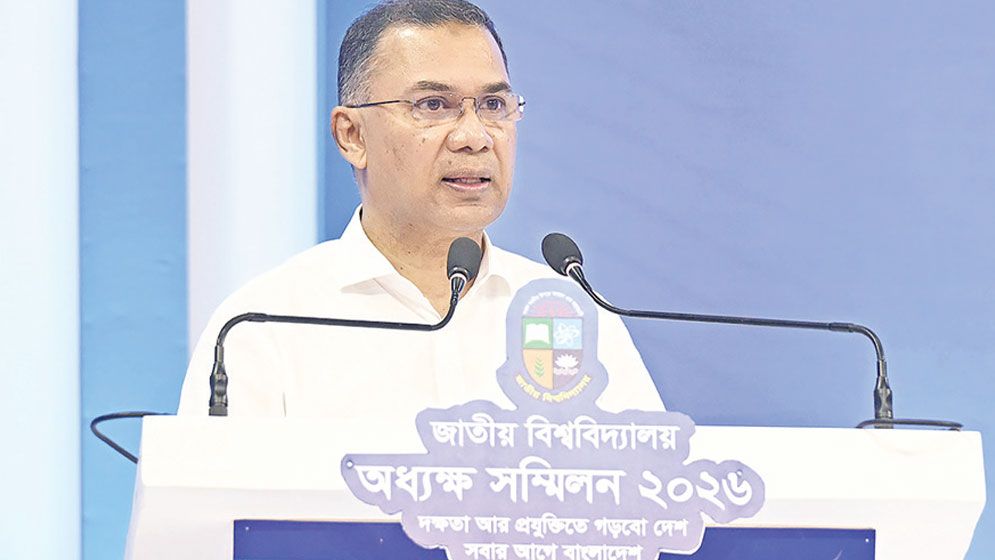
Prime Minister Tarique Rahman on Saturday urged college principals to keep educational institutions free from factionalism and personal rivalries, calling for a critical assessment of education quality and a shift towards student-centred, research-based and skills-oriented teaching.
“Differences in political opinion and belief are natural in a democratic society. But teachers must remain alert and conscious so that such differences do not disrupt the learning environment, teaching activities, administrative discipline and the safety of students,” he said while addressing a conference of principals of the National University (NU) as the chief guest at Shaheed Suhrawardy Indoor Stadium in Mirpur.
Principals of all 2,318 affiliated colleges attended the event, themed “Building the country through skills and technology, Bangladesh first”.
Describing principals as institutional leaders and moral guides, he said their competence, judgement and foresight largely determined the progress of their colleges.
Recalling that former prime minister Begum Khaleda Zia had established the NU in 1992 to expand higher education opportunities, he said the number of colleges and students had grown significantly, but the improvement in education quality required critical examination.
He said the education sector had suffered during the previous fascist regime and called for collective efforts to build a modern, quality-oriented system.
Stressing the importance of teacher training, Tarique Rahman called for replacing traditional teacher-centred methods with student-centred and research-based teaching.
Warning that academic certificates alone would not guarantee employment, he identified the lack of practical and technical skills as a major cause of graduate unemployment.
Referring to advances in artificial intelligence, robotics, big data, automation and other emerging technologies, he said education must become technology-driven, innovation-oriented and responsive to changing job markets.
He called for stronger links between educational institutions and industries, suggesting that experienced industry professionals be engaged as guest lecturers and businesses expand internship, industrial attachment and hands-on training opportunities.
Students should also develop creativity, reasoning, leadership and human values through literature, philosophy, history, science and cultural activities, he said. He urged colleges to promote foreign language learning, career counselling and entrepreneurship.
The prime minister also called for coordinated action to assess teacher shortages, fill vacant posts and ensure professional training. He urged colleges with suitable rooftops to install solar panels and asked teachers and students to strengthen cleanliness and tree-planting initiatives.
He further stressed the need to support financially disadvantaged, marginalised and special-needs students, wishing success for the NU’s “One Student, One Tree” programme.
NU Vice-Chancellor Prof Dr ASM Amanullah presented the keynote paper and handed the prime minister a sapling. A documentary was also unveiled on “Durjog Theke Shosti”, a disaster-response app developed by NU student Shahjahan Molla.
Around 40 lakh students study at the 2,318 NU-affiliated colleges, accounting for nearly 70 per cent of the country’s higher education students.
Education Minister Dr ANM Ehsanul Hoque Milon and Prime Minister’s Education Adviser Mahdi Amin attended the conference, chaired by the NU vice-chancellor.