


 For all latest news, follow the Daily Sun's Google News channel.


Do not destroy the country in the name of movement
Special Correspondent
Published: 29 Nov 2026, 12:00 AM
The country’s economic condition is not good. There are various problems and uncertainties in public life. In particular, the struggle for livelihood has become harder and harder for low-income people. In such a situation, political instability will further increase the suffering of ordinary people. Attempts to create sabotage and anarchy in the name of various types of programmes will be harmful to the country and its people. Yet the defeated force seems to want to do just that.
Arson and destructive politics have begun again in Bangladesh. To achieve unreasonable demands, a force isolated from the people and rejected by them is trying to make its presence felt by holding the public hostage. However, history says demands can never be achieved by holding people hostage or destroying public property. The only way to achieve demands is to go to the people and speak with them — to involve the people and find solutions to problems peacefully through dialogue and discussion. Instead of taking that path, a faction has chosen the path of arson and sabotage. This will increase the suffering of the people and devastate the country’s economy.
For the past month, such terrorist activities have been going on in the name of politics. Cocktail explosions under cover of darkness, arson on buses and trains, attacks on police vehicles, road blockades, and blank shots — continuous sabotage from the capital to district towns is increasing anxiety among the public.
Incidents of cocktail explosions, arson on vehicles, clashes, and road blockades have occurred in 21 districts, including Gopalganj, Narayanganj, Netrokona, Pirojpur, Rangpur, Cumilla, Meherpur, Habiganj, Barishal, Mymensingh, Khulna, Rajshahi, Faridpur, Chattogram, Tangail, Dinajpur, Narail, Cox’s Bazar, and Natore. Police stations, railway stations, and various government installations have been attacked. Railway tracks on a culvert in the Patli area between Barhatta and Thakurakona stations in Netrokona were set on fire. Atitpur Railway Station in Barhatta was also set ablaze. This came to light from two videos circulating on Facebook. One 16-second video shows a young man pouring flammable material onto railway tracks on a culvert, setting it on fire, and quickly leaving. Another 41-second video shows Atitpur Station being set on fire. The distance between the two places is about 15 kilometers.
Further terror and violence are feared in the coming days. In particular, plans for arson terror centered around Dhaka have reportedly been drawn up. Threats are being given to paralyse the entire country. Deep anxiety has arisen in the public mind over why attempts are being made to create instability simultaneously in so many places. Today the country holds its breath in unknown fear. On everyone’s lips is a single question: what is going to happen? And what else will happen? What are law enforcement agencies doing? Ordinary people ask: how many more lives will be lost over political rivalries? Will there no longer even be certainty about stepping out onto the street, going to the workplace, or returning home at night? Will the situation remain confined to political clashes alone, or will it spread to every sphere of the economy and public life?
Is the purpose of the violence merely a show of force to press demands, or is it an attempt to challenge state institutions and the governing authority of the government? Is spreading panic in transport and industrial zones to disrupt economic activity also part of a larger plan? Is a third vested-interest group taking advantage of political divisions to complicate the situation further?
Political analysts say the most alarming aspect of the ongoing violent incidents is the scale and nature of the violence. Reports are coming in of arson terror, clandestine attacks, and assaults on various installations — as well as loss of life — in at least 28 districts of the country. Whether these incidents are happening in isolation or have taken place as part of a common political objective and plan demands investigation.
Those who have destroyed state property have no patriotism. To engage in politics, patriotism is essential. If they cannot love the country itself, they have no right to do politics. Politics cannot be done by destroying national property and harming the country. Such incidents are premeditated attacks by trained miscreants. Those who have destroyed the country’s assets, pushed the people of the country into crisis, and harmed the country are committing nothing less than betrayal of the nation.
Power is born from the collective consent of the people; violence can destroy power, but it cannot create it. A party that cannot convince people begins to burn. We are trapped in a kind of politics whose grammar is not logic, but fire. In this language, an opponent is not defeated; an attempt is made to wipe them out. And each fire practically creates the justification for the next fire.
In his autobiography Long Walk to Freedom, Nelson Mandela wrote that the man who takes away another man’s freedom is a prisoner of hatred; both the oppressed and the oppressor lose their humanity. The man who spent twenty-seven years in prison knew that no nation is liberated through the politics of revenge.
The public expects the state to suppress violence and provide remedies, not counter-violence by party members. The government must control these criminal and unethical acts with a firm hand.
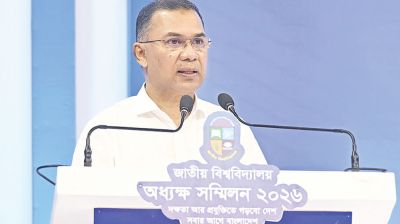
Under the leadership of Tarique Rahman, the BNP government has taken a firm stand against destructive activities in the name of politics. On one hand, he has adopted a zero-tolerance policy against the politics of terror; on the other hand, he has taken initiatives to build national unity against arson terror. In addition, the prime minister has called for staying vocal on the streets against terror. Home Minister Salahuddin Ahmed stated that the government is determined to eradicate any attempt to create instability or carry out sabotage anywhere in the country. He said law enforcement agencies are prepared to deal with any kind of violence.
He made these remarks to journalists on Saturday morning while visiting police personnel injured in the Gopalganj violence at Rajarbagh Central Police Hospital in the capital.
The home minister said the oath of the law enforcement forces is to protect the country’s assets even at the cost of their lives if necessary. Members of the forces are always ready.
However, those who are carrying out sabotage, endangering the lives of ordinary people for their own interests, and destroying state property must also understand that public trust cannot be earned by intimidating people. Such actions will create resentment against them among ordinary people. They will become even more isolated from the public. Above all, this kind of anarchy will push the country toward destruction. Therefore, no movement should be waged that is harmful to the people of the country — one that leads the country toward destruction. Because country comes first. Find peaceful ways to achieve demands in the interest of the country. Do not push the country to the brink of destruction in the name of movement.