



 For all latest news, follow the Daily Sun's Google News channel.


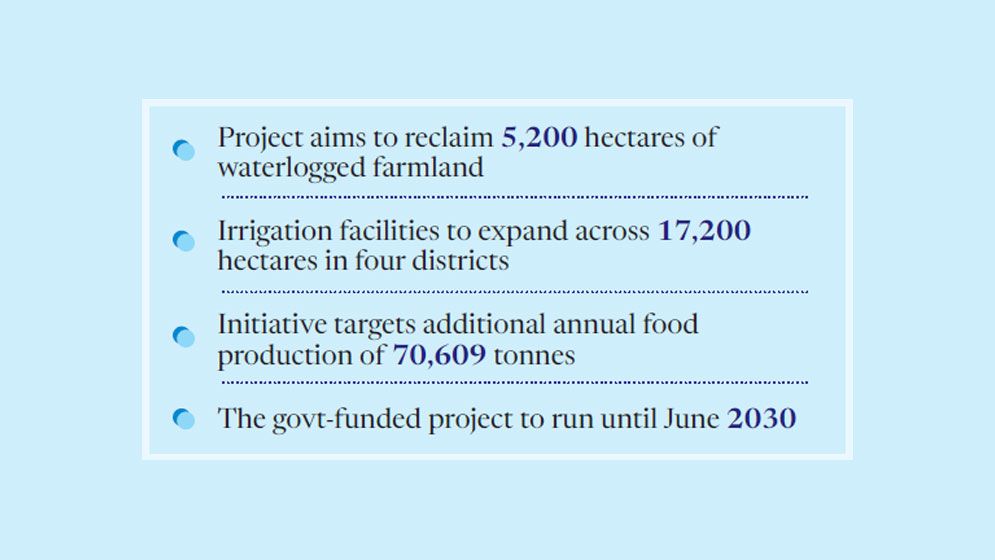
A Tk299.80-crore government-funded project is set to unlock the agricultural potential of greater Jashore by reclaiming waterlogged farmland, expanding irrigation facilities and boosting food production across four districts in the Khulna division.
The proposed initiative aims to bring 5,200 hectares of waterlogged land back under cultivation and expand irrigation facilities across 17,200 hectares, with an expected additional annual food production of 70,609 tonnes.
The project, titled “Greater Jashore District Waterlogging Mitigation and Irrigation Area Development Project”, will cover Jashore, Jhenaidah, Magura and Narail, bringing 21 upazilas under an integrated programme for improved water management and agricultural development.
The Bangladesh Agricultural Development Corporation (BADC) will implement the project under the Ministry of Agriculture. Scheduled for implementation from January 2026 to June 2030, the entire project cost will be financed by the government.
According to the project documents, the initiative is expected to give fresh momentum to agriculture in the region by transforming waterlogged areas into productive farmland, improving irrigation infrastructure and encouraging the use of modern, environment-friendly technologies.
Agriculture Minister Mohammed Aminur Rashid told Daily Sun that one of the major expected outcomes of the project was the recovery of 5,200 hectares of waterlogged land through improved drainage facilities.
“For farmers in the region, the restoration of these lands will create opportunities to bring previously underutilised agricultural resources back into production,” he said.
The project will also expand irrigation facilities across 17,200 hectares, helping farmers increase cropping intensity and diversify production, the minister said.
Jashore, Jhenaidah, Magura and Narail are important agricultural areas where farmers cultivate paddy, wheat, jute, maize and sugarcane, alongside onions, garlic, mustard, guava, jujube, dragon fruit, flowers and various vegetables, he said.
Improved water management is expected to support the production of these crops and encourage more intensive use of agricultural land throughout the year, according to the project profile.
The project places significant emphasis on developing modern drainage and irrigation infrastructure.
Under the plan, 170 kilometres of canals will be re-excavated to improve water flow and drainage. In addition, 24 sets of water drainage pumps and 325 sets of solar-powered and electric irrigation pumps will be installed.
The project also includes six kilometres of underground drainage channels, 439.5 kilometres of underground irrigation pipelines and 130 hydraulic structures.
To promote efficient water use, 42 sets of drip and sprinkler irrigation systems will be introduced. Another 10 kilometres of crop protection embankments will be constructed to protect agricultural land.
Explaining the project's technical objectives, Md Abdullah Al Rashid, Superintending Engineer of BADC, said, “The overall objective of the project is to eliminate waterlogging, ensure optimum utilisation of surface water and expand environmentally friendly irrigation facilities.
“Under the project, waterlogged beels will be drained using pumps to bring 5,200 hectares of land back under cultivation. Other interventions include re-excavation of canals, construction of crop protection embankments, installation of solar-powered pumps and development of irrigation infrastructure.
“Through these interventions, surface water-based irrigation will be expanded to 8,720 hectares, while another 3,280 hectares will be brought under groundwater-based irrigation. Overall, irrigation facilities will be extended to 17,200 hectares, generating an additional 70,609 tonnes of food annually.”
According to BADC's Minor Irrigation Survey Report 2026, the four project districts have a combined land area of 657,880 hectares, including 475,216 hectares of cultivable land.
Currently, 331,777 hectares are under irrigation, while 143,439 hectares remain outside irrigation coverage.
The proposed interventions are expected to improve irrigation access and make a significant portion of the currently underserved agricultural areas more productive.
The expansion of irrigation facilities is also expected to create opportunities for crop diversification, particularly in high-value crops such as vegetables, fruits and flowers.
The project also plans to train 725 farmers in modern irrigation technologies and improved agricultural practices.
The project will cover eight upazilas in Jashore, six in Jhenaidah, four in Magura and three in Narail.
By combining water drainage, irrigation expansion, infrastructure development and farmer training, the initiative is expected to bring coordinated improvements to agricultural production across the four districts.
Agriculture and Fisheries and Livestock Minister Mohammed Aminur Rashid is scheduled to visit Bhobodoho Beel today to observe the waterlogging situation in the project area.
The project has been included in the list of unapproved projects under the Annual Development Programme (ADP) for fiscal year (FY) 2026-27. The Ministry of Finance has given consent to provide the full project cost, and the feasibility study has been completed.