



 For all latest news, follow the Daily Sun's Google News channel.


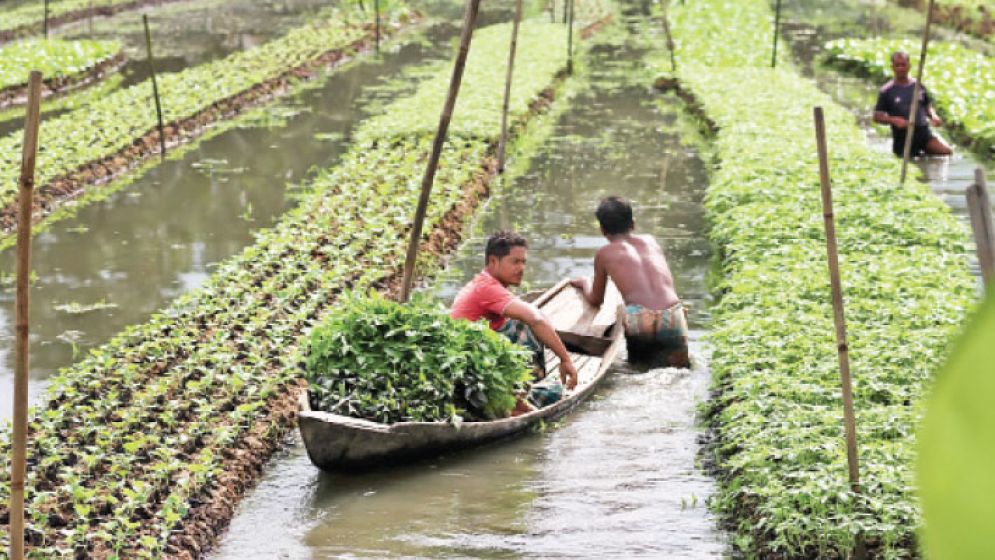
Water that once left farmland idle for months is now helping farmers earn money in Banaripara of Barishal as they grow vegetables and raise seedlings on floating beds of water hyacinth and other aquatic plants.
Around 200 hectares of land in the upazila are currently under floating-bed cultivation, according to the Department of Agricultural Extension (DAE).
The method has become popular in different areas of Bisharkandi and Iluhar unions, where large tracts of low-lying land remain submerged for much of the year, making conventional farming difficult.
Farmers make the floating beds by layering water hyacinth, moss and other aquatic plants. A typical bed is about two feet thick, 50–60 metres long and around 1.5 metres wide.
A bed costs around Tk10,000 to prepare, but farmers can produce vegetables or seedlings four to six times from it, making the method profitable. The beds can also be reused by adding fresh water hyacinth and other aquatic plants when necessary.
Instead of sowing seeds directly on the beds, farmers first prepare seed containers, locally known as daulla, using small pieces of water hyacinth, aquatic plants and coconut-husk powder. Germinated seeds are kept in the containers for three to seven days before being placed in rows on the floating beds.
Farmers regularly add roots and moss collected from underneath the beds to the base of the seedlings. Within 20–22 days, the germinated seeds grow into full-fledged seedlings.
Vegetables including brinjal, papaya, bottle gourd, beans, pumpkin, tomato, ridge gourd, bitter gourd, cucumber, yardlong bean and various types of chilli are grown on the floating beds.
The farmers also commercially produce vegetable seedlings, which are supplied to different areas of Barisal division as well as Khulna, Bagerhat and Madaripur.
Women are also actively involved in the farming system, particularly in preparing daulla, seeds and seedlings. Family members jointly make the beds, sow seeds, care for the crops and collect seedlings, creating additional employment and income opportunities.
Saiful Chakidar, a farmer from Umarer Par village, said the method allows them to cultivate vegetables and produce seedlings without conventional farmland.
“We can utilise land that remains submerged in water for cultivation,” he said.
Another farmer, Abul Kalam, said the floating-bed method enables him to earn money during the months when his farmland remains underwater.
The system also turns water hyacinth, which often clogs waterways and reduces oxygen levels, into a useful farming material. Floating gardens require little or no synthetic fertilisers and pesticides, helping farmers cut production costs, reduce environmental impacts and lessen their dependence on commercial agricultural inputs.
The method also allows farmers to continue cultivation during floods, when conventional farming becomes difficult or impossible. As it relies mainly on locally available materials and traditional knowledge, floating gardening is relatively affordable and accessible to small farmers, women and landless workers who may not be able to afford costly agricultural inputs.
Md Abul Kalam Azad, additional director of the Barisal DAE, said floating-bed vegetable and seedling production is relatively profitable and has already gained popularity among farmers.
“Farmers have been trained in floating-bed cultivation under a project, and the method is now being expanded,” he said, adding that the DAE is regularly encouraging and advising farmers to adopt the technique.