


 For all latest news, follow the Daily Sun's Google News channel.


Longest COP ever collapses as EU rejects deal
Agencies, Antalya
Published: 23 Nov 2026, 12:00 AM
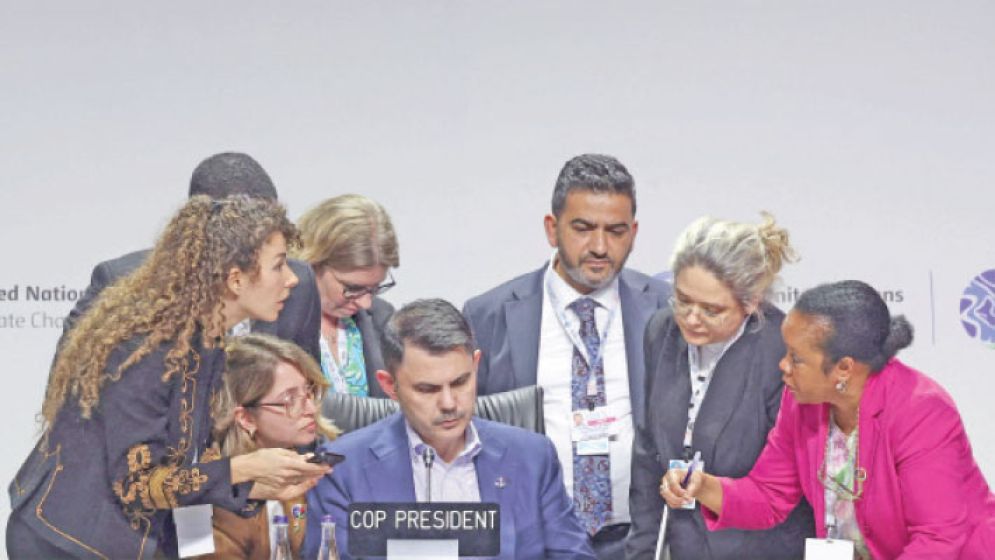
COP31 President Murat Kurum is surrounded by advisors during a session of the closing plenary at the COP31 in Antalya, Turkey, on Sunday.-REUTERS PHOTO
Climate talks at COP31 on Sunday collapsed completely after the EU rejected the current draft deal and accused it of “greenwashing” over its failure to mention fossil fuels.
The UN climate talks fell into in disarray on Sunday as COP31 presidents Turkey and Australia failed to secure a consensus agreement on how to advance the fight against climate change, with others joining the EU to reject the final draft deal.
After more than two weeks of negotiations, which had been due to end on Friday but stretched deep into the weekend, Turkey's Cop31 President Murat Kurum said at the closing plenary that a deal was not approved, adding “we have to accept the will of the parties” following the longest Cop ever.
"It is clear that there are parties in this hall who oppose this text. We recognize that there is no consensus on this document. Therefore, these decisions have not been adopted," he said.
Irish Minister Darragh O’Brien, speaking on behalf of the EU, said the bloc formally rejects the deal, adding it cannot accept a text in which fossil fuels are not mentioned. He said the drafts “do not begin to address the climate emergency we face”.
A spokesperson for the British delegation added it is “profoundly disappointed” by the cover draft.
Other delegations at the venue, where catering outlets and exhibits have already been dismantled, were less sure.
Observers to the closed-door talks said Saudi Arabia and other big oil-producer nations had pushed hard in negotiations for keeping fossil fuels out of the text, and carbon removal in.
"It seems like we are negotiating with the Saudis," said Tuvalu's climate minister, Maina Talia.
The collapse of the talks came in a year that has seen the most destructive impacts of global warming such as extreme heat in Europe and glacial floods in Nepal overshadowed by the demands of wars and public outcry over soaring living costs.
Panama has also threatened to block a final agreement unless its demands are met, saying the conference had been “hijacked by petroleum”. It was among a group of countries including France who also sent a letter on Friday calling for "a clear transition away from fossil fuels".
German Environment Minister Carsten Schneider has said the latest version of the draft agreement is "not acceptable."
Schneider said that the draft decision "not only fails to provide an adequate response but actually takes a step backward. A step backward from previous decisions on climate protection is the last thing Germany can support."
The last major breakdown in UN climate talks came in Copenhagen in 2009, when countries failed to adopt the Copenhagen Accord by consensus in a setback for multilateral climate diplomacy.
Australia, which was leading the negotiations, and host nation Turkey had issued multiple drafts of a text that sought to find compromise between the needs of nations most vulnerable to climate change and those whose economies depend on either the production or consumption of fossil fuels.
The text acknowledged for the first time that global warming is on course to exceed the 1.5 degree Celsius threshold countries had sought to preserve, while calling for faster development of carbon-removal technologies to eventually reverse the overshoot.
But the bid to win consensus backing proved unsuccessful, with critics of the text calling it unambitious.
The COP process is the main vehicle through which countries coordinate their efforts to curb global warming. Its annual summit is seen as an important opportunity to signal that nations are willing to work together to find solutions and help finance the myriad problems caused by rising temperatures.
While a major blow to efforts to ratchet up international action, the failure to agree a political declaration in Antalya does not wipe out the obligations agreed by previous summits or erase the technical and legal frameworks governing multilateral action against climate change.