



 For all latest news, follow the Daily Sun's Google News channel.


Warangal – where an empire still stands in stone
Forts, temples and a UNESCO-listed marvel in Telangana carry the legacy of the Kakatiya dynasty

A few hours’ drive from Hyderabad’s urban bustle lies one of South India’s most remarkable historical chapters. During a recent workshop, we had the chance to visit the heritage sites of Warangal district in Telangana. It is not merely a place of old forts, temples and stonework, but a living meeting point of history, culture, engineering and everyday life.
At first glance Warangal looks like any other city, yet its key structures are tied to centuries of history. Massive stone gateways, finely carved temples, ancient reservoirs and ruins tell stories of the past. The Kakatiya capital was Orugallu, today’s Warangal. The Telugu word means “one stone” or a single rock, a nod to the massive outcrop around which the city grew. Here history is not confined to museum walls. It is woven into daily routines, religious rituals, local festivals and the surrounding landscape.
Capital of an empire
From the twelfth to the fourteenth century, the Kakatiyas built a strong political and cultural presence across the Deccan, and Warangal became an important administrative, military and cultural centre. Among the notable rulers were Rudradeva, Ganapati Deva,
Queen Rudrama Devi and Prataparudra. Their reigns saw advances in urban planning, fort construction, temple architecture, agriculture and irrigation. Rudrama Devi, one of medieval South India’s most widely discussed women rulers, holds a special place in the dynasty’s history.
The Kakatiyas were also notable for water management. To strengthen an agrarian economy, they built reservoirs, lakes and irrigation systems whose historical importance is still discussed across Telangana.
Warangal Fort: gateways of memory
Inside Warangal Fort, the eye is drawn first to the Kakatiya Kala Thoranam, a massive stone gateway and one of the best-known symbols of Kakatiya architecture. It also appears on Telangana’s state emblem. Standing before it, one imagines royals, soldiers, officials and traders passing through centuries ago.
Much of the fort is now in ruins, but the gateways still testify to the strength and style of the era. Scattered pillars, temple remains and the outlines of other structures suggest how extensive urban life once was. Carvings bearing religious symbols, ornament and varied designs show the skill of Kakatiya artisans in marrying the strength of stone with beauty. The fort was more than a military bastion. It was a hub of politics, administration, worship and city life.
The Thousand Pillar Temple
At Hanamkonda stands the Thousand Pillar Temple, also known as the Rudreshwara Temple, one of Warangal’s most important monuments. According to official historical sources, Rudradeva built it in 1163 CE. It is a trikutalaya, a temple with three sanctums, for the worship of Shiva, Vishnu and Surya.
Its appeal lies not in the number of pillars alone but in their design, arrangement and fine carving. Some bear geometric patterns, others floral and creeper motifs, others ornamental designs. The massive Nandi, carved from a single block of stone, is among the finest examples of Kakatiya sculpture. The builders, it is clear, were combining art with engineering.
Ramappa: engineering within stone
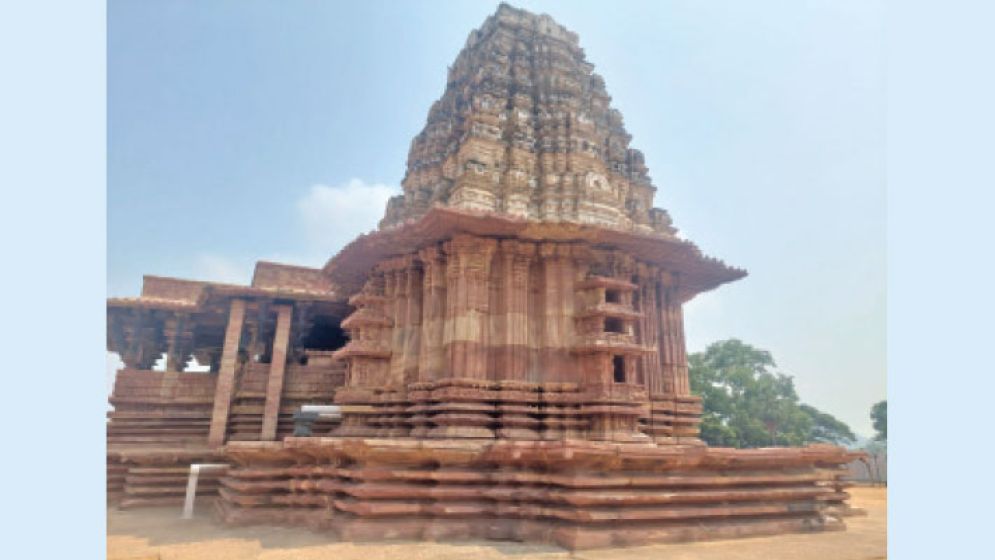
The most memorable stop was the Ramappa Temple at Palampet, about 200 kilometres north-east of Hyderabad. On 25 July 2021, UNESCO inscribed it on the World Heritage List, making it Telangana’s first World Heritage site.
Its official name is the Kakatiya Rudreshwara Temple. Construction began in 1213 CE under Recharla Rudra, a general of Ganapati Deva, and, according to UNESCO, continued for about 40 years. Unusually, the temple is known by the name of its chief architect and sculptor, Ramappa, rather than that of its deity, a notable distinction in Indian temple history. The pillars, wall ornamentation, roof and entrance all reflect meticulous planning.
The most discussed feature is its construction technology. The upper structure of the roof used lightweight, porous “floating bricks”, whose relatively low density reduced the load on the building. The foundation is equally innovative. UNESCO documents mention “sandbox” technology, in which sand-based materials were laid in the foundation layers to improve stability. Together with careful selection of stone, brick and foundation materials, these methods helped reduce structural load and improve resilience against earthquakes, according to UNESCO’s evaluation.
Dancers in stone
The sculptures are especially captivating. Dancing women, musicians, mythological figures and ornamental designs adorn the walls and pillars, some in postures so natural that the stone seems to move. In the dancers, the hands, feet, curves of the body and facial expressions show extraordinary skill. UNESCO regards the sculptures as important evidence of the dance, culture and way of life of the Kakatiya period.
The setting adds to the beauty. The temple sits beside Ramappa Lake, amid greenery and farmland, and the setting reflects a tradition of integrating architecture with nature.
A tourism circuit recognised
Efforts are under way to develop a tourism circuit linking Warangal’s historic and natural attractions. In October 2026, the Warangal Tourism Circuit won the Silver Banyan Award for best tourist circuit or trail in the Heritage Tourism category at The Week Heritage Awards.
The circuit includes Warangal Fort, the Kakatiya Kala Thoranam, the Thousand Pillar Temple, Ramappa Temple, Laknavaram Lake and Bogatha Waterfall. The Telangana Tourism Development Corporation has undertaken measures to improve hotels, boat services, connecting roads and other visitor amenities, according to its website.