


 For all latest news, follow the Daily Sun's Google News channel.


Politicians’ harassment abroad tarnishing Bangladesh’s global image
Daily Sun Report, Dhaka
Published: 21 Nov 2026, 12:00 AM
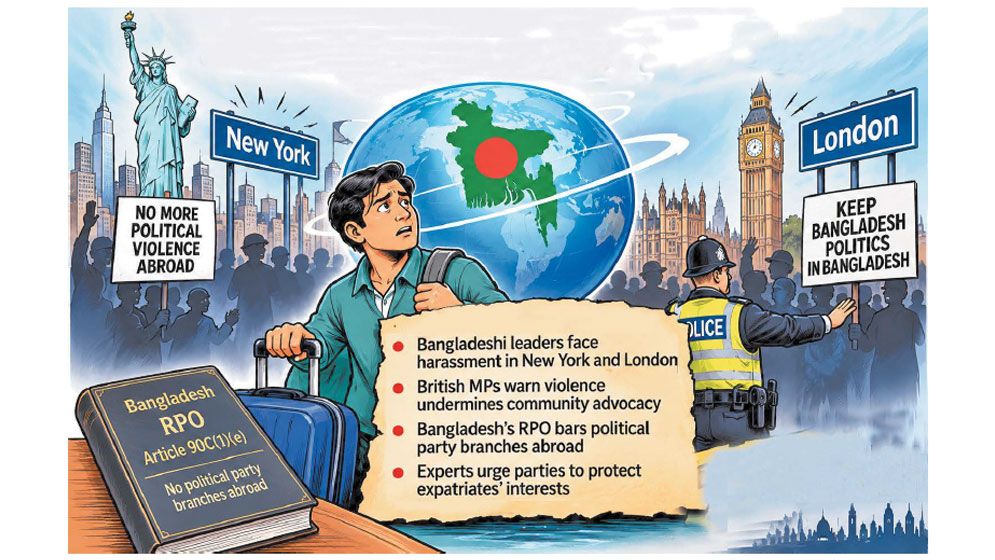
Repeated incidents involving the harassment, intimidation and physical attacks on Bangladeshi political leaders and prominent figures by activities-banned Awami League activists and supporters during visits to foreign countries are ruining the country’s international image, with political rivalries at home increasingly spilling onto the streets of cities abroad.
From New York to London, politically motivated confrontations involving Bangladeshi expatriates are causing serious survival crisis for the ordinary Bangladeshis living abroad and threatening the prospects of Bangladeshis aspiring to go abroad for work or study.
“Such negative activities by the supporters of different political parties abroad are hampering the impression of the country globally. I haven’t seen citizens of any other countries taking their domestic feuds in a foreign land. It is high time for our political parties to rethink and close their branches abroad,” former ambassador Humayun Kabir told the Daily Sun.
The latest incident took place in east London on Monday, when a reception programme organised for National Citizen Party (NCP) Convener and Opposition Chief Whip Nahid Islam was reportedly disrupted by the activists and supporters of Awami League.
They allegedly threw eggs and water bottles at guests arriving at the venue, while several people were assaulted. A subsequent clash left four people with serious head injuries, prompting police intervention.
No end to attacks and clashes
The latest incident came just over a month after former interim government Chief Adviser Professor Muhammad Yunus was confronted by a group of Bangladeshi expatriates at New York’s John F Kennedy International Airport on 12 October. Yunus, who was in a wheelchair, faced verbal abuse and was forced to return inside the terminal before security personnel escorted him away.
The harassment of political figures overseas is not new at all. In September 2025,
NCP Member Secretary Akhter Hossen and then NCP Senior Joint Member Secretary Tasnim Jara faced hostility from expatriate Awami League supporters after arriving at JFK Airport as members of a Bangladesh delegation attending the 80th United Nations General Assembly.
Similar tensions have surfaced in other countries. In June this year and September last year, protests outside an NCP programme in London led to police intervention and arrests. Bangladeshi actress Azmeri Haque Badhan also faced alleged harassment in Venice, Italy, in September this year, prompting diplomatic and consular action.
Earlier, Awami League supporters and activists were involved in protests and showing black flags to late BNP chairperson Begum Khaleda Zia when she travelled to London for receiving treatment and spending time with family members.
In the past, BNP activists and supporters were also seen organising protests abroad when the prime minister and ministers visited different countries. Supporters got involved in clashes and law enforcement agency members were seen intervening to control such situations.
Observers say political differences should be addressed through democratic debate and lawful channels rather than violence or intimidation on foreign soil. Political leaders also need to demonstrate restraint and respect for the laws and social norms of countries hosting them.
“Bangladesh’s overseas reputation is closely linked to the conduct of its citizens and political representatives. Unless political parties take steps to discourage violence among their supporters abroad, such incidents risk turning internal political disputes into an increasingly damaging international image problem,” migration expert Asif Munier said.
Violence disrupts efforts to support Bangladeshis abroad
British Labour MP Jas Athwal on Thursday called for Bangladeshi political rivalries to be kept out of Britain, saying conflicts originating in Bangladesh had no place on British streets. He raised the latest London violence with British Foreign Secretary Ed Miliband, showing him video footage of the violence.
“Bangladeshi politics has to be contained in Bangladesh because it hasn’t got any place here,” he said.
He stressed that violence spilling over from Bangladeshi politics was counterproductive and made it harder for British politicians to advocate for people and communities with links to the country.
“The violence coming over here is not helping anybody and it certainly won’t help people who want advocates for them in the British Parliament to help raise their case at the highest level. You cannot raise the cases for violent behaviour like that. It’s made it so much more difficult for everybody else to really be helpful.”
He described the British-Bangladeshi community as law-abiding and hard-working.
“Reputations that have been built over decades, generations, were simply just ruined over one night of madness. The people that night let the whole community down. It brought embarrassment on all of us and we must be aware of that,” Athwal said.
“Think of the local people who had to experience that horror, that terror, people being scared to come out of their houses. We have to be better than this as a community,” the British MP added.
Apart from Jas Athwal, local Labour MP for Ilford North also condemned the violence and urged police to investigate. Andrew Rosindell, MP for Romford, expressed shock, saying such behaviour was unacceptable on British streets.
The incident has also become a political issue for anti-immigration groups. Reform UK leader Nigel Farage shared footage of the clashes on Facebook, describing the participants as Bangladeshi groups fighting over a political dispute unrelated to Britain.
British police launch manhunt over clashes
London’s Metropolitan Police detectives have launched an investigation into clashes involving supporters of Bangladesh’s NCP and Awami League activists.
The investigation comes after videos showing groups of people attacking each other with sticks and branches went viral on social media, drawing widespread condemnation from British politicians, particularly those opposed to immigration.
The incident has received extensive coverage in British newspapers, including the Evening Standard, The Times, Metro, The Sun and The Express, with some outlets portraying the violence as an example of tensions within immigrant communities spilling onto British streets.
What Bangladesh law says
Under Bangladesh’s Representation of the People Order (RPO), 1972, registered political parties cannot have official organisational branches, offices or committees outside Bangladesh.
The specific provision is Article 90C(1)(e), which states that a political party is not qualified for registration if its constitution contains: “any provision for the establishment or operation of any office, branch or committee outside the territory of Bangladesh.”
Asked about the continuous violation of law, Humayun Kabir, also the president of the Bangladesh Enterprise Institute, said, “Some 13 million Bangladeshis are working abroad. Many Bangladeshi students are studying as well. Political parties have to realise this. They must respect the law while doing politics.”
Following every such incident, the Bangladesh government strongly condemned the violence and urged authorities of the respective countries to investigate and bring those responsible to justice.
But there is no instance where any of the perpetrators involved in these incidents were punished and sent back home.
Dr Md Jakerul Abedin, Director General of the Legal Affairs Wing at the Ministry of Foreign Affairs, couldn’t be reached for a comment on the issue.